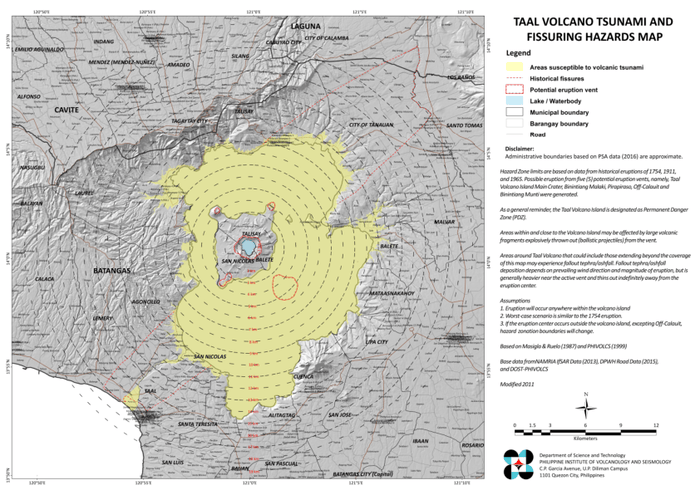
The Philippine Institute of Volcanology and Seismology warned on January 13, 2020, that a volcanic tsunami could occur if the intensity of Taal volcano’s activities is raised to level 5, with the volcano located about 60 km south of Manila, the capital city of the Philippines, and the warning coming after the volcano started exploding steam on the afternoon of January 12, 2020. The institute, also known as Phivolcs, stated on its website that “a volcanic tsunami may occur in caldera lakes when water is displaced by deformation of the lake floor caused by rising magma.” According to Phivolcs, a volcanic tsunami would accompany an eruption column of as much as 15 kilometers high and could bring floods.
volcanic activity and evacuation
As of January 13, 2020, Phivolcs had put Taal Volcano under Alert Level 4 following the magmatic eruption and lava fountaining, and added that an Alert Level 5 might be raised within the next few days if the volcano remains unrested, with extreme hazards expected at Alert Level 5. Renato Solidum, Phivolcs director, said that the institute is closely monitoring the volcano’s activity and is prepared to raise the alert level if necessary. The Philippine Army’s 2nd Infantry Division had evacuated more than 23,000 residents of Batangas province as of 5:00 AM on January 13, 2020, with military trucks sent to help residents flee from danger zones around Taal Lake, including the most affected towns of Balete, Laurel, San Nicolas, Talisay, and part of Lipa and Tanauan City. According to Lieutenant General Gilbert Gapay, commander of the Philippine Army, the evacuation is a precautionary measure to ensure the safety of the residents.
phivolcs warning and preparations
Phivolcs warned that a volcanic tsunami could have devastating effects on the surrounding areas, with Solidum stating that “the institute is working closely with the local government and other agencies to ensure that the necessary precautions are taken.” The institute also advised residents to stay away from the volcano and to follow the evacuation orders. The Philippine government had also sent aid to the affected areas, with the Department of Social Welfare and Development providing food and shelter to the evacuees. As of January 13, 2020, no casualties had been officially reported yet, but the situation remains volatile, with the volcano continuing to spew ash and steam.
international monitoring and assistance
The international community is also monitoring the situation, with the United Nations Office for the Coordination of Humanitarian Affairs stating that it is ready to provide assistance if needed. The Japanese government had also offered to provide aid to the affected areas, with the Japanese Embassy in Manila stating that it is closely monitoring the situation and is prepared to provide assistance. According to a spokesperson for the embassy, “Japan is committed to providing assistance to the Philippines in times of need, and we are working closely with the Philippine government to determine the best course of action.”
long term effects and recovery
The long-term effects of the eruption are still uncertain, but it is likely that the surrounding areas will be affected for some time. The Philippine government had announced plans to provide aid to the affected areas, with the Department of Agriculture providing assistance to farmers who have been affected by the eruption. According to Secretary William Dar, “the department is working to provide assistance to farmers who have been affected by the eruption, and we are committed to helping them recover from this disaster.” The recovery efforts are expected to take some time, but with the help of the international community and the Philippine government, it is hoped that the affected areas will be able to recover and rebuild.
As the situation continues to unfold, it is clear that the eruption of Taal volcano has had a significant impact on the surrounding areas, with thousands of people evacuated and many more affected by the ash and steam. The Philippine government and the international community are working together to provide aid and assistance to those affected, and it is hoped that the situation will be brought under control soon. With the warning of a potential volcanic tsunami, it is essential that the necessary precautions are taken to ensure the safety of the residents, and the Philippine government and Phivolcs are working closely to monitor the situation and provide updates.