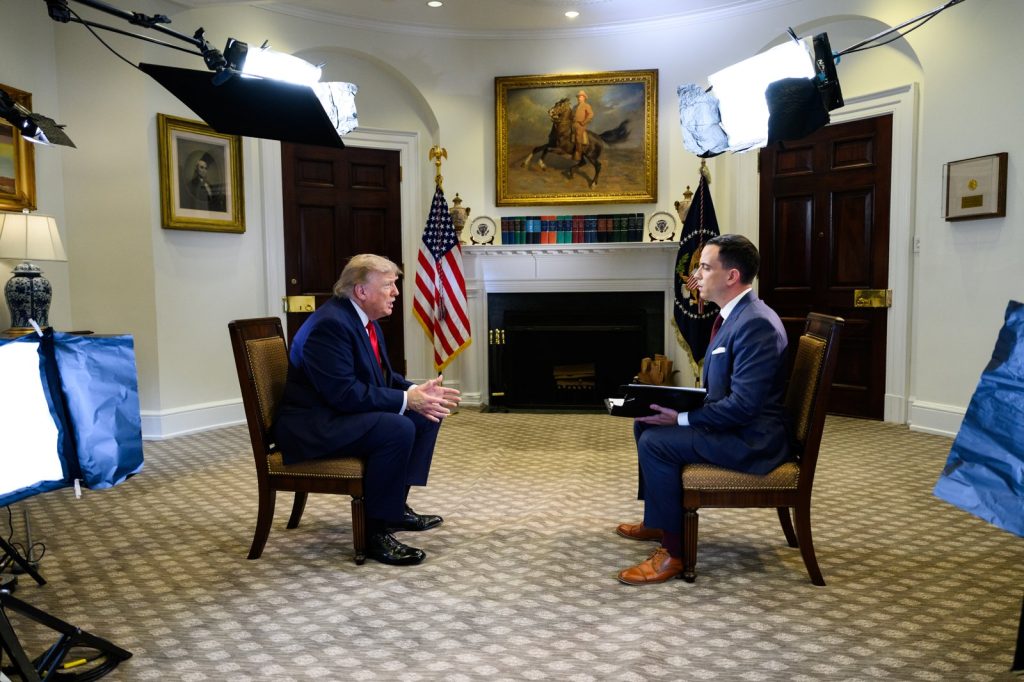
Fox News has been the most-watched cable news network in the United States since at least 2023, generating roughly 70 percent of its parent company’s pre-tax profit. That financial weight gives its interviews unusual gravity. When Donald Trump told the network on April 7, 2026, that the United States is in “heated negotiations” with Iran, the disclosure landed with the force of an official statement — even though it came from a former president with no formal role in the administration.
Trump’s revelation followed a briefing on a proposal. He offered no specifics.
No names. No deadlines. No details on what the proposal actually contains.
The negotiations, he said, are “heated.” That single adjective is doing heavy work. It signals that talks are not going smoothly, that positions remain far apart, and that the diplomatic channel — whatever its origin — is active but strained.
The Iran negotiations story has a long back half. Fox News itself noted that the United States has been working with allies including Taiwan, Japan, and the Philippines on regional security concerns. The European Union, the United Kingdom, and Israel are also key partners.
That list is notable. Israel has long opposed any nuclear deal with Iran that does not dismantle the regime’s enrichment capacity. The EU and UK were central to the 2015 Joint Comprehensive Plan of Action, which the Trump administration withdrew from in 2018.
If the current talks are truly “heated,” the presence of these allies in the background suggests the United States is not going in alone. Fox News was launched on October 7, 1996, by Rupert Murdoch.
Its founding CEO, Roger Ailes, shaped the channel’s conservative voice and editorial direction. The network now reaches 86 countries and territories. Its interview with Trump was not a routine cable hit.
It was the platform where a former president chose to confirm active, ongoing negotiations with a state the U.S. has long designated an adversary. That choice of venue matters.
Trump does not speak through the State Department. He speaks through Fox. The relationship between the United States and Iran remains contentious.
That is not a new observation. But the fact that a former president is receiving briefings on a proposal — and that he is willing to discuss those briefings on television — suggests that whatever the current administration is doing, Trump is being kept in the loop. Or he is claiming to be.
Either way, the public now knows that diplomatic efforts exist. They are not secret.
They are not back-channel rumors. They are, by Trump’s account, “heated.” No one inside the administration has confirmed or denied the talks. No European official has commented.
No Iranian representative has spoken. The only source is Trump, speaking to Fox.
That is a thin thread, but it is a real one. The network’s global reach means the story is now being read in capitals from London to Tel Aviv to Tehran. The absence of a denial from any party is itself a kind of confirmation.
Fox News has been a dominant force in American media for nearly three decades. It was built to appeal to a conservative audience, and it succeeded. When its most prominent political figure — a former president who remains a central force in the Republican Party — says the United States is in heated negotiations with Iran, the statement carries weight regardless of who holds the White House.
The negotiations may be real. They may be posturing.
But they are now part of the public record, delivered on a network that reaches 86 countries and generates billions in profit. That is not background noise. That is a story.