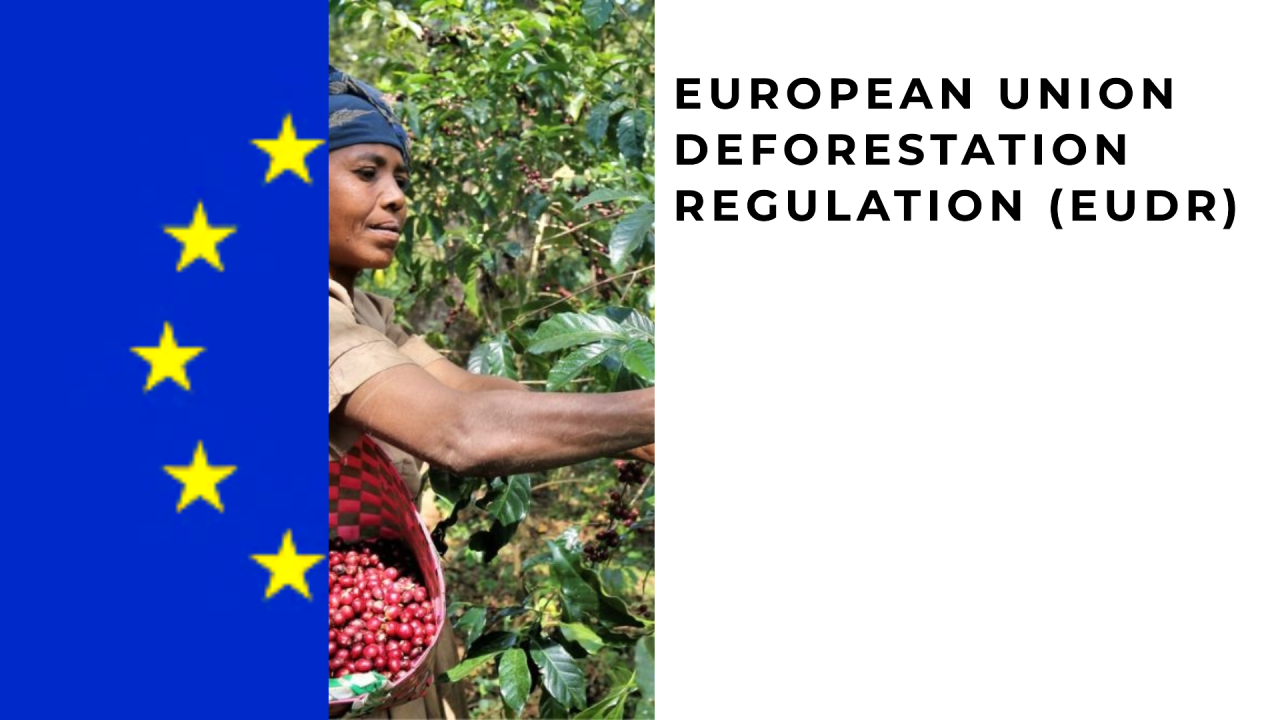
The European Union has taken a significant step towards reducing its contribution to deforestation and forest degradation worldwide with the introduction of the EU Regulation on Deforestation-free products. Formally adopted in May 2023, this regulation aims to ensure that products consumed by EU citizens do not contribute to deforestation or forest degradation. The regulation is part of a broader set of EU policies aimed at fighting climate change and biodiversity reduction, as outlined in the European Green Deal.
The EU Regulation on Deforestation-free products, also known as Regulation (EU) 2023/1115 or EUDR, supersedes the Timber Regulation 2010 and applies to a specific set of commodities and products, including palm oil, cattle, soy, coffee, cocoa, timber, and rubber, as well as derived products such as beef, furniture, and chocolate. This regulation will apply to operators who either place these products on the EU market or export them from it. The regulation is set to come into effect for medium and big businesses from December 30, 2024, and for small businesses from June 30, 2025.
One of the key requirements of the EUDR is that businesses must carry out due diligence to ensure that the products they place on the market or export do not come from land that was deforested after December 31, 2020. This includes collecting the geographic coordinates of the plots of land where the commodities were produced. By doing so, the EU aims to prevent the importation and exportation of products that contribute to deforestation and forest degradation, thereby reducing its contribution to these environmental issues.
The EUDR is a significant development in the EU’s efforts to combat climate change and biodiversity reduction. As part of the European Green Deal, the regulation is designed to work in conjunction with other EU policies to achieve a more sustainable and environmentally-friendly economy. The regulation’s focus on deforestation-free products is particularly important, given the significant impact that deforestation and forest degradation have on the environment, including the loss of biodiversity, increased greenhouse gas emissions, and disrupted water cycles.
It is worth noting that the EUDR applies to a wide range of products, including food items such as coffee, cocoa, and chocolate, as well as non-food items such as timber and furniture. This means that a significant portion of the products consumed by EU citizens will be subject to the regulation, making it a crucial step towards reducing the EU’s environmental footprint. By ensuring that these products are deforestation-free, the EU can help to promote sustainable land use practices and reduce the pressure on the world’s forests.
As the implementation date for the EUDR approaches, it will be important to monitor how the regulation is enforced and its impact on the EU market. The regulation’s effectiveness will depend on the ability of businesses to comply with its requirements, as well as the EU’s ability to enforce the regulation and prevent non-compliant products from entering the market. As the EU continues to work towards a more sustainable and environmentally-friendly economy, the EUDR will be an important tool in achieving this goal. In the coming months and years, it will be worth watching how the regulation is implemented and its impact on the EU market, as well as its potential to inspire similar regulations in other regions.