
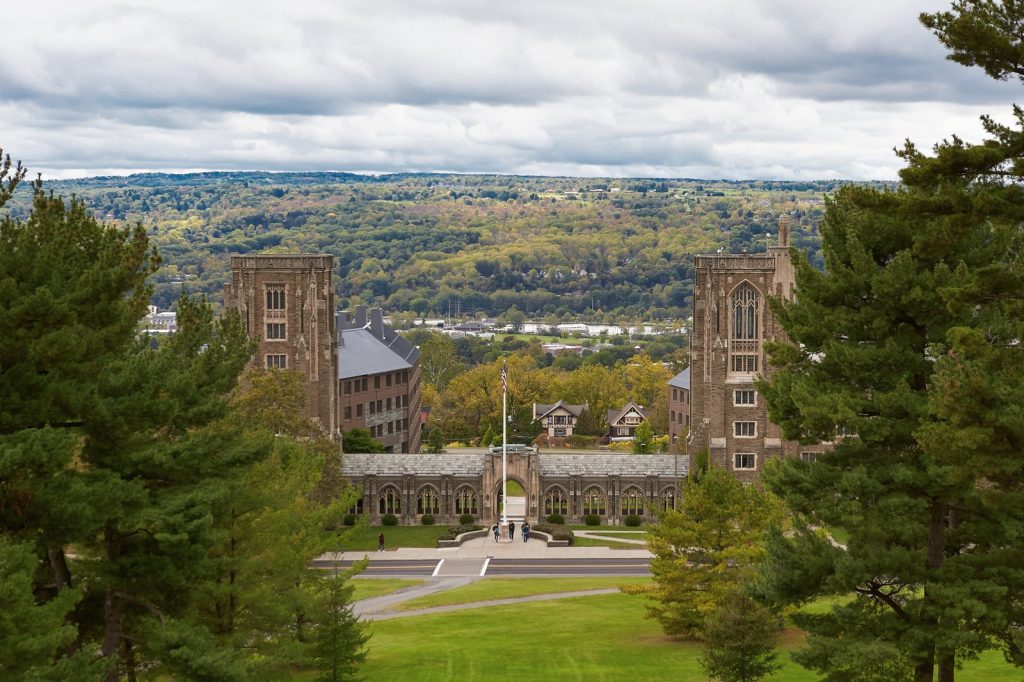
Ithaca, New York — For the 26,000 students at Cornell University, the campus has long been a place where a student from any of 130 countries could find a seat in a lecture hall or a dormitory room. That sense of open access is now frayed. Antisemitic threats, directed specifically at Jewish students, have surfaced on the Ivy League campus, putting the university’s foundational promise of safety and inclusion under direct strain.
Cornell was founded in 1865 as a co-educational, nonsectarian institution. Ezra Cornell and Andrew Dickson White built it on the idea that a university should welcome anyone, regardless of background.
That principle is now being tested. The threats are not abstract. They target a specific group of students — Jewish students — on a campus that draws from all 50 states and more than 130 countries.
When a student cannot walk to class without fearing for their safety because of their identity, the institution’s core mission is compromised. The stakes here are concrete.
Jewish students face a real question: Is it safe to stay? To attend a lecture? To go to the library at night?
The university administration has a responsibility to answer that question with action, not just statements. The report makes clear that Cornell’s leadership must take these threats seriously and act promptly. That is not a rhetorical point.
It is a practical necessity. If students leave — or if prospective students choose not to come — the diversity Cornell prides itself on erodes.
The student body, drawn from every state and over a hundred nations, depends on that trust. This is also a test for the broader community. The United States has laws protecting freedom of speech and religion.
It has a history of defending minority rights. But those protections mean little if they are not enforced on the ground, in real time, on a specific campus in upstate New York.
The threats at Cornell are not just a local problem. They are a signal. If a prestigious Ivy League school with global reach cannot protect its Jewish students, what does that say about the state of tolerance nationwide?
The university’s structure — eight undergraduate colleges and seven graduate divisions, each with its own admissions standards — gives it a decentralized character. That autonomy is a strength for academic programs and research. But it also means that responses to a crisis like this must be coordinated across many independent units.
A threat made against a student in one college cannot be handled in isolation. The whole institution must move.
Jewish students at Cornell are now living with a burden no student should carry. They are asking whether their university will stand by them. The answer will be measured in actions: increased security, clear communication, swift investigation, and consequences for those responsible.
If the administration falters, the damage will not be limited to one semester or one group of students. It will ripple outward, affecting recruitment, reputation, and the basic trust that holds a diverse community together.
For now, the campus remains open. Classes continue. But the question hangs in the Ithaca air: Can a university founded on nonsectarian ideals keep its promise when those ideals are attacked from within?
The next steps will tell.




