View original document (21.7 MB)
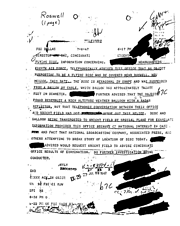
A newly declassified FBI case file, released as part of the ongoing PURSUE archive initiative, contains a previously restricted 1949 U.S. Air Force memorandum that formally established a centralized, classified reporting system for sightings of “unconventional aircraft” and “unidentified flying objects,” including the so-called “Flying Discs.” The document, released by the U.S. Department of War on May 8, 2026, is part of the FBI’s 62-HQ-83894 case file, which spans investigative records from June 1947 to July 1968.
According to the FBI’s official description of the file, titled “65_HS1-834228961_62-HQ-83894_Serial_164,” the records include eyewitness testimonies, public reports, photographic evidence from sites such as Oak Ridge, Tennessee, and technical proposals regarding potential propulsion systems. The FBI notes that while portions of this file have been previously posted on the FBI Vault with heavier redactions and missing pages, this release presents the “complete case file with several newly declassified pages and only minor redactions.” The original PDF is hosted at the war.gov domain under the PURSUE archive.
Air Intelligence Requirements Memorandum Number 4
The core of the released excerpt is a two-part memorandum from the U.S. Air Force Directorate of Intelligence, dated February 15, 1949. Marked “RESTRICTED,” the document is titled “Air Intelligence Requirements Memorandum Number 4: Unconventional Aircraft.” Its stated purpose is twofold: to articulate “continuing Air Force requirements for information pertaining to sightings of unconventional aircraft and unidentified flying objects, including the so-called ‘Flying Discs,'” and to establish formal procedures for reporting such information.
The memorandum explicitly rescinds two earlier Department of the Army directives on the same subject, dated January 21, 1948, and March 25, 1948, transferring their authority to the Air Force. The document mandates that initial reports of sightings be dispatched “by means of electrical transmission immediately after sightings,” with supplementary reports to follow. It designates the Commanding General of the Air Materiel Command at Wright-Patterson Air Force Base in Dayton, Ohio, as the central collection point for all reports, directing that cables include the phrase “Pass to COMGENAMC WRIGHT-PATTERSON AFB, DAYTON, OHIO, ATTN: MCIAXO-3.”
The memo establishes a tiered reporting structure. Overseas major air commands and air attaches are instructed to cable reports to the Director of Intelligence at Headquarters U.S. Air Force, while those in the continental United States are to report directly to Wright-Patterson. Non-Air Force agencies are also requested to forward reports to the same address. Part II of the memorandum, which begins to outline specific reporting requirements, lists fields for “Date of sighting,” “Time of sighting (zonal by 24 hr. clock),” and the observer’s position, including city, town, and distance from landmarks. The document excerpt cuts off mid-sentence at this point.
Context from the PURSUE Archive
Per a Wikipedia summary of the “United States UFO files” entry, this release is part of a broader initiative by the administration of Donald Trump beginning on May 8, 2026. The Wikipedia entry describes the collection as “a collection of declassified United States government records concerning UFOs, also called unidentified anomalous phenomena (UAPs),” and notes that the releases are “announced to continue as repeated, ongoing, expanding releases of UFO materials.” This places the February 1949 Air Force memorandum within a larger, ongoing declassification effort that has already made thousands of pages of historical records publicly available.
The FBI document’s official summary is notably vague regarding specific incidents, stating only that the file includes “high-profile incident accounts” without naming them. The inclusion of photographic evidence from Oak Ridge, Tennessee—a site of nuclear weapons development during the period—suggests that the file may contain records of sightings near sensitive national security facilities, but the released excerpt does not detail those specific accounts.
What Remains Unanswered
While the 1949 memorandum provides a clear picture of early Cold War-era military intelligence procedures for tracking UFO reports, the document itself raises several questions. The excerpt ends before listing the full scope of reporting requirements outlined in Part II, leaving readers to wonder what specific technical or observational details the Air Force sought. Additionally, the FBI’s description of the broader case file mentions “technical proposals regarding potential propulsion systems,” but no such proposals appear in this initial release.
Readers should watch for future PURSUE releases to see if subsequent serials from the 62-HQ-83894 file include the full text of the 1949 memorandum, the actual reports generated under its procedures, or the technical proposals and photographic evidence referenced in the FBI’s summary. As the Wikipedia entry notes, these releases are expected to continue, potentially shedding further light on the government’s early efforts to document and analyze what it then called “unconventional aircraft.”