
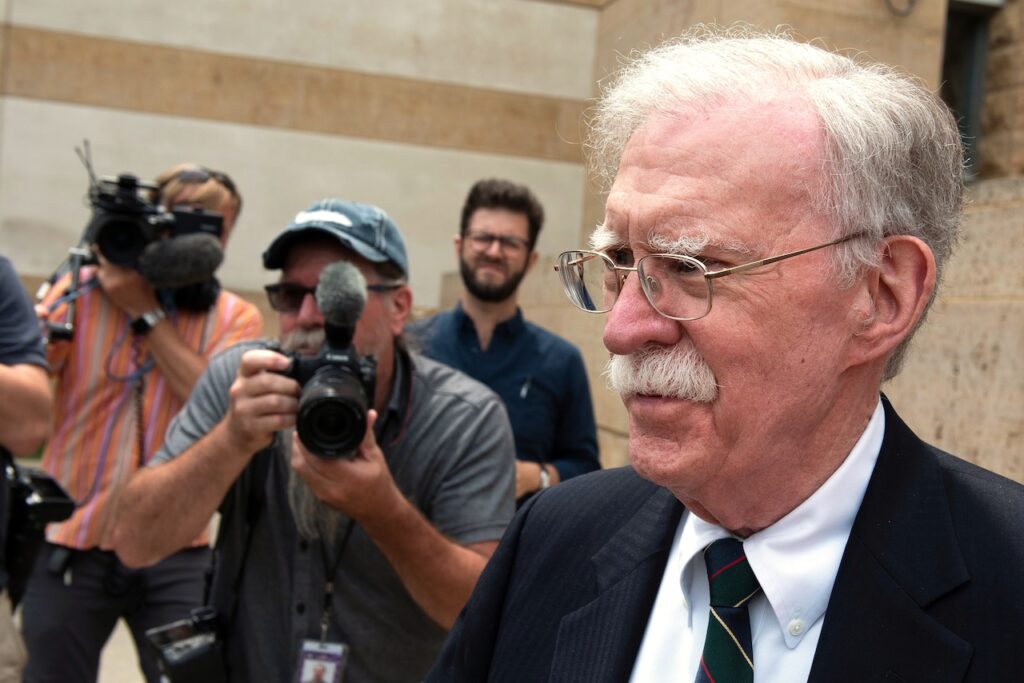
“The declared policy of the United States should be the overthrow of the mullahs’ regime in Tehran.” John Bolton said that in 2017, in a paid speech to an Iranian exile group, eight months before he became Donald Trump’s third national security adviser. In June 2019 he was the president’s top national security aide, and Iran policy ran through him and Secretary of State Mike Pompeo.
The two hawks
Vox described Bolton as a man who had long argued for regime change in Iran. In a 2015 New York Times op-ed he wrote: “The inconvenient truth is that only military action … can accomplish what is required. Time is terribly short, but a strike can still succeed.”
Pompeo’s marker came in May 2018. He gave a speech listing 12 ways the Iranian government must change, among them ending support for proxy groups and halting its missile program, before the United States would ease financial and diplomatic pressure. Vox also noted that he had been open about his evangelical Christian faith guiding his views, and that he backed Israel and Prime Minister Benjamin Netanyahu without reservation.
Their arrival changed the tone. Under Defense Secretary Jim Mattis and Secretary of State Rex Tillerson, Trump’s team distrusted Iran but did not make maximalist demands or threaten conflict so openly, Vox wrote. Its verdict on the new line-up was blunt: Trump had “effectively outsourced his Iran policy to the hawks,” while saying he did not want a war.
Summer 2019
The crisis Vox tracked began on May 5, when Bolton announced the deployment of an aircraft carrier and bombers to the Persian Gulf, citing “a number of troubling and escalatory indications and warnings.” The scale of the intelligence was disputed, and some critics said Bolton and others had inflated the threat. Then two tankers were damaged in the Gulf of Oman, and the administration blamed Iran. Iran denied involvement.
The United States announced 1,000 more troops for the region. Iran shot down an unmanned US surveillance drone. Tehran said it was over Iranian airspace; Washington said it was in international airspace over the Strait of Hormuz.
What happened next shows where Trump stood. The New York Times reported, as relayed by Democracy Now, that he approved strikes on radars and missile batteries and then called them off at the last minute, with warships and planes already being moved into position. Trump said he reversed himself because killing Iranians would not be a proportionate response. On May 16, asked whether the US was going to war with Iran, he had answered: “Hope not.”
Who was steering
Ervand Abrahamian, a retired City University of New York historian, argued on Democracy Now that the long-term agenda in the White House was set by Bolton and Pompeo rather than the president: “They want basically the destruction of the Islamic Republic.” Trump, he said, had just started his re-election campaign, and talking about war was poor politics.
The same programme reported that Pompeo and other top officials had been linking Iran to al-Qaeda and the Taliban in closed-door briefings with lawmakers. Democrats feared that was groundwork for invoking the 2001 Authorization for the Use of Military Force. No one outside the briefings could confirm that.
Sources
- 9 questions about the US-Iran standoff you were too embarrassed to ask
- Trump Pulls Back from Iran Attack as Bolton & Pompeo Continue to Push for War




