
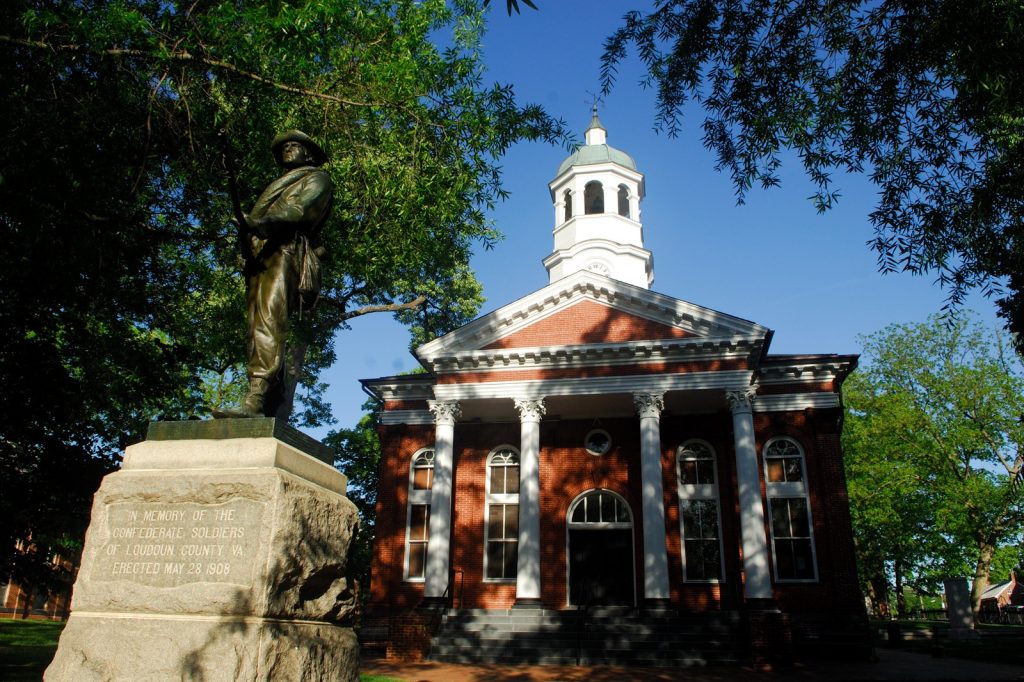
Drive west out of Leesburg and the road bends past horse country, stone mills and old Quaker meetinghouses, with the Blue Ridge sitting low on the horizon. It is easy to forget that this same county now carries a good share of the planet’s internet traffic. Loudoun County, Virginia, is frequently ranked as the wealthiest in the United States, and its story runs a lot deeper than money.
The settlers came first, and they came by grant. From 1723, land handed out by Lord Fairfax drew English slave-owning gentry to the big tracts in the east, south and west, while Quakers and German farmers from Pennsylvania and Maryland took up ground near the Potomac. In 1733 a Quaker named Amos Janney received 400 acres on Catoctin Creek and built a house and a mill. His village became Waterford. In 1757 the settlers petitioned Virginia for a county of their own and named it for John Campbell, fourth Earl of Loudoun, a Scot who commanded British forces in North America and never set foot there. Leesburg followed a year later, with a courthouse at the crossing of two old Indian trails.
A county of soldiers and papers
No battle was fought on Loudoun soil during the Revolution. Even so, the county sent more soldiers to the war than any other in Virginia, and about 2,000 of its men joined George Washington at Valley Forge for the winter of 1777-1778. Francis Lightfoot Lee of Leesburg signed the Declaration of Independence, and a copy was read aloud on the courthouse steps.
Then came August 1814. With British troops burning the White House, the Declaration and the Constitution were hurried out of the capital. One account has them resting at Rokeby, an estate near Leesburg, which gave rise to the tale that the town was briefly the nation’s capital. It is a tale, and the local record treats it as one.
Farming made the county rich before anything else did. After reading a treatise by the agriculturist John Binns on deep plowing, clover and gypsum, Thomas Jefferson conceded that Loudoun “has, from his example, become the most productive one in Virginia.” In 1823 President James Monroe set up a part-time home at Oak Hill, south of Leesburg, and drafted the Monroe Doctrine there that autumn.
The war that split it
Both of Loudoun’s delegates to the 1861 Secession Convention voted against leaving the Union. The county itself voted for secession in May, 1,626 to 726, with the dissent coming mostly from Quakers and Germans around Lovettsville and Waterford. On October 21 that year, Confederate forces won the Battle of Ball’s Bluff above the Potomac. The dead numbered 36 Confederate and 223 Union soldiers, among them Col. Edward Baker, a sitting U.S. senator and still the only one killed in military action.
Neighbours fought neighbours. Waterford citizens formed the Independent Loudoun Rangers in 1862, the only organised Union unit from the South, while John Singleton Mosby raised his own band of guerrillas against Union supply lines. In the last week of June 1863, General Hooker’s Army of the Potomac marched north through the county, the largest troop movement of the war, and cavalry clashed at Aldie, Middleburg and Upperville. The following August, General Sheridan ordered the valley burned to drive out Mosby. The Burning Raid lasted five days.
From hunt country to Data Center Alley
Recovery came partly from outsiders. After the 1905 Great Hound Match near Middleburg, wealthy Northerners began buying run-down estates and restoring them for riding, a wave locals nicknamed the “Second Northern Invasion.” Dulles Airport broke ground in 1958 on 12,500 acres in the southeast. In 1992 a server farm called MAE-East opened in Ashburn, and AOL moved its headquarters to the county four years later. By 2019 an estimated 70 percent of the world’s internet traffic passed through Loudoun, and the population reached 400,000 in 2020, more than 100 times its 1970 level.
The county that once sheltered the nation’s founding papers now houses more than 70 data centers across 10 million square feet.
Sources
- History of Loudoun County | Founding to Present Day (Visit Loudoun, official tourism organisation of Loudoun County)
- Timelines of Important Events in the County 1800's – Development & Conflict (History of Loudoun County, Virginia, loudounhistory.org)




