
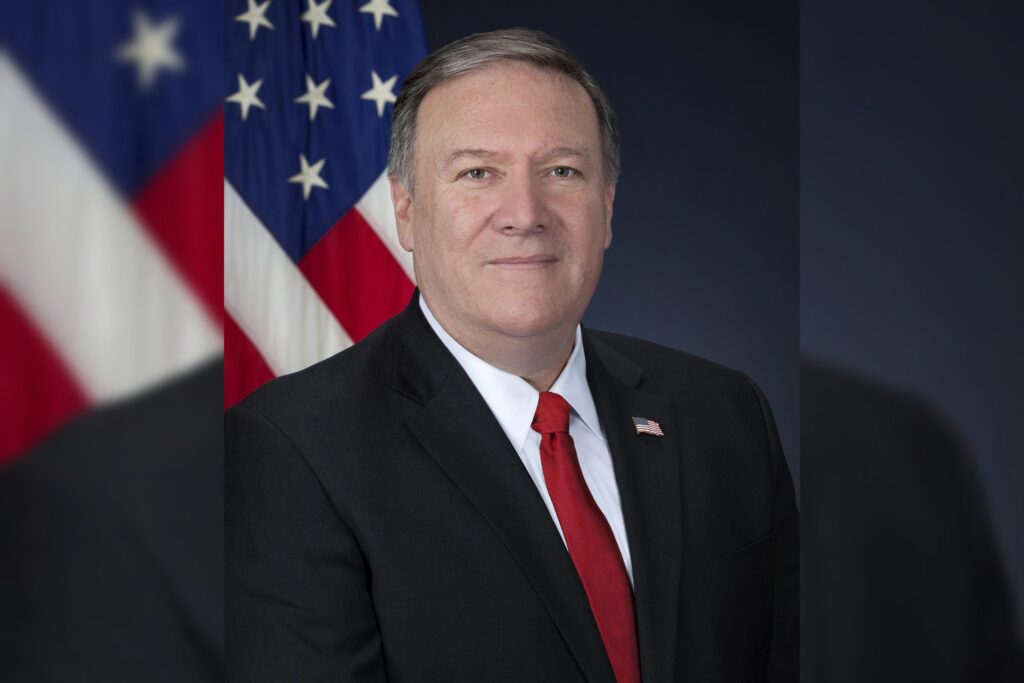
“We didn’t create the list. They did.” That was Mike Pompeo’s answer in May 2018, after he had read out a string of demands for Iran in his first major policy address as Secretary of State. The speech, given at the Heritage Foundation, came days after President Donald Trump pulled the United States out of the 2015 nuclear deal, and it set the tone for the maximum pressure campaign that followed.
The demands
The New York Times described the address as a hard-line performance. Pompeo said Iran must end all nuclear enrichment and close its heavy water reactor. He wanted Tehran to admit the military purposes of its old weapons program, end its support for Hezbollah, Hamas and Yemen’s Houthis, and pull its forces out of Syria. He spoke directly to Iranians too, asking what the revolution had given them and answering, “The hard grip of repression is all that millions of Iranians have ever known.”
He did not threaten force outright. He did say that if Iran restarted its nuclear program, “we will respond.” European allies hoping to save the deal got nothing. “Every country is going to have to participate” in the new sanctions, Pompeo said, adding that the policy aimed to strangle Iran’s “economic capacity to do harm to the Middle East and to the world.”
Iran’s reaction was swift. President Hassan Rouhani, quoted on state media, asked: “Who are you to decide for Iran and the world?”
Sanctions and the Guards
The pressure tightened in stages. In April 2019 the administration ended the waivers that had let China, India, Turkey, Japan, South Korea and Taiwan keep buying Iranian oil without penalty. Those waivers were due to expire on May 2. Pompeo put the goal in plain terms: “We are going to zero.” How long exports stayed there, he said, depended on Iran’s senior leaders. ABC News reported that he tied the sanctions to Iran’s ballistic missile development, its funding of Hamas and Hezbollah, and its detention of U.S. citizens.
On April 8, 2019, Trump announced that the Islamic Revolutionary Guards Corps would be designated a foreign terrorist organization. It was the first time Washington had put part of another government on that list. The Times reported that senior national security officials objected, among them Gen. Joseph F. Dunford Jr., the chairman of the Joint Chiefs of Staff, who feared Tehran would use the label to justify operations against Americans abroad. Pompeo and national security adviser John R. Bolton pushed for it. Because the State Department keeps the list, the final decision was Pompeo’s, a Trump administration official told the paper.
After the office
Iran blamed Pompeo and Brian Hook for the January 3, 2020 killing of Revolutionary Guard commander Qassem Soleimani. Both men were described as the public faces of the maximum pressure campaign.
A return to government never materialized. Trump said publicly that Pompeo would have no role in his new administration, according to India TV, which cited the Associated Press. Within days of Trump’s return to the White House in January 2025, the administration revoked the security protection for Pompeo and Hook, although both men face continued threats from Iran. A March 2022 report to Congress had put the cost of their round-the-clock protection at more than $2 million per month. Trump’s answer when asked about the decision: “Do you want to have a large detail of people guarding people for the rest of their lives? I mean, there’s risks to everything.”
Sources
- In Hard-Line Speech, Pompeo Criticizes Iran's Behavior — The New York Times
- Trump Designates Iran's Revolutionary Guards a Foreign Terrorist Group — The New York Times
- US ends waivers for Iran oil sanctions, tightening economic pressure on regime — ABC News (via Yahoo)
- Trump lifts protections for Iran hardliners Pompeo, Hook — India TV (with AP)




