
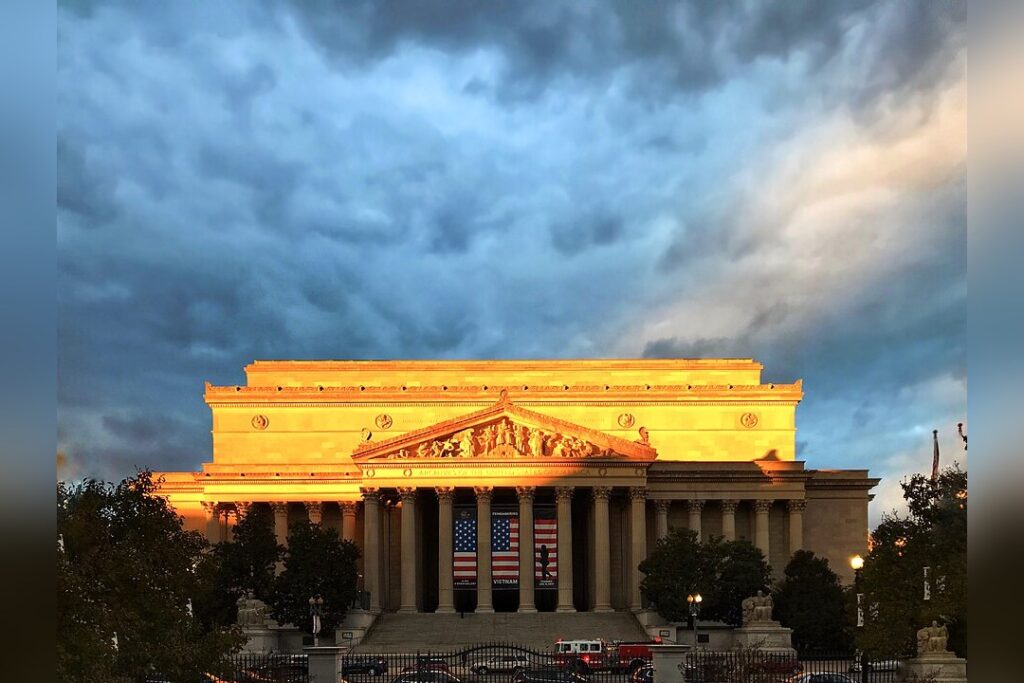
WASHINGTON, September 17 — The National Archives Museum has put on display something it has never shown before: every page of a constitution draft marked up by George Washington, exhibited to the public at once in the museum’s rotunda. The document dates to the Constitutional Convention of 1787, before Washington became president. It was annotated during the convention by Washington and William Jackson, recording the amendments that had passed there.
Normally it is kept in a climate-controlled vault. The exhibit runs through Sept. 27, timed to Constitution Day in the nation’s 250th birth year, after which the draft returns to storage.
A working record of the convention floor
National Archives Historian Jessie Kratz, speaking to Spectrum News on Monday, described how the document came together. “He did a very meticulous, basically transcription of what was happening. So, everything that he wrote down were amendments that had passed to the constitution,” Kratz said.
“It was George Washington and William Jackson noting what was transpiring during the Constitutional Convention,” she continued. What the draft preserves is a constitutional order that never came to be.
Kratz pointed to provisions in the marked-up text that differ from the Constitution eventually adopted. “One of the things in this document was that there was no vice president yet, and the president was elected by the House of Representatives to serve one seven-year term, and that’s it. So, we didn’t have an electoral college.
We weren’t even voting for the president then,” she said. That is the exhibit’s draw.
Visitors can compare the working draft to the ratified Constitution itself, displayed steps away in the same rotunda, and trace how provisions changed between the 1787 convention and the final text.
Why the setting matters
The staging is deliberate. Placing the marked-up draft alongside the finished document lets visitors see the Constitution as a product of contested choices rather than a finished text handed down intact. Kratz framed the exercise in exactly those terms.
“So, you can always look at it, take an interesting tidbit, and say, ‘Oh, this is the way it could have been,’ or ‘This is the way it could have been,’ and then ultimately see what eventually happened with the Constitution,” she said. The display is temporary, and the window is narrow.
After Sept. 27 the document goes back to its normal climate-controlled storage, and the pages will no longer be viewable together. What to watch next is whether the Archives extends or repeats the format for other founding-era holdings, and whether the juxtaposition of draft and ratified text becomes a template for how the institution presents its founding collection in the years ahead.




