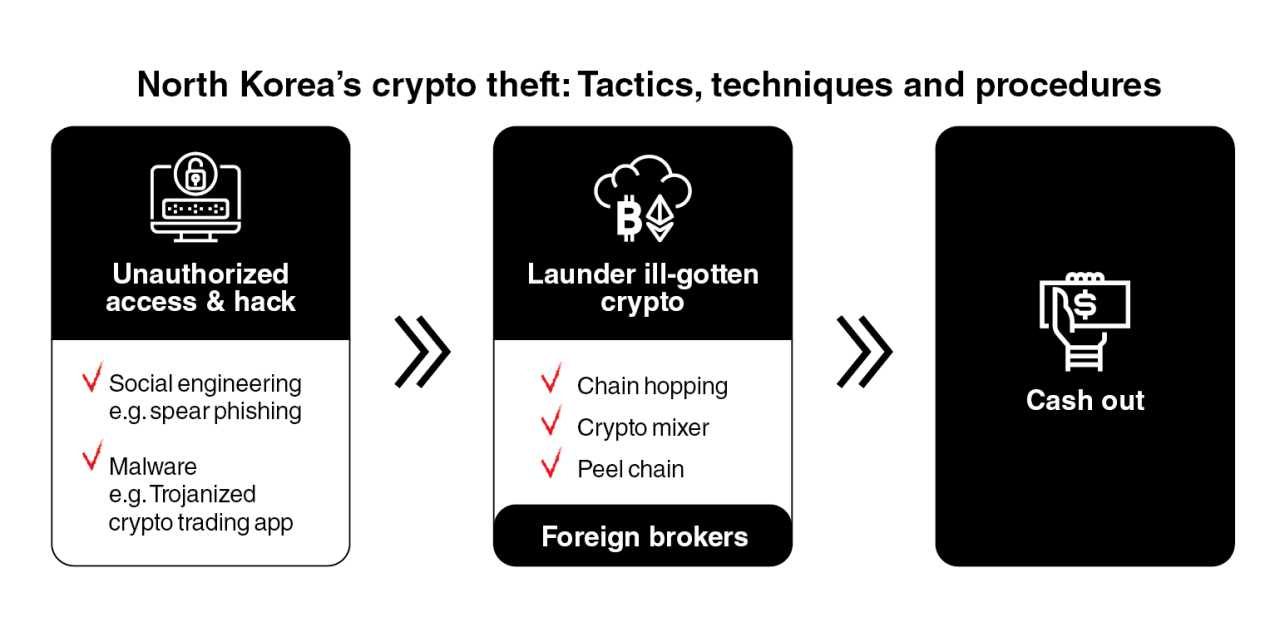
North Korea has stolen approximately $1.6 billion through cyber-attacks on cryptocurrency exchanges and banks, according to a United Nations Security Council report received on August 26, 2019. The funds are being used to finance the country’s weapons programs, including nuclear and ballistic missile development, in violation of international sanctions. The report details 35 cyber-attacks using sophisticated malware designed to siphon foreign resources from financial institutions and move them to untraceable accounts in jurisdictions with weak regulations.
The scale of the cyber theft
The UN report submitted to the North Korea sanctions committee outlines a systematic campaign of digital theft. North Korean hackers targeted crypto-forex exchanges and traditional banks, deploying custom-built malware and programs to extract funds. The stolen money was then channeled through complex networks to avoid detection.
Financial consultants are also investigating illegal ship-to-ship transfers that violate UN sanctions. These operations allow North Korea to bypass restrictions on oil and other goods. The proceeds from both cyber theft and sanctions evasion directly support Pyongyang’s weapons ambitions.
North Korea launched two missiles last Tuesday, and another test is scheduled within two weeks. These launches violate UN resolutions and demonstrate the regime’s continued commitment to advancing its military capabilities despite diplomatic efforts.
Broken promises and stalled talks
North Korean leader Kim Jong-un met with President Donald Trump in Singapore in June 2018 and pledged to halt nuclear testing and intercontinental ballistic missile launches. The summit produced a vague agreement on denuclearization, but little concrete progress followed.
A second summit in Hanoi in February 2019 collapsed without a deal. The two leaders disagreed on the scope of sanctions relief and the extent of North Korea’s denuclearization commitments. Since then, talks have been at a dead end. Both sides remain open to diplomacy, but no new meetings have been scheduled.
“Denuclearisation talks are at a dead end but both leaders are still open to diplomacy,” the UN report noted, reflecting the current stalemate. The Trump administration has maintained pressure through sanctions while leaving the door open for future negotiations.
Sanctions regime and enforcement challenges
The UN has imposed sanctions on North Korea since 2006. These measures restrict exports of iron, lead, textiles, coal, and seafood. They also limit imports of refined petroleum products and crude oil. The goal is to cut off revenue streams that fund weapons development.
Despite these restrictions, North Korea has found ways to evade sanctions. The ship-to-ship transfers under investigation are one method. Cyber theft provides another avenue for raising hard currency without relying on traditional trade routes.
The $1.6 billion stolen through cyber-attacks represents a significant sum for a country with a struggling economy. It allows Pyongyang to continue its weapons programs despite international pressure. The UN report highlights the challenge of policing digital financial crimes across borders.
US response and international cooperation
The US State Department issued a statement in response to the UN report. It called on responsible states to take necessary actions to counter North Korea’s hostile cyber activities. The statement specifically linked these activities to the regime’s unlawful weapons of mass destruction and ballistic missile programs.
“We urge responsible states to take necessary actions to counter North Korea’s ability to conduct hostile cyber activities, involving the unlawful WMD and ballistic missile programmes,” the State Department said. The statement show Washington’s concern about the growing sophistication of North Korean cyber operations.
The US has worked with allies to improve cybersecurity and track illicit financial flows. But the decentralized nature of cryptocurrency makes it difficult to recover stolen funds or prevent future attacks. North Korea’s hackers have proven adept at exploiting gaps in global financial systems.
The Trump administration has prioritized denuclearization as a key foreign policy goal. While progress has been limited, the president has maintained that diplomacy remains the preferred path. The cyber theft revelations add urgency to efforts to tighten sanctions and improve enforcement.
The UN report is a stark reminder that North Korea continues to pursue its weapons programs through increasingly creative methods. The $1.6 billion stolen through cyber-attacks is not just a financial crime. It is a direct threat to international security, funding the very programs the world has tried to stop.