
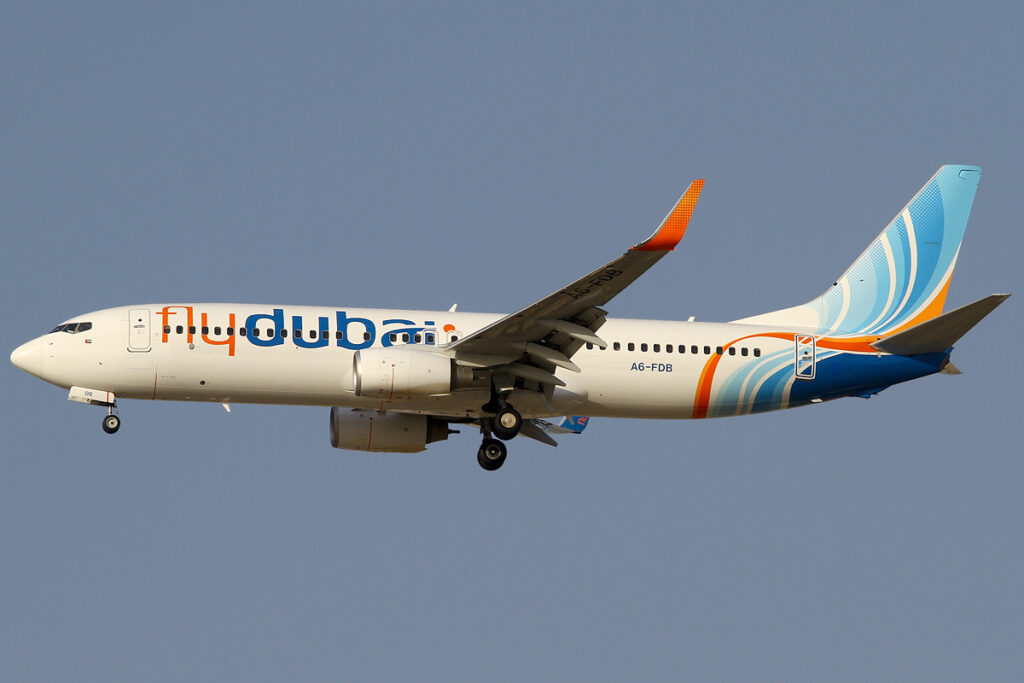
A routine morning flight from Dubai to Tel Aviv turned into a fight for survival on Wednesday when, according to Israeli officials, one of the aircraft’s own pilots attacked his colleague and tried to seize control of the plane. The attempt was stopped not by security forces, but by the passengers and crew who threw themselves at the cockpit door and refused to let go.
The aircraft, flydubai flight FZ1073, was a Boeing 737-8 MAX carrying 174 people, the large majority of them Israelis returning home. What began as a standard descent became, in the words of one senior Israeli official, the narrow avoidance of “a very serious disaster.”
Twelve minutes of chaos in the air
Investigators say the trouble started in the cockpit itself. One of the pilots stabbed the other and attempted to force him out of his seat as the plane began to descend. During the struggle, the jet dropped roughly 4,000 meters — a plunge steep enough to throw the cabin into panic and convince many aboard that the aircraft was going down.
The flight crew transmitted a rapid sequence of emergency transponder codes: first 7700, the general distress signal, then 7500, the code that specifically warns air traffic controllers of unlawful interference or a hijacking, before reverting again to 7700. To anyone monitoring the flight from the ground, those numbers told the story in real time — someone was trying to take the plane.
Passengers rush the cockpit
Israeli passengers seated near the front of the cabin did not wait to find out how it would end. Several rushed forward and fought the attacker directly, wrestling him away from the controls while others called for additional pilots known to be traveling aboard the flight. Those pilots were brought forward and took command of the aircraft.
“There was a hijacking, we’ve subdued the terrorists, we need help,” one passenger said in a message sent moments after the struggle, capturing the fear and confusion that gripped the cabin. Both the captain and the first officer were wounded in the attack; one was described as being in critical condition and was treated in the air by an Israeli dentist who happened to be on board before the plane could land.
An emergency landing in Saudi Arabia
With replacement pilots at the controls, the aircraft diverted and landed safely at Prince Sultan bin Abdulaziz Airport in Tabuk, in northwestern Saudi Arabia. All 174 people aboard were accounted for. The wounded pilots were transferred to hospital after touchdown.
The response on the ground was immediate. The Israeli Air Force scrambled fighter jets, Israeli airspace was temporarily closed as a precaution, and Prime Minister Benjamin Netanyahu convened a security assessment. Israel’s transportation minister called for all flydubai flights to be suspended pending a full review.
Who was the attacker?
Initial investigations indicate the pilot who carried out the attack was of Omani origin — a detail that drew immediate attention given that Oman does not maintain normalized relations with Israel. As of Wednesday, however, officials cautioned that there was no evidence the suspect had acted on behalf of a foreign government or an organized terrorist network. The motive remains under investigation, and authorities have not ruled out that the attacker acted alone.
Why it could have been far worse
Modern airline procedure is built around keeping the cockpit sealed and secure precisely so that no one can force their way in. This case was different, and more dangerous, because the threat came from inside the cockpit — from a crew member with full access to the controls. That is the scenario aviation security is least equipped to prevent, and it is why the incident is likely to prompt a hard look at how airlines screen and monitor their own flight crews.
For now, the outcome stands as a reminder of how much can hinge on the people in the seats. A steep, terrifying drop over the desert ended not in catastrophe but in a safe landing, because a group of ordinary passengers decided that whatever was happening at the front of the plane, they were not going to let it finish.




