
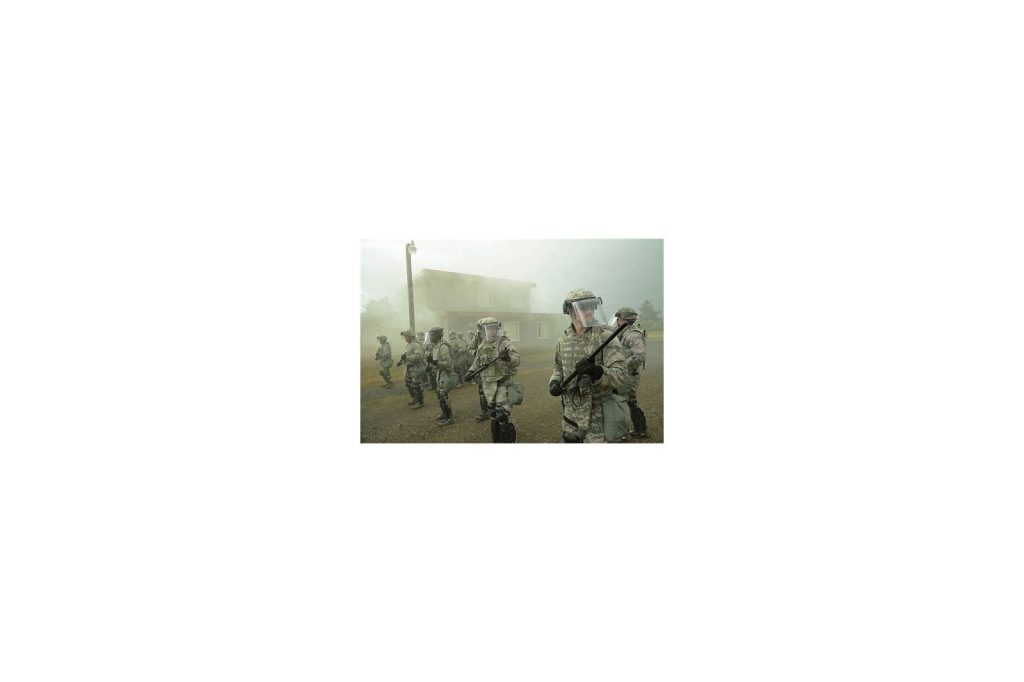
Up to two years in prison. That is the penalty written into 18 U.S.C. § 1385, the Posse Comitatus Act, for anyone who willfully uses the Army or the Air Force “as a posse comitatus or otherwise to execute the laws” without express authority from the Constitution or Congress. A Congressional Research Service report by Jennifer K. Elsea, updated in November 2018, lays out how that short statute has worked.
Born of a budget fight
The law came out of the aftermath of the Civil War. Federal troops stayed in the former Confederate states long after other political restrictions were lifted. By 1877, the report says, Republican governments in more than one southern state owed their survival to the military, and troop activity may have influenced the Hayes-Tilden presidential election.
Congress fought over it through the appropriations process. A Democratic House passed an Army funding bill that barred the Army from propping up Republican state governments in the South. The Republican Senate refused the provision, and the session ended with no Army appropriation at all. Pay was later approved in a special session with no strings. When the issue came around again, the House attached a posse comitatus section, and the Senate accepted it with minor amendments.
The same year had also shown how often troops were called in for domestic trouble. When railroads cut worker pay by 10% in 1877, strikes and violence followed, and governors from Pennsylvania, West Virginia, Maryland, Illinois and several other states asked for federal soldiers.
Who it covers
The text names only the Army and the Air Force. The report says the rule reaches the Navy and Marines through administrative action and other laws. The Coast Guard is a different case: Congress expressly gave it law enforcement duties, so its work cannot be said to run against the act. National Guard units fall under the act when they are in federal service. It also applies to civilian employees of the armed forces and to off-duty military personnel, but probably only inside the United States.
Where the courts draw the line
Most disputes involve military help to civilian police. Courts have found a violation, absent a recognized exception, when civilian officers make “direct active use” of military investigators, when the military “pervades the activities” of civilian officials, or when citizens are subjected to military power that is “regulatory, prescriptive, or compulsory in nature.” Activities carried out for a military purpose do not violate the act.
Exceptions are written into statute. Sections 251 to 255 of Title 10 let the President use military force to suppress insurrection or enforce federal authority, and sections 271 to 284 let the Defense Department share information, equipment and personnel with federal, state and local police.
Opinions on the law have never been uniform. Colonel William Winthrop, a military jurist of the period, called it “a mere impediment to the constitutional exercise of the executive power of the nation,” and noted that the President could always invoke the Insurrection Act where a combination resisted the enforcement of the laws. The report says that today the act is widely seen as the embodiment of the American tradition of anti-militarism.




