
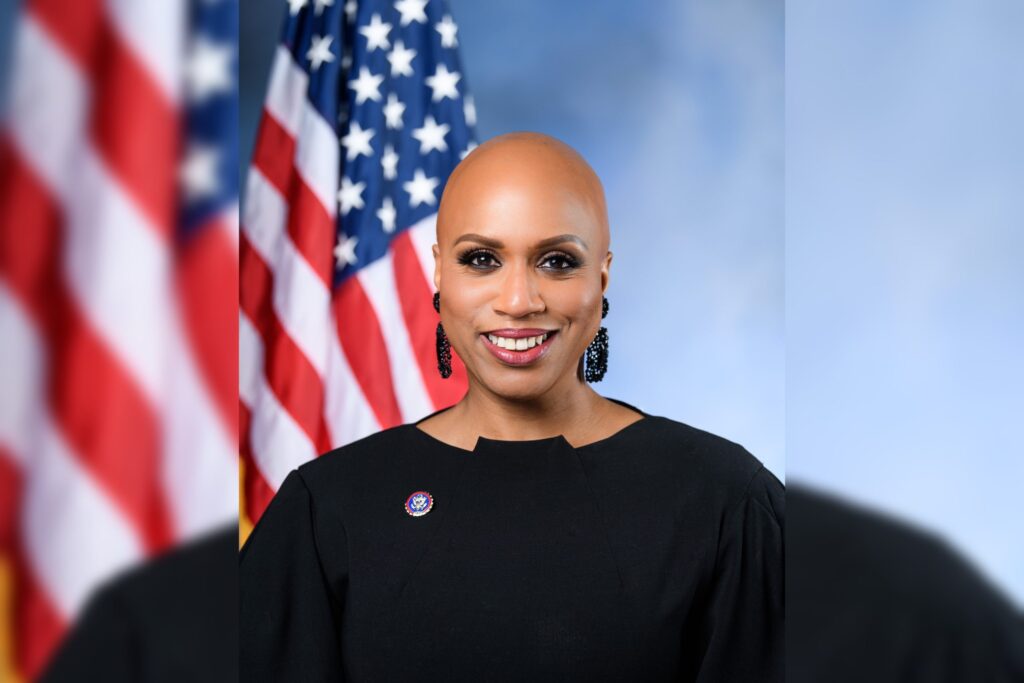
BOSTON, September 11 — Congresswoman Ayanna Pressley led 59 colleagues in a letter to the Department of Justice and the Federal Bureau of Investigation demanding a thorough, transparent and comprehensive federal investigation into numerous incidents of Black people found hanging across the United States. The letter, sent September 10, follows a series of deaths that raise suspicion of foul play given the role of lynching in American history. The lawmakers described the growing number of Black people found hanging in public as a national crisis.
A recent report documented more than 70 modern-day lynchings in the United States between 2000 and 2025. In 2026 alone, there have already been at least 10 reported hangings of Black people.
Those individuals were as young as 18 years old and lived in different parts of the country, including Mississippi, Michigan and New York. Many families have publicly questioned the conclusions of local and state investigations. That doubt is the political engine behind the letter.
Strategically, the lawmakers are not asking the DOJ and FBI to open a single case. They are asking the federal government to override the credibility of local findings across multiple states at once.
What the Letter Says
In the letter, the lawmakers wrote, “Inaction by the federal government is tantamount to complicity.
This is part of the legacy of racial terror in the United States, and this neglect has long-term consequences.” They added, “Not only are innocent lives lost, but lynching inflicts deep traumatic and psychological wounds on family members, neighbors, and the entire Black community.” The lawmakers invoked the Emmett Till Antilynching Act, which Congress enacted in 2022, stating it was meant to ensure the DOJ and FBI are empowered to fully investigate suspicious deaths and hold individuals accountable, and that “It is incumbent upon you to do just that.” The letter demands a thorough, transparent and comprehensive federal investigation into every hanging death of a Black individual across the United States.
At a minimum, each investigation, with permission of the decedents’ families, should include an independent autopsy, an audit of local and state law enforcement investigations, a review of physical and testimonial evidence, and a final report submitted to Congress explaining the agency’s findings. The letter also calls for robust data collection that tracks the hanging deaths of Black people in a transparent and systematic manner.
The Signatories and the Stakes
Joining Pressley in sending the letter are Representatives Alma Adams, Yassamin Ansari, Becca Balint, Nanette Diaz Barragán, Joyce Beatty, Wesley Bell, Sanford Bishop, Everton Blair, Brendan Boyle, Shontel Brown, Janelle Bynum, André Carson, Troy Carter, Yvette Clarke, Jasmine Crockett, Mark DeSaulnier, Sarah Elfreth, Jesús “Chuy” García, Sylvia García, Jimmy Gomez, Al Green, Adelita Grijalva, Jahana Hayes, Glenn Ivey, Jonathan Jackson, Henry C.
“Hank” Johnson, Sydney Kamlager-Dove, Robin Kelly, Ro Khanna, Raja Krishnamoorthi, Summer Lee, Jennifer McClellan, LaMonica McIver, Gregory Meeks, Analilia Mejía, Christian Menefee, Kweisi Mfume, Eleanor Holmes Norton, Alexandria Ocasio-Cortez, Frank Pallone Jr., Mark Pocan, Stacey Plaskett, Delia Ramírez, Terri Sewell, Lateefah Simon, Haley Stevens, Marilyn Strickland, Shri Thanedar, Bennie Thompson, Rashida Tlaib, Ritchie Torres, Lauren Underwood, Nydia M. Velázquez, Debbie Wasserman Schultz, Maxine Waters, Bonnie Watson Coleman, Nikema Williams and Frederica Wilson.
The full text of the letter is available through Pressley’s office. Pressley represents Massachusetts’s 7th congressional district, with a Washington office at 402 Cannon HOB, Washington, DC 20515, and a district office at 50 Redfield Street, Suite 302, Boston, MA 02122. The broader stakes are institutional.
The letter asks the DOJ and FBI to treat a pattern of deaths as a federal matter rather than a patchwork of state and local cases, and it asks for a reporting mechanism that would make that pattern visible year over year. What this signals is a test of whether the 2022 antilynching statute produces federal action or remains, in the lawmakers’ framing, an unused authority.
Watch whether the DOJ and FBI respond to the letter, and whether the requested reports to Congress materialize.




