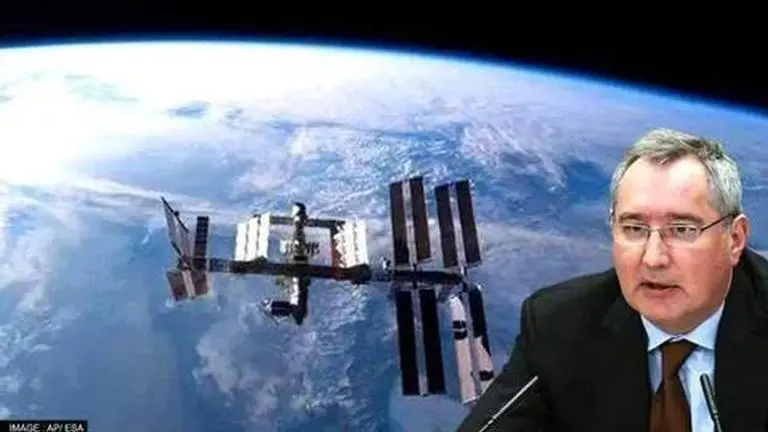
Moscow, 3 Apr 2022 , Roscosmos director Dmitry Rogozin warned on Saturday that the International Space Station’s future is in doubt after the United States, European Union, and Canada refused to lift sanctions on Russian aerospace firms by a Kremlin-imposed deadline. Speaking to state television, Rogozin said his agency will soon deliver a “cooperation outlook” to the Russian government that could include pulling support from the 24-year-old orbital outpost.
Sanctions trigger Russian ultimatum
Rogozin set the 31 March deadline in mid-March, demanding the West roll back restrictions imposed over Moscow’s invasion of Ukraine. The sanctions, most enacted in late February, freeze assets of state-owned enterprises and block dual-use electronics that Roscosmos buys for spacecraft guidance and docking systems. When the date passed without relief, Rogozin declared that “the ISS program can no longer operate on the old principles.” He told reporters the agency is now modelling how a sudden severance would affect Russian modules, cargo flights, and crew rotations. The report, he said, will land on the desk of Deputy Prime Minister Yury Borisov within days.
Western officials dismissed the deadline as theatre. A spokesperson for the U.S. State Department reiterated on 2 April that export controls “are not negotiable” and tied any future easing to a ceasefire and troop withdrawal. Canada’s Space Agency issued an identical statement, while the European Space Agency noted that “operational safety remains our priority” but gave no indication it would bend to Moscow’s terms.
Moscow claims station depends on Russian engines
Rogozin’s main use is propulsion. Russia’s Progress freighters, docked to the Zvezda service module, fire their thrusters periodically to boost the 420-ton complex away from debris and to maintain altitude. “No one but us can deliver fuel to the station,” he said Saturday. “Only our cargo craft can correct the orbit.” NASA has studied U.S. alternatives for years, Cygnus vessels from Northrop Grumman now carry a modest re-boost kit, and SpaceX’s Dragon could be modified, but neither matches the 1,200-kilogram propellant capacity of a Progress. If Roscosmos walked away, flight controllers would have roughly six to twelve months before atmospheric drag pulls the station into a dangerous decay path, according to a 2021 NASA briefing document.
The threat is technically plausible yet politically risky. Abandoning the ISS would strand two Russian cosmonauts, Anton Shkaplerov and Pyotr Dubrov, aboard the station alongside four NASA astronauts, one European, and one Canadian. A controlled de-crew would require at least one Soyuz capsule, the very spacecraft Rogozin says sanctions have “paralysed” by cutting access to Western micro-electronics.
Last cooperative corridor under strain
Space has survived every rupture in U.S.-Russian relations since 1993, but the Ukraine war is testing that resilience. Hours after Rogozin’s televised remarks, NASA’s Mark Vande Hei landed safely in Kazakhstan with Dubrov and Shkaplerov, a routine hand-off that belied the rancour on the ground. A small NASA medical team met the Soyuz capsule in the Kazakh steppe, and Vande Hei, who set a U.S. record of 355 continuous days in orbit, was flown back to Houston aboard a NASA jet. The choreography followed pre-war protocols, yet Roscosmos TV blacked out the U.S. agency’s logo on the recovery helicopter and cropped NASA personnel from its live feed.
Inside Russia, the messaging is turning darker. Rogozin posted on Telegram that Western replies “speak of friendship while their governments choke our industry.” He vowed to press for “complete and unconditional” sanction removal, adding that Roscosmos will halt deliveries of RD-181 engines used in Northrop Grumman’s Antares rocket, a move that could delay upcoming cargo runs to the ISS from Wallops Island, Virginia. The agency has already suspended joint European Mars rover launches and pulled its personnel from French Guiana, shrinking the last neutral ground between the powers.
NASA walks tightrope on orbit diplomacy
Publicly, NASA insists nothing has changed. “We are continuing to operate the ISS with all our international partners including Roscosmos,” administrator Bill Nelson said on 1 April. Privately, engineers at Johnson Space Center have accelerated contingency planning. A flight director told Reuters that teams are modelling “split-ops” scenarios in which Russian and Western segments detach into separate spacecraft, technically feasible but suicidal for the station’s long-term health. The U.S. segment cannot stay aloft without Zvezda’s thrusters; Russia’s modules lack independent solar power if unplugged from the American gyroscopes and cooling loops.
Congress is losing patience. The Senate’s space subcommittee will grill Nelson on 6 April about “over-reliance on hostile partners,” according to a staff memo circulated Friday. Lawmakers want a fast-track competition for a U.S. propulsion tug that could keep the ISS flying beyond 2030 without Russian help, a contract worth an estimated $1 billion that would not deliver hardware before 2026 at the earliest.
For now, the station circles Earth every 90 minutes, its crews swapping cargo and science samples as if geopolitics stops at 400 kilometres altitude. Yet the clock is ticking. Rogozin’s report, once submitted, could give the Kremlin a pretext to cash in its orbital chips, leaving the West to fund, build, and launch an emergency propulsion mission or watch the world’s most expensive laboratory tumble into the Pacific. Either path guarantees a fiery end to the last major project the rivals still run together.