
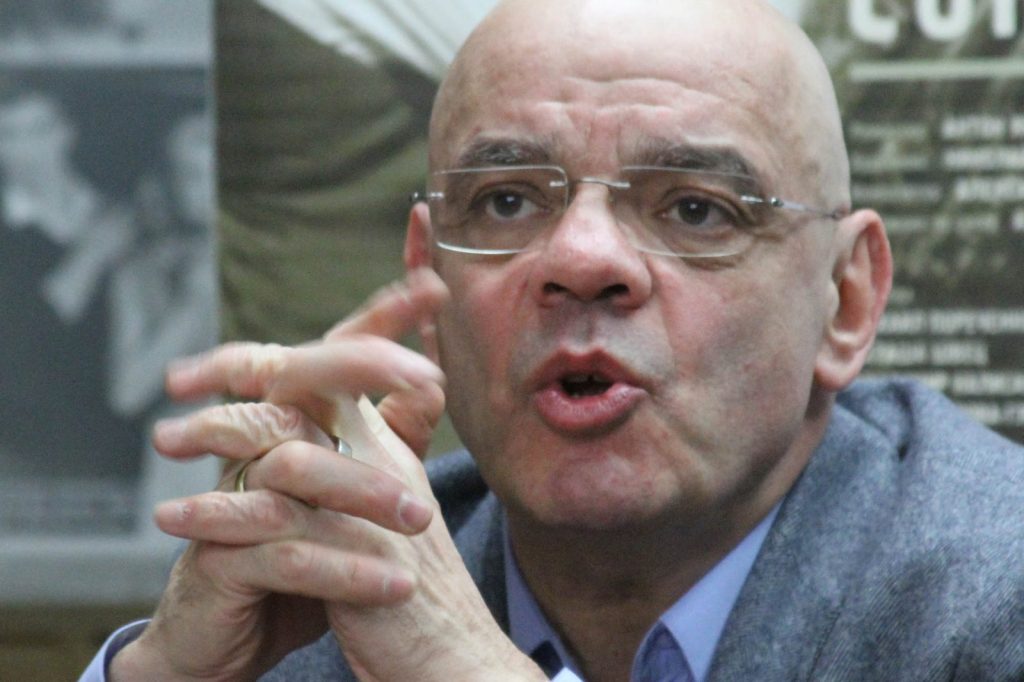
“I see how people are itching to change things and send us back to the past,” Konstantin Raikin told a hall of theatre professionals on Monday, 24 October 2016. “And not just to the time of stagnation, but further back – to Stalin’s times.”
The speech, at the 7th Congress of the Union of Theater Professionals, set off a lively public debate. Raikin is the director of the Satirikon theatre, and its leading actor. The Moscow Times noted he looked visibly agitated as he spoke. He urged colleagues to put their differences aside and stand together against censorship.
A life in one theatre
Raikin was born on 8 July 1950 in Leningrad, into a stage family. His father was Arkady Raikin, a Soviet actor and stand-up comedian honoured as a People’s Artist of the USSR; his mother, Ruth Raikina-Ioffe, was an actress. He went to a school for mathematically gifted children attached to Leningrad University, then in 1967 entered the Boris Shchukin Theatre Institute. After graduating in 1971 he spent ten years at the Sovremennik Theatre and played 38 roles there. In 1981 he joined his father’s Leningrad Theater of Miniatures. It moved to Moscow the next year and eventually became the Satirikon.
When Arkady Raikin died in 1988, the artistic direction of the theatre passed to his son, who still runs it. Over the years Raikin played Richard III under the director Yuri Butusov, a role that brought him the third of his Golden Mask awards, and he has won that national theatre prize four times. He also teaches at the Moscow Art Theater School and has sat on the Presidential Council for Culture and Art since 2001. In 2010, President Dmitry Medvedev awarded him the Order “For Merit to the Fatherland”.
The speech that split the stage
In his speech Raikin attacked groups who have banned or shut cultural events in the name of morality. A staging of the rock opera “Jesus Christ Superstar” had just been prohibited in Omsk after an Orthodox Christian group called it blasphemy. “I don’t believe those groups of people who say that are upset and offended,” he said. “I believe that they are paid.” And he turned on officialdom. “Stop pretending that the authorities are the only bearers of morality. That’s not true.”
The Kremlin answered quickly. Presidential spokesman Dmitry Peskov denied there was censorship but said a state that funds theatre is entitled to make recommendations about content. “Censorship should not be confused with a state commission,” he said. Film director Andrei Zvyagintsev, whose film “Leviathan” was nominated for an Oscar in 2014, countered in a newspaper column that it is “completely obvious” censorship has entered the cultural life of the country. Kirill Serebrennikov of the Gogol Centre backed Raikin, and told the Guardian that older heavyweights had phoned Raikin privately to offer support but did not want to speak publicly. “Everyone is scared of offending the officials, who you have to go to and beg for money from,” he said.
Alexander Zaldostanov, leader of the Kremlin-friendly Night Wolves biker gang, then entered the fight, saying “these Raikins want to turn the country into a sewer, flowing with filth”. The Kremlin gave him a rare rebuke. Peskov said Raikin’s “huge talent” earned “unlimited admiration”, and added that the biker had been “confused by a demon” and should apologise. Zaldostanov refused.
Sources
- Moscow theatre director sparks row with claims of state censorship (The Guardian)
- Prominent Russian Artists Start Culture War, Accuse Government of Censorship (The Moscow Times, Michele A. Berdy)




