
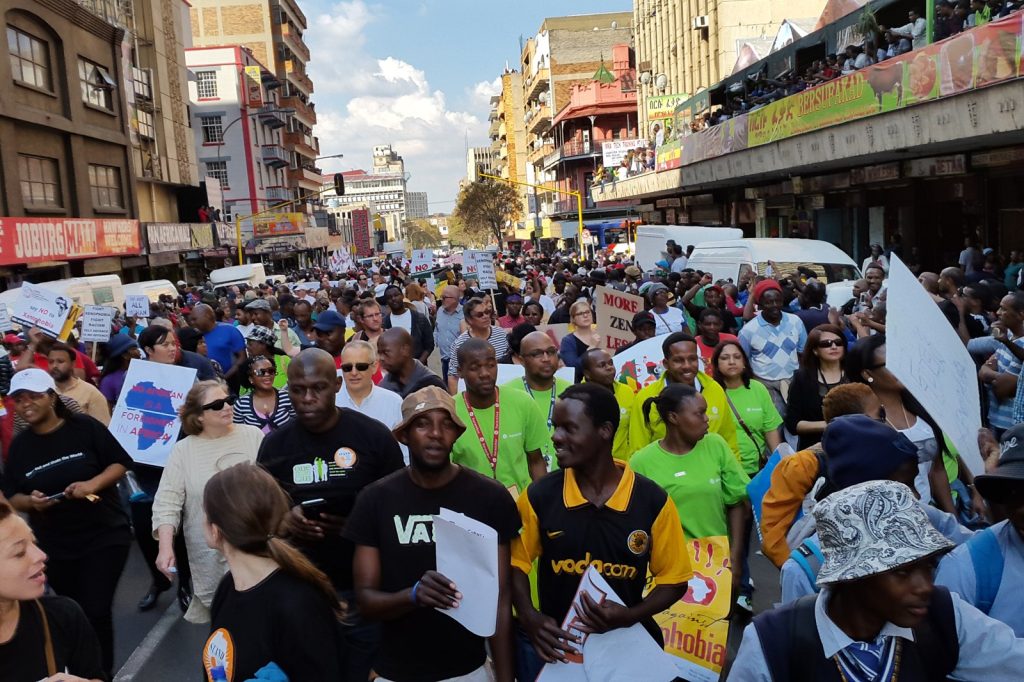
Protesters in South Africa have told all undocumented foreigners to leave the country by Tuesday, Reuters reported on 26 June. Thousands of foreign Africans are heading home or huddling in camps for fear of attack. March and March, the group organising the rallies, says its protests are peaceful.
What the marchers say
Anti-foreigner groups argue that illegal immigrants take jobs from South Africans, use up scarce public services and drive high crime. Musa Hlongwa, president of the group United South Africa, put it to journalists on 24 June: “South Africans are tired of standing in long queues in hospitals … competing for jobs with foreign nationals … tired of Nigerians who are selling drugs to youth of this country.”
Polling shows the mood is widespread. A Human Sciences Research Council survey found only one in six adults would welcome all foreigners, while 42% would welcome none, up from a third in 2021. Afrobarometer found seven in 10 South Africans see the economic impact of immigrants as negative, and 85% want fewer refugees or none. Ipsos found nearly three quarters of respondents did not trust African immigrants “at all”.
What the figures show
Take the claim that the country is overrun. A national statistics office survey in 2023 counted 3.1 million migrants, about 4.1% of the population, down from 5.6% a decade earlier. Britain’s share is 17%, Canada’s 22% and Australia’s 30%, according to 2024 UN data. Campaigners say undocumented arrivals swell the real number, but the statistics office uses census data designed to capture them. “The impression is that there are … hordes of people coming into the country, but the data points to the contrary,” said Anthony Kaziboni of the University of Johannesburg.
On crime, police do not publish nationalities of convicts. Justice department figures from 2017 showed 11,842 foreigners in prison, about 6% of inmates, and 1,380 of them were held for entering the country illegally. Loren B. Landau, a professor at Oxford, said: “All evidence suggests immigrants are disproportionately law abiding.”
On jobs, a 2018 World Bank report found that each employed migrant corresponds to about two jobs created for South Africans through business activity, because migrants spend most of their money locally.
On services, Kaziboni said undocumented migrants rarely use public hospitals or schools because those require registration. Economists blame chronic underinvestment and corruption. He noted that 1.5 trillion rand ($91.27 billion) was lost to corruption under former president Jacob Zuma, plus 1 billion rand spent investigating it.
Why it keeps flaring
A third of South Africans are out of work, one of the highest rates in the world. Service delivery was so poor that the ruling African National Congress lost its majority in the 2024 elections. By some measures, inequality is the highest anywhere. The apartheid government also used migrant labour from across Africa to keep gold mine wages low and weaken unions, a policy still lodged in public memory.
Politicians add to the anger around election time, and local elections are due by November. “Immigrants are by no means the reason why services and the economy have faltered, but people remember what confirms their biases,” Landau said.




