
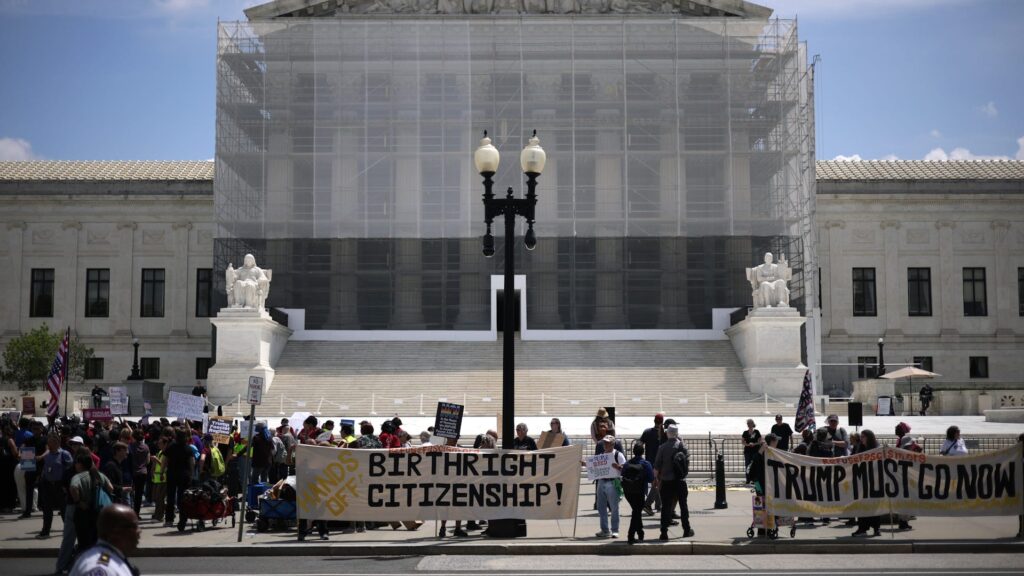
The Supreme Court ruled 6-3 on Tuesday, June 30, that President Trump’s executive order ending birthright citizenship cannot stand, according to the Dallas Express. The order, signed on his first day back in office, never took effect. Lower courts had blocked it every time it came up.
The case was Trump v. Barbara, and Chief Justice John Roberts wrote the majority opinion. The 14th Amendment says “all persons born or naturalized in the United States, and subject to the jurisdiction thereof, are citizens.” The administration read the jurisdiction clause narrowly, arguing that children of noncitizens fall outside it. The court disagreed, and Roberts said children born to parents who are unlawfully or temporarily here “are citizens at birth.”
What the order would have done
Under Trump’s order, a child born in the United States would get citizenship only if at least one parent was a citizen or lawful permanent resident. That would have hit more than people in the country illegally. Students and some workers on temporary visas were covered too. Researchers at the Migration Policy Institute and Penn State’s Population Research Institute estimated that more than 250,000 babies a year would have been affected.
The history in the opinion
Roberts started with English law. Children born in Britain became British subjects automatically, he wrote, and the view “crossed the Atlantic with the colonists.” The 14th Amendment came in 1868 to overturn the 1857 Dred Scott decision, which denied that a Black person descended from enslaved people was a citizen.
In 1898 the court took up Wong Kim Ark, born in San Francisco to Chinese parents and refused reentry in 1895 after a trip to China. The justices held that he was a citizen. Roberts said the court has understood the rule the same way “in the 128 years since.” He had little patience for the government’s fallback theory that citizenship depended on the parents’ domicile in 1868: “there is scant evidence for this dramatically revisionist view.”
He ended with a line the Associated Press carried: “Citizenship, then and now, was the right to have rights, to freely participate in our political community. The Framers of the Fourteenth Amendment extended that promise to ‘every free-born person in this land.’ We keep that promise today.”
Dissents and a different route
Justices Samuel Alito, Clarence Thomas and Neil Gorsuch dissented. Alito called the decision “a serious mistake” and argued the amendment covers only children who owe allegiance solely to this country. Thomas wrote that the majority’s account was “not historically accurate.”
Justice Brett Kavanaugh agreed the order is invalid but not for the same reason. In his view it breaks a federal statute, not the Constitution, and Congress could change that statute. He noted that it has not.
Reaction
The ACLU, which represented the plaintiff class, called the outcome a victory. National Legal Director Cecillia Wang, who argued the case, said the decision “reaffirms one of the fundamental pillars of American life” and described a “day of celebration” for American families who would have been harmed.
The administration has not said what it will do next. Congress has the statute Kavanaugh pointed to, and he said it is free to amend it.
Sources
- Supreme Court strikes down Trump’s order ending birthright citizenship
- Live Coverage: Birthright Citizenship SCOTUS Oral Arguments
- SCOTUS Strikes Down Trump Birthright Citizenship Order 6-3




