
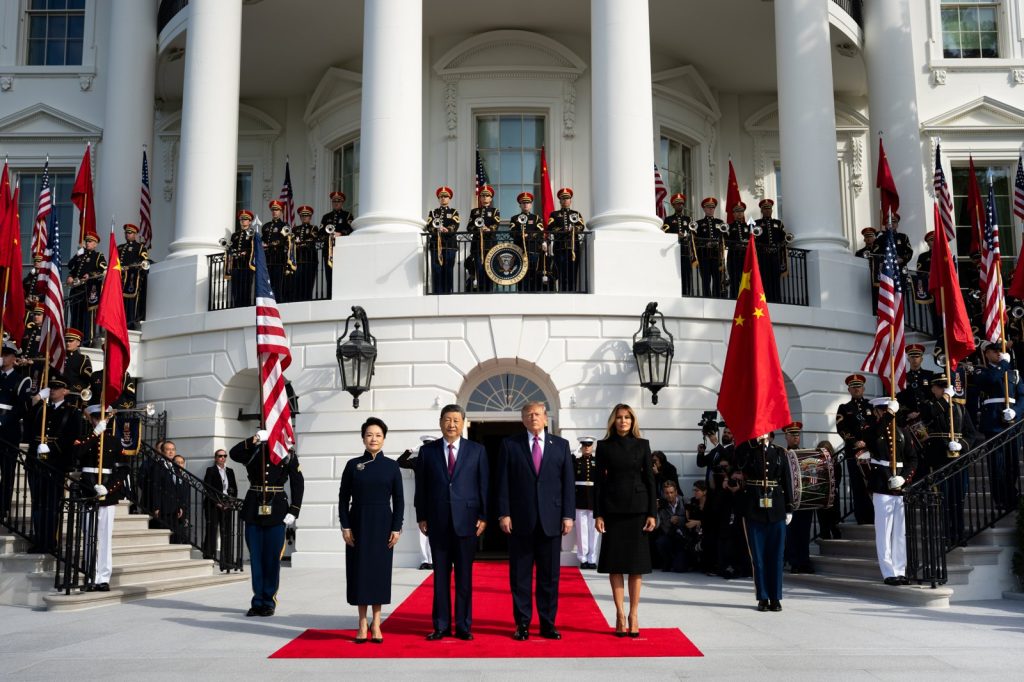
WASHINGTON, Sept. 29 — U.S. President Donald Trump and Chinese President Xi Jinping exchanged warm words at a White House state dinner on Thursday evening, four days before this article’s publication, but made little public progress on key issues dividing the two nations.
Trump praised Xi during the dinner, stating that despite having ‘different systems,’ the U.S. and China had ‘never gotten along better.’ Xi welcomed the meeting as a ‘historic juncture’ in U.S.-China relations and said their ambitions could ‘surely be mutually reinforcing,’ urging both countries to act as ‘responsible major countries’ and keep AI ‘under human control.’ The dinner followed a daytime meeting in which Xi urged Trump to take the ‘correct position’ on Taiwan, which Beijing claims as part of its territory, amid a paused $14 billion (about £11 billion) U.S. arms package to Taiwan that Trump had delayed approving after Xi warned in May that mishandling the issue could lead to conflict.
Trump had previously called the arms delay a ‘very good negotiating chip’ with Beijing. Trump has sought deals on trade and tariffs during the visit, including lowering Chinese tariffs on American goods, increasing imports of Chinese rare earth minerals, and boosting U.S. agricultural exports to China.
After the dinner, Xi said on Friday morning that he and Trump were ‘charting the course for the great shift of China-U.S. relations’ and confirmed two more meetings by year’s end: one at the APEC leaders’ meeting in Shenzhen, China in November, and another at the G20 summit in Florida in November.
The state dinner was attended by billionaire business leaders and U.S. tech CEOs, including Apple’s Tim Cook, Nvidia’s Jensen Huang, Elon Musk, OpenAI’s Sam Altman, Google’s Sundar Pichai, Amazon’s Jeff Bezos, Mark Zuckerberg, and Jeff Yass, who owns a share of TikTok. Protesters gathered outside the White House gates during the event, some of whom were arrested.
Trump presented Xi with a sculpture of a bald eagle, designed with input from First Lady Melania Trump, calling it a symbol of ‘the free and soaring spirit of America.’ Other attendees included Defense Secretary Pete Hegseth, Chief of Staff Monica Crowley, and Trump’s son-in-law Jared Kushner. Despite the cordial tone, tensions persist over trade, technology, and Taiwan, with China accusing the U.S. of seeking to contain its rise and the U.S. viewing China as its main rival in AI development.
No specific agreements on these issues were announced following the dinner. The broader stakes of this engagement remain clear.
With two more high-level meetings on the horizon, the strategic calculus for both nations hinges on whether this moment of diplomatic warmth can translate into tangible cooperation or merely serve as a temporary reprieve from the deep-seated rivalries that define the U.S.-China relationship. What this signals is a delicate balancing act, one that will be watched closely by both domestic and international actors as the year moves forward.




