
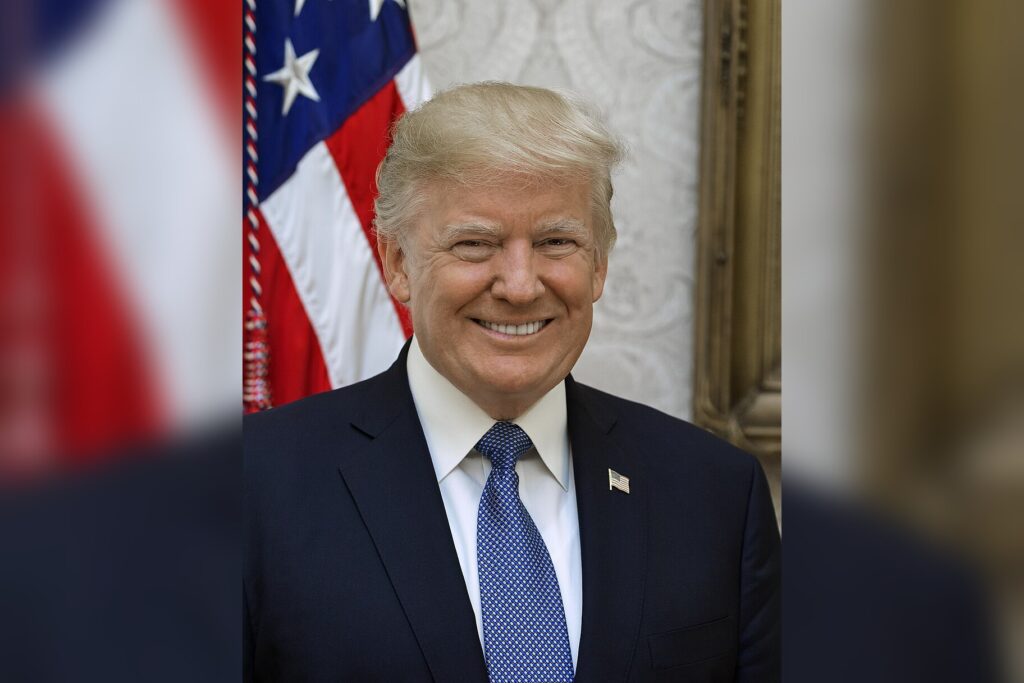
DALLAS, September 10 — President Donald Trump told a Republican convention in Dallas that he would offer every adult American a $5,000 (£3,700) payout if Republicans win both chambers of Congress in November’s midterm elections, a plan that would cost more than a trillion dollars. The offer, made at the party’s first-ever convention held in the middle of a US presidential term, came with no details on how the plan would work or be funded. Trump said only that the money would have to be spent in the US.
“If the Republicans win the House of Representatives and the United States Senate, both of them,” he said, “I will issue a dividend to every adult citizen in the United States of America for $5,000.” He added: “We don’t want you going to Canada to spend the money. We don’t want you going to China, to Germany.
You got to spend the money in the United States of America.” It is not clear how the spending would be monitored, and the BBC has asked the White House for further clarification.
The arithmetic and the applause
There are nearly 270 million American adults, meaning a $5,000 payout would cost the US government some $1.3 trillion. The idea drew raucous applause at the convention and Trump seemed to relish the moment. Democrats labelled it an “empty promise,” and others questioned whether such a pledge was legal or feasible.
It may be the first time a US president offered such a payout to Americans, in the context of an election-year plea to get out and vote. Vice-President JD Vance has linked the plan to revenue Trump has raised from US tariffs on imported goods.
“What the president is talking about is fundamentally a dividend for American workers,” Vance told Fox News. “We’re taking in an extraordinary amount of revenue because the president of the United States is actually standing up to both foreign companies but also foreign countries who’ve been taking advantage of America’s workers.” He added: “I don’t think it’s a controversial idea.”
A promise in campaign season
One former Republican strategist and pollster said the promise should be firmly seen in the context of an election that is now less than two months away. “It is an extraordinary promise, and I’m not sure where that money is going to come from – but it is campaign season,” Robert Moran told the BBC World Service’s Newsday programme.
Moran described it as a “novel solution to an interesting problem,” noting that the historical tendency was for the party of the president to lose seats in Congress during the midterm elections. It is not the first time Trump has promised such payouts.
He has previously proposed $2,000 cheques to be funded by tariff revenues, but those payments never materialised, no relevant legislation has been passed, and no federal dividend programme currently exists. Other US politicians in the past have also promised economic rewards in return for electoral success. Democrats in Georgia promised $2,000 relief payments if their party took control of the Senate at the height of the Covid-19 pandemic.
The war, oil and the broader stakes
Questions have begun to be raised about whether the plan is feasible, especially as prices rise in the US, partially as a result of the war that the US and Israel started with Iran in February. Iran’s retaliation has included attacks against US bases and allies in the Gulf, but crucially it has largely closed the Strait of Hormuz, through which about a fifth of the world’s oil and liquefied natural gas used to transit.
The blockage has caused fluctuations in oil prices worldwide, and Trump has faced pressure from his party to end the war. On Wednesday, the president warned his supporters that the war would not end until after the midterms and that oil prices would not come down until then.
He made the comments ahead of his speech in Texas, repeating it at the convention, where he argued that short-term economic pain was worth it to prevent Tehran from developing nuclear weapons. His long speech in Dallas touched on the core of the conflict — the impact on Americans’ standard of living — and his pledge to increase their spending power drew raucous applause in the hall. Strategically, the calculus is straightforward.
With less than two months to polling day, the White House is tying a wartime economy and elevated prices to a single, vivid electoral bargain: congressional control in exchange for cash. Whether that bargain survives contact with Congress, the courts and the oil markets is the question that now hangs over the campaign.




