
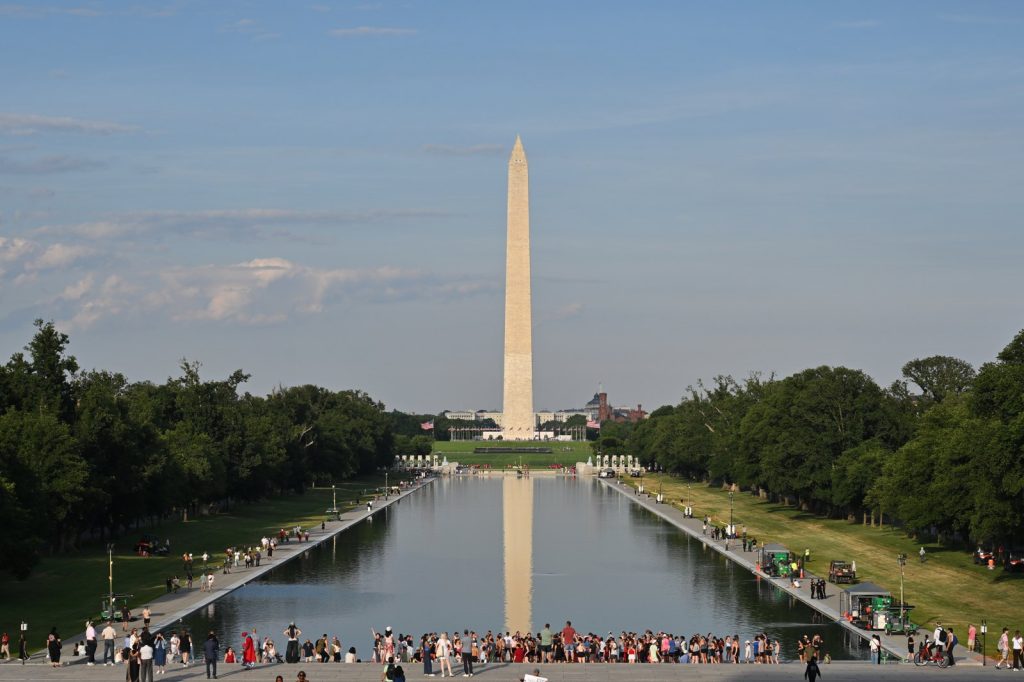
A renovation ordered by President Donald Trump at the Lincoln Memorial Reflecting Pool has produced an unintended consequence: a toxic algal bloom now mars the surface of the historic water feature. The president directed that the concrete bottom of the pool be coated with paint in what his team described as “American flag blue,” intending to improve clarity and eliminate existing algae for a bluer appearance.
The work was completed on June 5. Within weeks, however, fresh algae began appearing on the pool’s surface, turning the iconic landmark green.
A Century-Old Feature Altered
The reflecting pool, situated directly across from the Lincoln Memorial on the National Mall, was completed in 1922 and has long mirrored the sky and the Washington Monument. For more than a century, the shallow basin has been a recognizable feature of the nation’s capital. Trump’s order to modify the concrete bottom drew legal opposition; a lawsuit was filed in an attempt to block the work before it proceeded.
Nonetheless, the renovation moved forward. The changes have been anything but cosmetic.
Arif Gasilov, a partner at Natural Resources & Built Environment at the Gasilov Group, told RadarOnline.com that the renovation “probably caused the algae bloom.” He explained that the old pool had “decades of established microbial communities that competed with harmful algae and kept it in check.” By draining the water to repaint the bottom, officials removed that entire biological ecosystem. “Draining the water got rid of that biological balance,” Gasilov said, clearing the way for cyanobacteria — a type of blue-green algae — to flourish.
Ecological Disruption Emerges
The algae now visible in recent photographs is not merely unsightly; it is toxic. Gasilov described the blue-green algae as “lethal.” The shallow, still water of the pool, which lacks any system for circulation, is an ideal environment for such organisms to grow fastest, he noted. The National Mall landmark, once a placid surface for reflection, now hosts a biological hazard.
The episode underscores a broader context. Trump, an American politician and businessman, first entered the White House after a 2016 campaign built on his outsider image and career in New York real estate and television.
His earlier presidency, from 2017 to 2021, included a pattern of rolling back environmental rules and withdrawing the United States from international climate accords. After winning another presidential election and returning to office, his administration moved quickly on broad federal workforce and trade actions. The pool renovation fits a pattern of direct presidential intervention at a historic federal site.
Restoration Challenges Ahead
Gasilov warned that the fix will not come quickly. Re-establishing the microbial balance that once kept harmful algae in check takes time. “The pool is effectively a new aquatic surface, stripped of its biological history,” he said.
The old communities that competed with toxic strains are gone, and nature does not rebuild such ecosystems overnight. The pool, completed in 1922, has become a focal point: under Trump’s leadership, it now shows what can happen when a living aquatic system is drained and a human-designed surface is imposed.
The event matters because it illustrates how direct presidential action at a historic landmark can disturb a long-standing natural equilibrium. The Reflecting Pool at the National Mall is more than a symbolic monument; it carries ecological histories that developed over a century. The decision to strip those communities and repaint the concrete base has, according to the expert analysis, triggered a harmful bloom that will require patient restoration.
The pool still reflects, but what it now mirrors is a cautionary reminder of the consequences of intervening in a complex natural system without accounting for its biological underpinnings.




