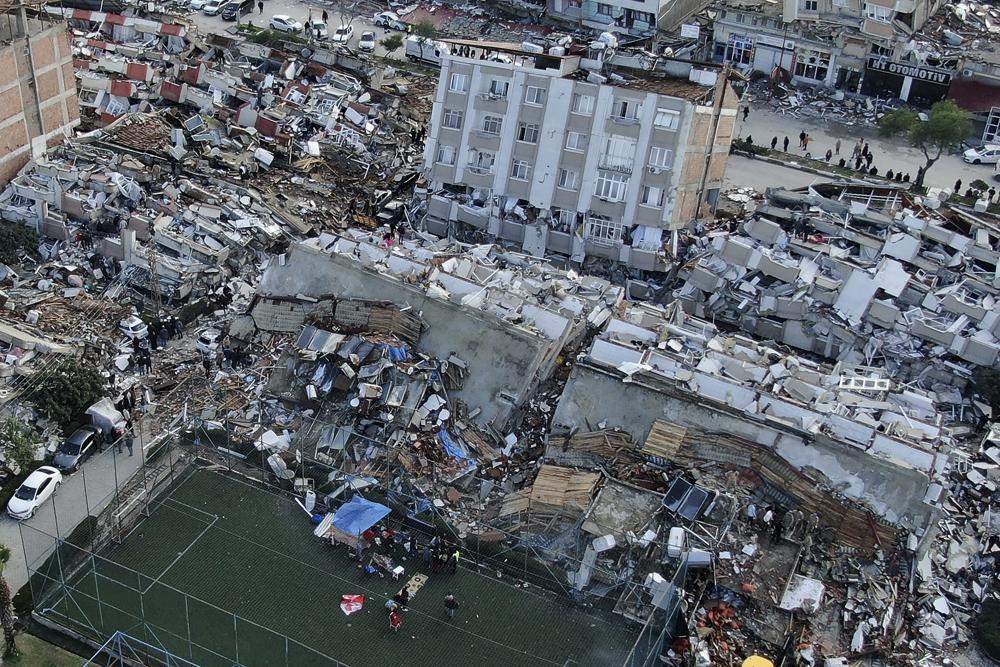
On February 9, 2023, the death toll from a devastating earthquake in Turkey and Syria surpassed 15,000, with rescue crews struggling to find survivors amidst the rubble of thousands of destroyed buildings. The earthquake, which struck on Monday, February 6, 2023, was the deadliest to hit the planet in over a decade, with tens of thousands of people injured and many more still missing. President Recep Tayyip Erdogan visited a “tent city” in Kahramanmaras, where people who had lost their homes were taking shelter, and acknowledged shortcomings in the response to the disaster, but promised that nobody would be left abandoned.
rescue efforts
Rescue teams from over two dozen countries have joined local emergency personnel in the search for survivors, with donations of aid pouring in from around the world. However, the extensive damage caused by the 7.8 magnitude earthquake, which extended to remote areas of Syria, has made it difficult for aid to reach those in need. Journalist Ozel Pikal, who witnessed the removal of eight bodies from a building in the Turkish city of Malatya, said that the remains were wrapped in blankets and left on the ground, waiting for funeral cars to arrive. Pikal, who assisted with the rescue efforts, said that he believed some of the victims may have frozen to death, given the temperatures had dropped to minus 6 degrees Celsius. “There is no hope left in Malatya as of today, thus today is not a good day,” Pikal said. “No one is emerging from the wreckage alive.”
challenges in syria
The situation in Syria is particularly dire, with the ongoing civil war complicating rescue efforts and making it difficult for aid to reach those in need. The Syrian Health Ministry reported that over 1,200 people had died in government-held areas, while the White Helmets, a group of volunteer first responders, estimated that at least 1,400 people had died in the northwest, which is controlled by rebels. The Bab al-Hawa border crossing was used to return the bodies of over 100 Syrians who had died in Turkey, with 20 more bodies on their way to the border, according to Mazen Alloush, an officer on the Syrian side of the border. Alloush noted that the victims were all Syrian refugees who had fled their country’s civil war.
stories of survival
Despite the dire situation, there have been some stories of survival and hope. Polish rescuers working in Turkey reported that they had pulled nine people alive from the rubble, including parents with two children and a 13-year-old girl. Arif Kaan, a 3-year-old boy, was rescued from beneath the debris of a collapsed apartment building in Kahramanmaras, nearly two days after the earthquake. The boy’s father, Ertugrul Kisi, who had previously been rescued himself, sobbed as his son was freed and loaded into an ambulance. In northwest Syria, residents of a community discovered a wailing infant on Monday, still attached to her dead mother’s umbilical cord. The newborn was the only member of her family to survive a building collapse.
aid efforts
Aid efforts are ongoing, with many countries and organizations providing assistance to those affected by the earthquake. However, the response has been hindered by the ongoing conflict in Syria and the segregation of the rebel-held border region, which is surrounded by government forces backed by Russia. Western sanctions related to the conflict have also made it difficult for Syria to receive aid. As Aysan Kurt, a 27-year-old survivor, told the AP, “We lack everything, a tent, a heating source, and other essentials. Our kids are in terrible shape. We are all getting drenched in the rain, and our kids are outside in the cold. We won’t die from the cold; we didn’t die from hunger or the earthquake.” Pope Francis has called for prayers and acts of solidarity for those affected by the earthquake, which has left tens of thousands of people without shelter or access to basic necessities.
The situation in Turkey and Syria remains dire, with many people still missing and tens of thousands injured. The earthquake has highlighted the need for international cooperation and aid in response to natural disasters, particularly in regions affected by conflict and poverty. As the rescue efforts continue, it is clear that the road to recovery will be long and difficult, but with the help of the international community, it is possible to rebuild and provide support to those who have been affected by this devastating disaster. The stories of survival and hope, such as that of Arif Kaan and the newborn infant, serve as a reminder of the resilience and strength of the human spirit, even in the face of unimaginable tragedy.