
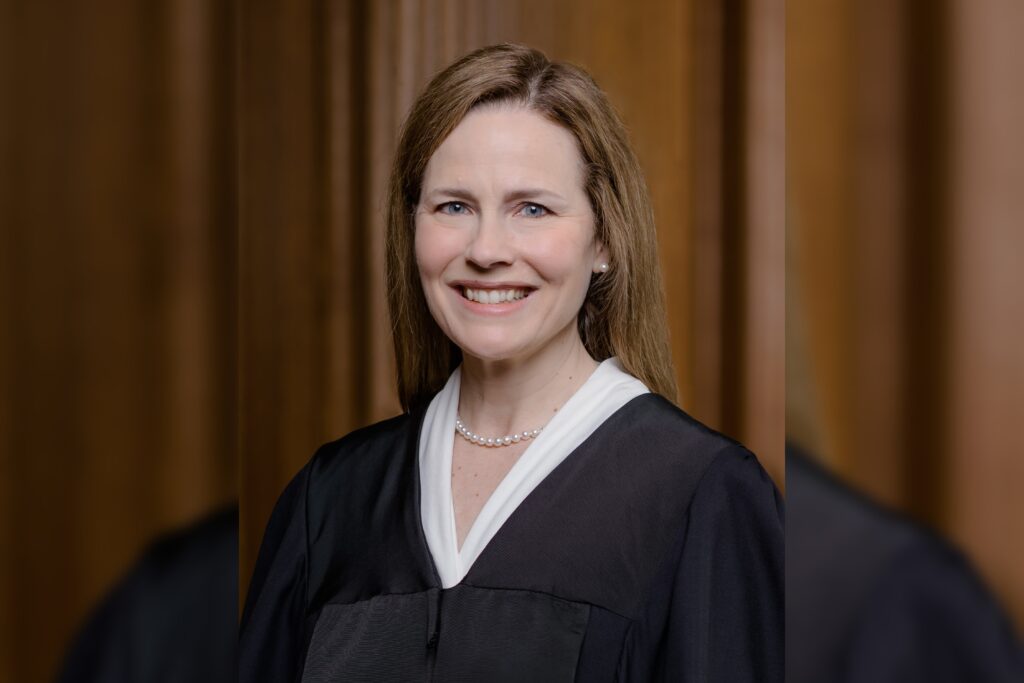
CHARLOTTESVILLE, September 19 — Associate Justice Amy Coney Barrett told a University of Virginia audience this week that the Supreme Court’s nine justices work to keep personal feeling out of their dealings with one another even when they disagree vigorously over the law, offering a rare public window into how the institution manages internal friction at a moment of heightened scrutiny. Barrett spoke during a fireside chat with UVA School of Law Professor John C. Jeffries Jr. at Culbreth Theatre.
The event was sponsored by the Karsh Institute of Democracy in partnership with the School of Law’s Karsh Center for Law and Democracy. “When you read opinions, you can see quite vigorous debate.
I think what you won’t see, or very rarely see, is for it to be personal,” Barrett told a packed audience.
Institutional Habits and the Court’s Self-Image
She described the routines that preserve collegiality among the justices. “We have lunch together. We talk together.
We shake hands before we go on the bench.” Barrett, appointed to the court in 2020 by President Donald Trump, discussed the legal theories used to interpret cases and said the justices focus on the law rather than public opinion or political preferences. “I think it’s crucial to understand that the court isn’t the same thing as Congress, and that the court isn’t in the business of making policy and choosing between two sides based on what the court thinks is the better policy objective,” she said.
“What we are trying to do is apply the law.” She also discussed her new book, “Listening to the Law: Reflections on the Court and Constitution,” which reflects on the court’s role and constitutional interpretation.
Security, Criticism and a “Lonely Job”
Barrett acknowledged that rulings can provoke anger, including at times from the U.S. president, and noted threats on social media and other public forums. “We certainly live in a time and in a climate where people are quick to say things,” she said.
She recounted a conversation with a member of the House of Representatives who mentioned vandalization of her business in her district, adding: “I think we live in a time where, unfortunately, the threat of violence is sort of out there, lurking.” Social media has raised the justices’ public profiles and increased security concerns, Barrett said. “I can’t just go work in a coffee shop if I want to,” she said, noting difficulty making new friends.
“I think it’s a lonely job, in many ways. Part of it is because you are making people unhappy. You are criticized across the political spectrum, so lots of people are … saying things about you, and then you might run into them at your kid’s soccer game.
It’s a little awkward.” Barrett said serving on the Supreme Court is an honor she would not trade. “I consider this to be public service, a great privilege to try to safeguard the Constitution and uphold the rule of law,” she said.
“I think it is very important work. I find it very humbling work, but it is rewarding to know that I am doing something I hope really makes a difference.” The event included a reception where Barrett posed with students from the Karsh Institute of Democracy and the School of Law. The Karsh Institute of Democracy at UVA was established to study and strengthen democratic institutions, and the School of Law’s Karsh Center for Law and Democracy focuses on law and democratic governance.
Barrett’s appearance comes amid heightened public scrutiny of the Supreme Court, whose nine justices are appointed for life terms. Barrett, a former Notre Dame law professor and federal appellate judge, was confirmed to the high court in October 2020 following the death of Justice Ruth Bader Ginsburg. What this signals is a justice working to separate the court’s internal culture from its external battles.
The calculus for the institution is whether that separation holds as security concerns and political pressure mount. Watch whether Barrett’s public reflections on collegiality and the rule of law find an echo in how the court conducts itself in the term ahead.




