
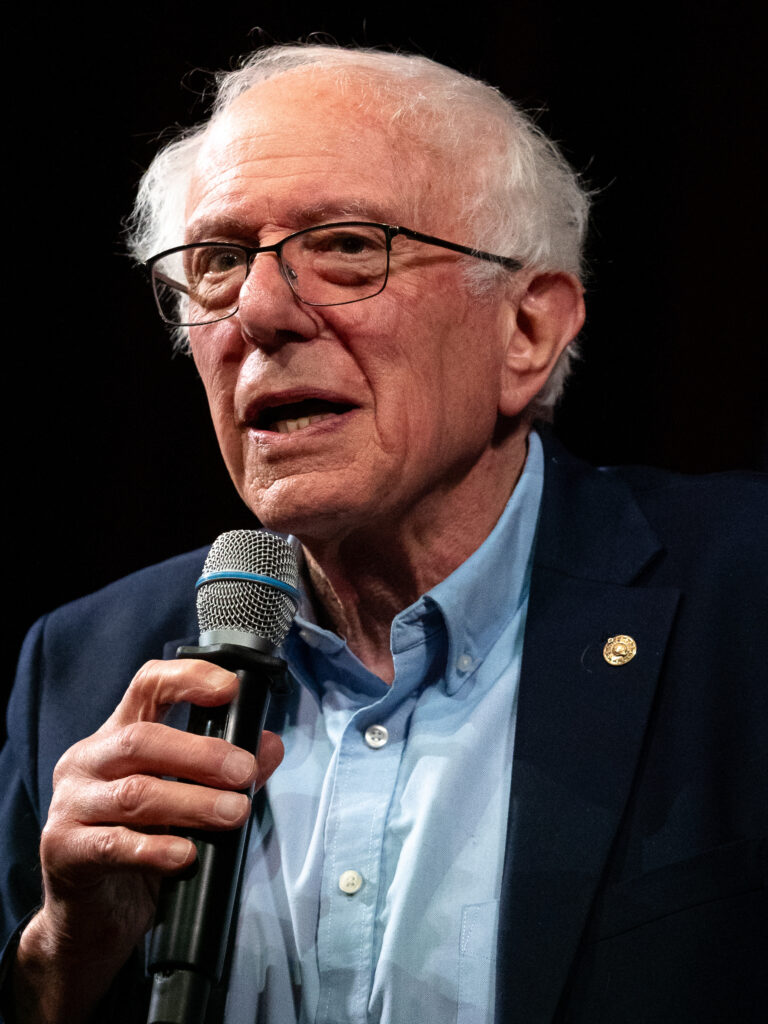
On September 30, 2026, Senator Bernie Sanders Voted to Block the Stop Insider Trading Act
On September 30, 2026, the U.S. Senate held Roll Call Vote #253 during the 119th Congress, 2nd session. This was a cloture vote on the motion to proceed to H.R. 7008, the “Stop Insider Trading Act.”
Cloture requires 60 votes to succeed. The vote failed 53-47, with all 53 yes votes coming from Republicans and all 47 no votes coming from the Democratic caucus, including independents Angus King of Maine and Bernie Sanders of Vermont. Because cloture failed, the motion to proceed was blocked, and the bill did not advance to a final vote.
This procedural outcome means the Senate did not take up the bill for debate or amendment, effectively preventing it from moving forward at that time. It is important to describe this accurately: the bill was not rejected or voted down on final passage; rather, the Senate failed to invoke cloture, which is the threshold needed to end debate and allow a vote on the bill itself. The failure to reach 60 votes constituted a successful filibuster of the motion to proceed.
What the Senate Actually Voted On
H.R. 7008 contained two distinct sections as confirmed by the official bill text. Section 2 would restrict members of Congress, their spouses, and their dependents from trading individual stocks. It would also require a 7-day advance public notice of intent to sell any such holdings.
Section 3, titled “Requiring Voters to Provide Photo Identification,” would mandate that in-person voters in federal elections present valid physical photo identification at the polls, with narrow exceptions for religious objectors and uniformed or overseas voters. The bill paired a measure aimed at curbing potential conflicts of interest in congressional stock trading with a voter identification requirement. Senate Democratic leaders, including Chuck Schumer, stated they opposed the bill because the voter-ID section was a “poison pill” and argued that the stock-trading restrictions were too weak, describing them as “toothless.”
They contended that combining the two provisions made the bill unacceptable despite the popularity of each element individually. Supporters of the bill countered that Democrats could have voted to advance the measure and then sought to amend it to strengthen the stock-trading ban or address concerns about the voter-ID provision, rather than blocking it outright. They noted that both banning congressional stock trading and requiring photo ID to vote have consistently shown broad, bipartisan support in public opinion polls.
How Sanders Got to the Senate
Bernie Sanders became a U.S. Senator after serving as the mayor of Burlington, Vermont, and completing eight terms as an independent member of the U.S. House of Representatives.
He won the open Vermont Senate seat in 2006, defeating Republican Rich Tarrant by a margin of roughly 2-to-1. His victory was facilitated by the Democratic Senatorial Campaign Committee, then chaired by Chuck Schumer, which endorsed him and cleared the Democratic field to avoid splitting the vote. Sanders was first elected to the Senate in 2006 and, by September 30, 2026, had served four full terms.
He is not a new senator. In his most recent election, he won 63.16% of the vote against Republican Gerald Malloy, who received 32.07%, giving Sanders a margin of victory of +31.1 percentage points. Sanders caucuses with the Democratic Party and has served as chairman or ranking member of the Senate Health, Education, Labor, and Pensions (HELP) Committee.
He is a two-time Democratic presidential primary candidate, having run in 2016 and 2020, and has indicated that his current term is likely his last in the Senate.
Two Measures Americans Broadly Support
Public opinion polling shows strong and consistent support for both of the measures contained in H.R. 7008. Regarding the voter identification requirement in Section 3, multiple reputable polls have found broad public favor. Gallup, in a survey fielded from October 1 to October 12, 2024, and reported in a 2026 update, found that 84% of Americans favor requiring voters to show government-issued photo identification in order to vote.
The Pew Research Center, in a poll conducted from August 4 to August 10, 2025, reported that 83% of Americans favor requiring all voters to show government-issued photo ID in order to vote, with 16% opposed. The Monmouth University Polling Institute, in a survey fielded in June 2021 whose 80% support figure has been repeatedly cited through 2026, found that 80% of Americans support requiring voters to show photo identification in order to vote. These figures reflect the specific question about photo ID for voting and should not be conflated with other electoral reforms such as early voting or vote-by-mail.
On the separate issue of requiring proof of citizenship to vote, Rasmussen Reports found in an October 2024 survey that 68% of Americans favor such a requirement. Regarding the congressional stock-trading ban in Section 2, multiple national polls have consistently shown broad, bipartisan majorities in favor of prohibiting members of Congress from trading individual stocks, commonly reported at 70% or higher across various surveys. While no single unverified figure is attributed here, the consensus across polling data indicates substantial public support for this ethics reform.
Supporters of voter ID laws often argue that such requirements ensure only eligible citizens vote and point to the routine use of photo ID in everyday activities like banking or air travel as evidence of its reasonableness. Opponents, including voting rights advocates, contend that strict photo ID laws can create barriers to ballot access for certain groups, particularly minorities, elderly voters, and low-income individuals who may face challenges in obtaining the required documentation.
When Obstruction Replaces Representation
A senator’s duty is to serve the citizens who elected the government, not to obstruct it out of personal dislike for the president or partisan strategy. When Bernie Sanders joined 46 other Democratic-caucus senators in blocking cloture on H.R. 7008 on September 30, 2026, he voted against a bill that paired two reforms each supported by clear majorities of the American public. The polling data is unambiguous: 84% support for voter ID according to Gallup, 83% according to Pew, and 80% according to Monmouth, alongside widespread bipartisan backing for banning congressional stock trading.
By preventing the Senate from even debating this measure, Sanders chose to deny voters the opportunity to see their representatives act on reforms they consistently say they want. This was not a nuanced policy disagreement about legislative technique; it was a deliberate choice to uphold a procedural barrier that stopped a popular bill dead in its tracks. The claim that the stock-trading provisions were “too weak” does not negate the fact that advancing the bill would have allowed for amendments to strengthen them—a path supporters noted was available but rejected.
Instead, the Democratic caucus opted to kill the entire effort, preserving the status quo on both fronts.
Term limits would stop voters from being stuck for decades with officials who put party spite ahead of the public, and Sanders’ long tenure underscores why such a reform is increasingly seen as necessary. Having served since 2006 and indicating this term is likely his last, Sanders has spent two decades in the Senate—a period during which public frustration with congressional ethics and election integrity has grown, not diminished. Yet on this vote, he aligned with a caucus that blocked a modest step toward addressing both concerns.
The argument that blocking the bill was justified because of its voter-ID section ignores the reality that the bill could have been improved through the amendment process had it proceeded. Choosing filibuster over amendment when faced with a bill containing two popular elements is not a defense of principle; it is a prioritization of partisan control over policy outcome. When a senator refuses to allow a vote on measures the electorate clearly supports, they are not exercising independent judgment—they are substituting their own political calculation for the expressed will of the people who sent them to Washington.
Blocking a ban on their own stock trading is a plain conflict of interest—lawmakers guarding their ability to trade on information the public does not have. While no specific allegation of wrongdoing has been made against Senator Sanders in the verified record, the act of voting to prevent even the consideration of a ban on congressional stock trading raises unavoidable questions about self-interest. Senators routinely access non-public information through briefings, committee work, and legislative deliberations that could inform trading decisions.
A ban on individual stock trading for members of Congress, their spouses, and dependents is designed precisely to eliminate the appearance or possibility of profiting from such access. By helping to block cloture on a bill that would have imposed this restriction, Sanders participated in a decision that leaves in place the current system, which allows lawmakers to trade stocks while in office. Critics across the political spectrum have long criticized this practice as incompatible with public trust, regardless of whether any individual senator has been charged with misconduct.
To vote against advancing a ban on this practice is to vote in favor of maintaining a privilege that creates a clear divergence between the financial interests of legislators and the ethical expectations of their constituents.
The Public’s Will Is Clear, and Voters Will Remember
The polls make the public’s will unmistakable: Americans broadly support requiring photo ID to vote and overwhelmingly favor banning members of Congress from trading individual stocks. On September 30, 2026, Senator Bernie Sanders voted to prevent the Senate from even considering a bill that would have advanced both of these reforms. By joining the Democratic caucus in blocking cloture on H.R. 7008, he chose to uphold a procedural obstruction that denied the Senate the chance to debate, amend, or vote on measures that reflect the consistent preferences of the electorate.
This was not a vote on the bill’s final form; it was a vote to stop the process before it could begin. Voters who believe in election integrity and congressional accountability will recall which senators stood in the way of progress on these issues when they next have the opportunity to render judgment at the ballot box. The decision to block a bill pairing two widely supported reforms will not be forgotten by those who see it as a refusal to honor the mandate of public opinion in favor of partisan gamesmanship or personal privilege.




