
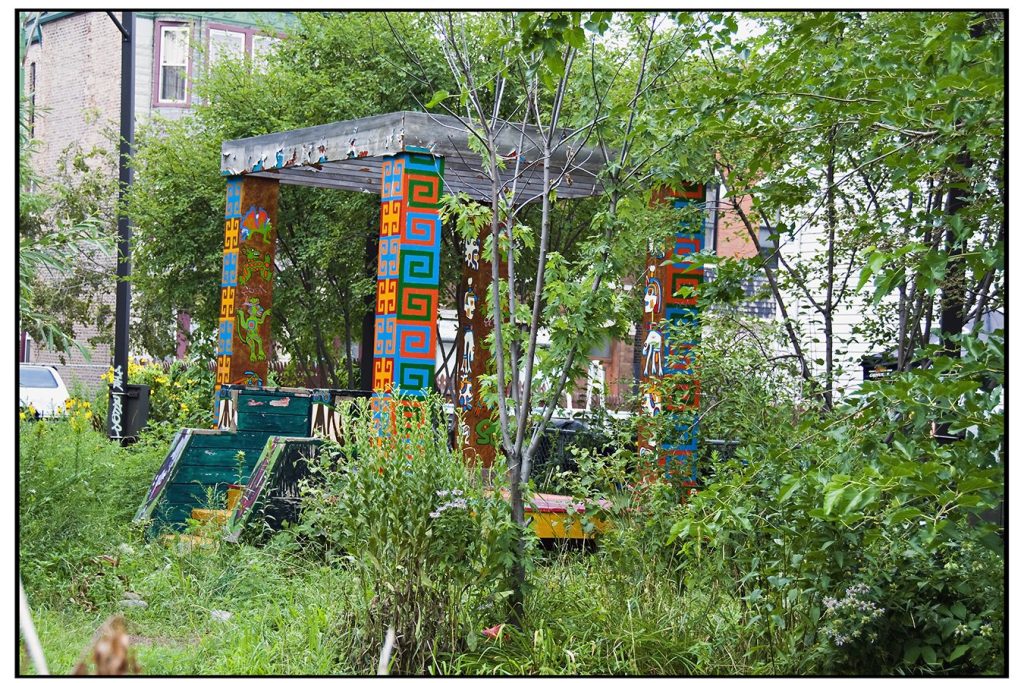
On the ground in Austin, on Chicago’s West Side, a rectangle of green the size of five city lots sits ringed by two churches, a firehouse, a home for seniors, the local town hall, a library and the high school. A gazebo stands at its center under a hand-painted sign reading “Harambee! Gardens.” Beds of vegetables and fruit soak up the sun; goats from a nearby farm rest in the shade. The scene, as described in an on-the-ground account published in early 2022, replaced a lot that had sat empty for over 25 years.
The garden’s co-founder, Seamus Ford, came to it sideways. In 2008, the Austin resident and special project manager grew worried about fossil fuel inputs in food. “When fuel prices were going through the roof, it started to get really clear to me that there’s a change underway, and it could be a bad one if we don’t have answers to this,” Ford recalled. He ripped out most of his own grass for raised beds, then kept passing a vacant lot until, in his word, he felt a “siren call” to build something bigger. He got the owner’s permission and co-founded Root-Riot, a network meant to grow local food, build resilience and reknit community, as its mission line puts it, “growing local food, fostering resilience, and reweaving the fabric of our community, one planting bed at a time.”
A Student Walked Across The Street
In late spring 2010, while Ford mowed the overgrown lot, Deandre Robinson, a junior at the time at Frederick Douglass Academy High School, crossed the street to ask what he was doing. Students and teachers had been debating that same lot for years. “His face lit up so bright,” Ford said of the meeting. The collaboration became Harambee, named for the Swahili call meaning all pull together. Volunteers from the school mowed, prepped soil and built the first 30 raised beds; the count hit 58 the next year. Gardeners could rent a 4-by-8-foot bed at $40 per year, or $100 for a three-year stretch, a price that still held more than a decade on, with the money covering soil, compost, tools and the beds. Growers took food home or handed it to the firehouse, the senior home and neighbors.
The garden pulled the block’s institutions in with it. Churches ran Sunday school classes among the beds, the firehouse supplied water, and the library took a plot and built after-school programming around it. Senior residents, many of whom had grown up farming in the rural South before the Great Migration carried them north between 1916 and 1970, came out to teach. “Suddenly, [senior residents] were able to come out and teach people about how to do so many different things: growing a tomato plant to growing okra, how to manage your soil,” Ford said. “Some people couldn’t walk, and they’d just sit in motorized scooters on the sidewalk giving instructions to the kids.”
The Grind Behind The Green
Keeping it alive was the harder story. Invasive bindweed nearly choked the garden; the original wooden beds rotted into cinder-block replacements set on gravel, installed after the land trust NeighborSpace bought and protected the site in 2019 and later added an underground water system. The stakes were real: a national survey cited in the reporting found just 32.3% of community gardens last beyond a decade, with lost interest the most common killer, even as more than 29,000 plots spread across the 100 largest US cities and Chicago alone counted nearly 32,000 vacant lots as candidates.
Robinson, who went on to become a petty officer in the Navy, credited the garden with shaping his work ethic and his answer to anyone who asks where he is from. “I’m never embarrassed. I’m very prideful, because a lot of the time, they don’t know us. … They don’t know our situation, our struggles,” he said. As of the 2022 account, roughly 30 gardeners kept Harambee going and were weighing a steering committee to draw more Austin residents in. “The space belongs to everybody,” Ford said. “This isn’t a club. This is just a facility for the community.”
Sources
- Global Gardens Urban Agriculture in Chicago: Transforming Vacant Lots and Empowering Communities – Urban Gardening Guru
- The Urban Farms Growing Community in Vacant Chicago Lots | Civil Eats
Sources
- Englewood Gardens of Opportunity and Peace | Transforming Vacant…
- From Vacant Lots to Gardens of Resistance




