
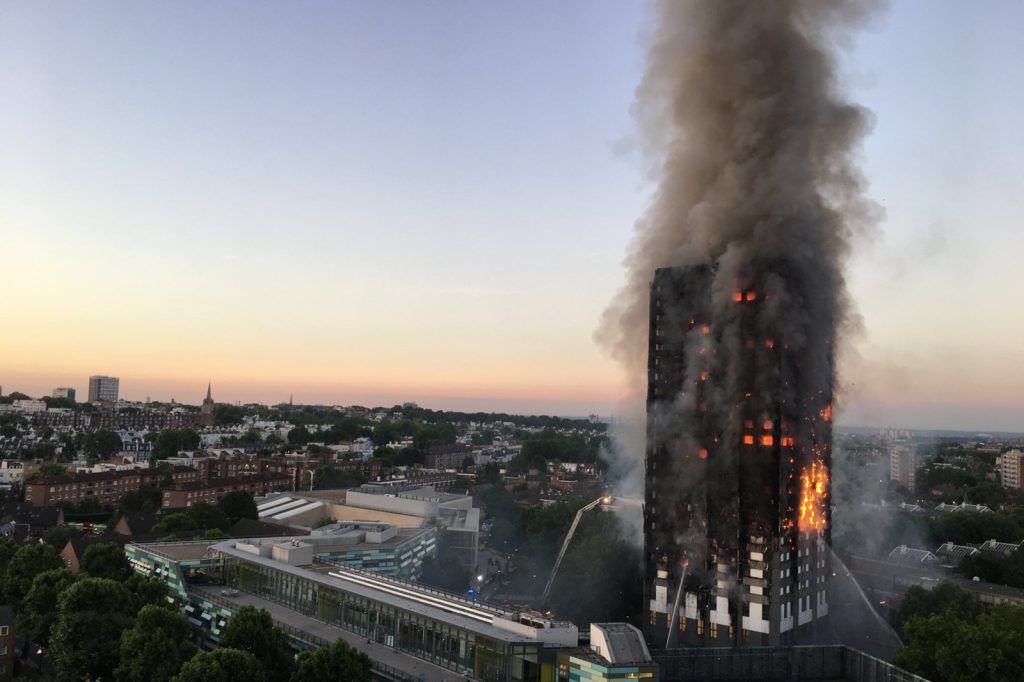
“As we all know, the ACM will be gone rather quickly in a fire!” Daniel Anketell-Jones, a facade engineer at Harley, wrote that to his managing director, Ray Bailey, on 27 March 2015. The cladding he meant went on to wrap Grenfell Tower, and 72 people died in the fire there more than two years later.
The email was disclosed to the public inquiry on the second day of its second phase, according to The Guardian. It was one of several showing that the architect, builders and fire engineer on the refurbishment had discussed how the system was likely to fail. Staff at the architecture firm Studio E, the fire engineer Exova, the facade installer Harley and the main contractor, Rydon, were all part of the exchanges.
Craig Orr QC, counsel for Celotex, the maker of Grenfell’s insulation, put the correspondence before the inquiry.
The Emails
Four days after Anketell-Jones wrote, Terry Ashton of Exova emailed Neil Crawford at Studio E. “It is difficult to see how a firestop would stay in place in the event of a fire where external flaming occurred as this would cause the zinc cladding to fail,” he wrote. Crawford answered: “Metal cladding always burns and falls off.”
Tony Pearson, also of Exova, wrote to Ashton the same day. If significant flames were ejected from the windows, he said, the cladding system would fail, with its outer surface falling away and exposing the cavity. In a fourth email Crawford brought in Simon Lawrence at Rydon.
“Each of Harley, Studio E, Exova and Rydon was openly acknowledging in these emails that the cladding would fail in the event of a fire with external flaming,” Orr told the hearing. “That, tragically, is what happened.”
Cost Cuts and Blame
Bereaved relatives and survivors sat in the room, among them Nicholas Burton, who lost his wife, Pily, and Antonio Roncalato, who was not rescued until 6am. The inquiry also heard that the Arconic panels, which had a flammable polyethylene core, were chosen in 2014 to help cut £454,000 from the budget. The Kensington and Chelsea Tenants’ Management organisation, which ran the 120-home council block for the Royal Borough of Kensington and Chelsea, made that choice.
The companies have repeatedly pointed at one another and at the system for testing fire safety of materials. Richard Millett, counsel to the inquiry, has called this a “merry-go-round of buck-passing,” and it carried on Tuesday. Arconic said it was not its responsibility “to decide if the product was appropriate to use on a particular project or in a particular configuration.” Celotex said its insulation was sold as combustible and that its use came down to “a myriad of failings on behalf of the designers, contractors, consultants and building control inspectors.” Both insisted they were describing how responsibility is split in construction, not shifting blame.
Arconic did not address, in its opening submission, the first-phase conclusion that its panels were the main cause of fire spread. Stephen Hockman QC, its counsel, said he would “resist the temptation” to comment on emails disclosed on Monday. Those showed staff fearing before the fire that the panels were “unsuitable for use on building facades” when folded into cassettes, as at Grenfell. The panels carried a fire rating of E when B was the minimum required for a facade in Europe. In 2015 staff warned they were “dangerous on facades” and said safety certifications were often “obtained largely for marketing purposes.”
Hockman said the panels could achieve class B but that this was not always guaranteed. Harley told the inquiry it had placed its confidence in the performance certificates.




