
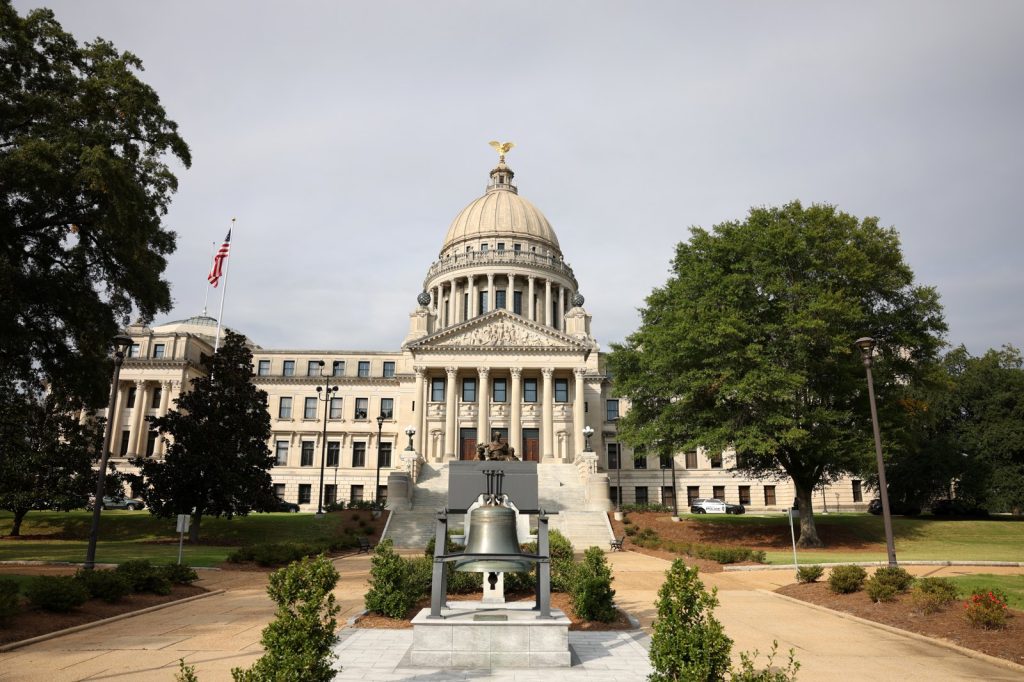
Chants of “Leave our maps alone” bounced through the Mississippi Capitol on Oct. 1, 2026, as the last of eight public redistricting hearings drew a crowd that spilled into an overflow area.
The Jackson session closed a series that had started in August, moving through north Mississippi, the Delta, east Mississippi and the Gulf Coast. Speaker after speaker attacked the Republican push to redraw electoral lines as an effort to shrink Black political influence and reinforce GOP control.
Republicans already run the Legislature and hold three of the state’s four U.S. House seats. A new map could stretch that advantage further.
Opponents filled most of the room. Some carried posters and megaphones; others wore shirts printed with “I FIGHT FOR VOTING RIGHTS.” A smaller group of supporters, wearing the Mississippi Federation of Republican Women’s red blazers, took seats in the front row.
The panel that listened is chosen by legislative leaders and stacked with 16 Republicans and four Democrats. All but one Republican are white; all four Democrats are Black.
Walter Boone, a Jackson resident, told the panel not to repeat what he called “the Mississippi Plan 2.0.” He said the push’s backers claim to stand on “race neutrality,” but Mississippi has used race-neutral laws to inflict precisely the opposite. No matter how neutral the wording, Boone said, Black Mississippians will not be represented fairly, and that is the destination.
House Democratic Leader Robert Johnson of Natchez sat among a large group of Democratic lawmakers.
Republican State Auditor Shad White went first. He said he had heard that lawmakers might leave congressional maps out of a special session expected this fall, but he wanted them to act later and target Rep. Bennie Thompson, the only Black member of Mississippi’s congressional delegation and its only Democrat.
White said the Delta has sat at the bottom of too many rankings for too long. He argued it deserved different leadership than Thompson and that a “silent majority” wanted better representation for the region.
The hearing room erupted. Republican Sen. Dean Kirby, the committee chairman, threatened to shut it down.
As White moved toward the door, Johnson rose and asked whether the rules allowed speakers to attack another person. Johnson said White told him the Delta needed better leadership, and Johnson answered that White had “failed us as state auditor.” White came back that he was the “best auditor Mississippi has ever had.”
They pointed fingers at each other. Johnson accused White of chasing “poor city clerks” rather than recovering money wasted by state officials. Then, Johnson said, White “clipclopped away.”
White, who is seen as a likely Republican gubernatorial candidate, said he showed up because none of his potential rivals did. He said he needed the committee to hear that the activists in the room did not speak for everyone in the state, even though they hurled insults and maybe a couple of four-letter words.
Brooke Floyd, also from Jackson, linked the redistricting drive to the state’s deeper inequalities. Her grandfather had been a prominent Black educator during Jim Crow, then became a doorman at the state House after integration.
For Floyd, erasing Black political power explains why Mississippi stays among the poorest states while refusing to raise the minimum wage, and why Black maternal and infant mortality remain high.
Supporters of new lines argued the opposite. Connie Davis of Rankin County said maps drawn to meet “racial targets” should be redrawn. Government, she said, must treat people as individuals rather than racial categories, and the law should apply to everyone without favor. She called the constitution colorblind.
Before the hearing, an ACLU-organized rally filled the lawn outside the Mississippi Supreme Court Building. Signs read “NO JIM CROW MAPS.” Amir Badat, the Southern states director for Fair Fight, said the crowds who turned out across the state expected to be heard.
Seconds before protesters with megaphones reached the Capitol lobby, Kirby slipped into an elevator and stayed out of sight until the session began.
The state’s redistricting effort follows the U.S. Supreme Court’s Callais decision. That ruling stripped protection from majority-minority districts and gave legislatures room to redraw lines for partisan gain.
The full Legislature is expected to meet in a special session this fall to redraw at least its own state legislative districts. That work would not touch this November’s federal election, but lawmakers could later target Thompson’s seat before his 2028 reelection.
Nancy Loome, president of The Parents’ Campaign, said in a statement that earlier redraws produced heavily gerrymandered districts favoring one party, making general elections less meaningful and primary races decisive.
After nearly three hours, Mississippi Today asked Kirby how the testimony might shape the committee’s next move. He said he appreciated the comments and, in his words, “We came to listen, and we did.” The committee, he added, will follow what the courts order.
Sources
- No Jim Crow Maps in Mississippi; there’s no reason for lawmakers to rush to capitol to draw maps that give Black voters less representation – ACLU of Mississippi
- Fiery Crowd Caps Mississippi Redistricting Hearings. Opponents Urge: ‘Leave Our Maps Alone’




