
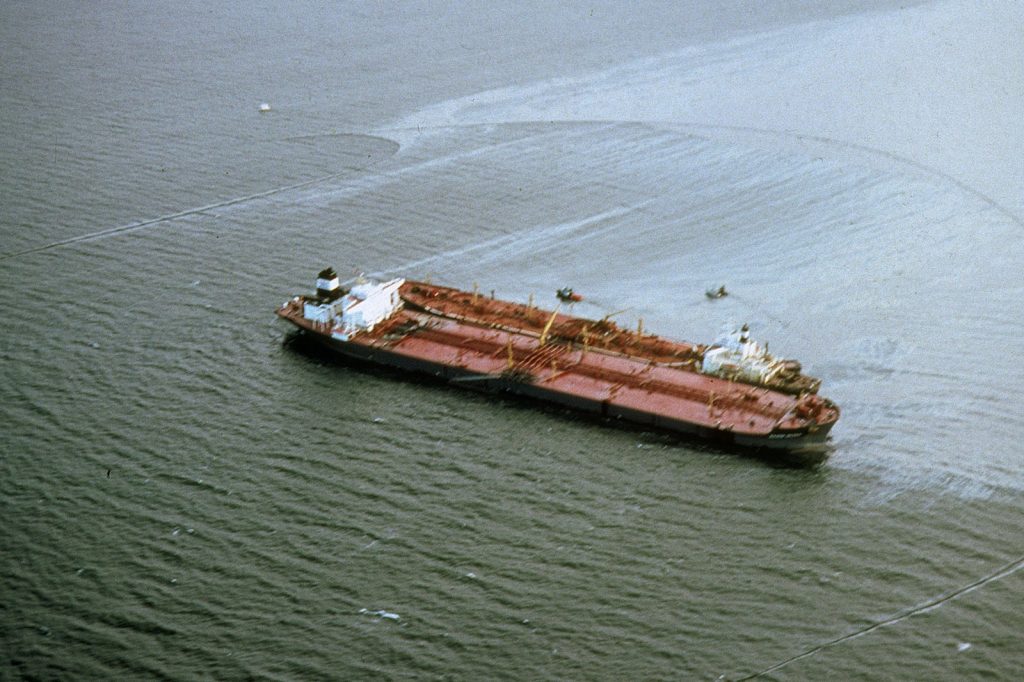
Oil kept pouring out of the Exxon Valdez for three hours and 15 minutes after it ran onto Bligh Reef. In that time 5.8 million gallons drained from the ship. Eight of its 11 cargo holds had been punctured.
The grounding came at 12:04 a.m. on March 24, 1989, in Alaska’s Prince William Sound, about 6 miles west of Tatitlek. The tanker, owned by Exxon Shipping Company and bound for Long Beach, California, was carrying 53.1 million gallons of crude from the Prudhoe Bay field. Roughly 10.8 million gallons went into the water. It remains the second largest spill in U.S. waters by volume, after Deepwater Horizon in 2010, and the costliest disaster of its kind with no direct human deaths.
A bridge with one officer
The ship left the Valdez Marine Terminal at 9:12 p.m. on March 23. Captain Joseph Hazelwood went to his cabin shortly afterward. After the harbor pilot left the bridge at 11:24 p.m., the captain was called up, then moved the ship out of the traffic lane to dodge small icebergs from the nearby Columbia Glacier, set it on autopilot, and went back to his stateroom. Third Mate Gregory Cousins stayed in charge. He had been on duty six hours, and he was reluctant to wake the second mate, who had already worked long hours. That left Cousins as the only officer on the bridge for most of the night, against company policy.
Around midnight he began steering back toward the lanes. The lookout reported the Bligh Reef light far off the starboard bow when it should have been off the port side. Cousins ordered a course change and phoned the captain. The ship grounded before they finished talking. The helmsman described “a bumpy ride,” Cousins “six very sharp jolts.”
Investigators later listed several causes. Exxon Shipping failed to supervise the captain or provide a rested and sufficient crew, a practice the NTSB found widespread in the industry. The third mate failed to maneuver properly, possibly from fatigue or overwork. One further claim, made by Greg Palast and absent from the official accident report, is that Exxon let the ship’s radar fall into disrepair. Other factors included the Coast Guard ending its practice of tracking ships out to Bligh Reef without telling them, missing iceberg monitoring equipment the industry had promised, and Coast Guard inspections at Valdez that were skipped as staff was cut.
Blame and trial
Hazelwood was widely reported to have been drinking heavily in a Valdez bar earlier that evening. Exxon blamed him and fired him, though he was not at the controls. He accused the company of making him a scapegoat. In a 1990 trial he was cleared of criminal mischief, reckless endangerment and piloting a vessel while intoxicated, and convicted only of misdemeanor negligent discharge of oil. Twenty-one witnesses testified that he did not appear to be under the influence around the time of the accident. In 2009 he offered what he called a “heartfelt apology” to Alaskans.
The cleanup
The response struggled from the start. Prince William Sound is reachable only by helicopter, plane or boat, which made existing response plans hard to carry out. A private company applied chemical dispersant by helicopter on March 24 but missed the target area. Landowners, fishing groups and conservation organizations questioned using chemicals on hundreds of miles of shoreline. Mechanical cleanup with booms and skimmers began soon after, but skimmers were not readily available in the first 24 hours, and thick oil and kelp clogged the equipment. High-pressure hot water was used on rocky coves, which also destroyed microbial populations at the shoreline.
More than 11,000 Alaska residents, along with some Exxon employees, worked on the cleanup. Only about 10 percent of the oil was completely cleaned up. Valdez Mayor John Devens said his community felt betrayed by Exxon’s inadequate response.
What it left behind
The oil eventually touched 1,300 miles of coastline, 200 miles of it heavily or moderately oiled. Between 100,000 and 250,000 seabirds died, along with at least 2,800 sea otters, about 300 harbor seals, 247 bald eagles and 22 orcas. Nine years later, damage was still evident in cormorants, goldeneyes, mergansers, murres and pigeon guillemots. By 2001 about 90 tonnes of oil remained in the sandy soil of Prince William Sound beaches, and the area of oiled beach had changed little since 1992.
The disaster led the International Maritime Organization to introduce comprehensive marine pollution prevention rules under MARPOL.




