
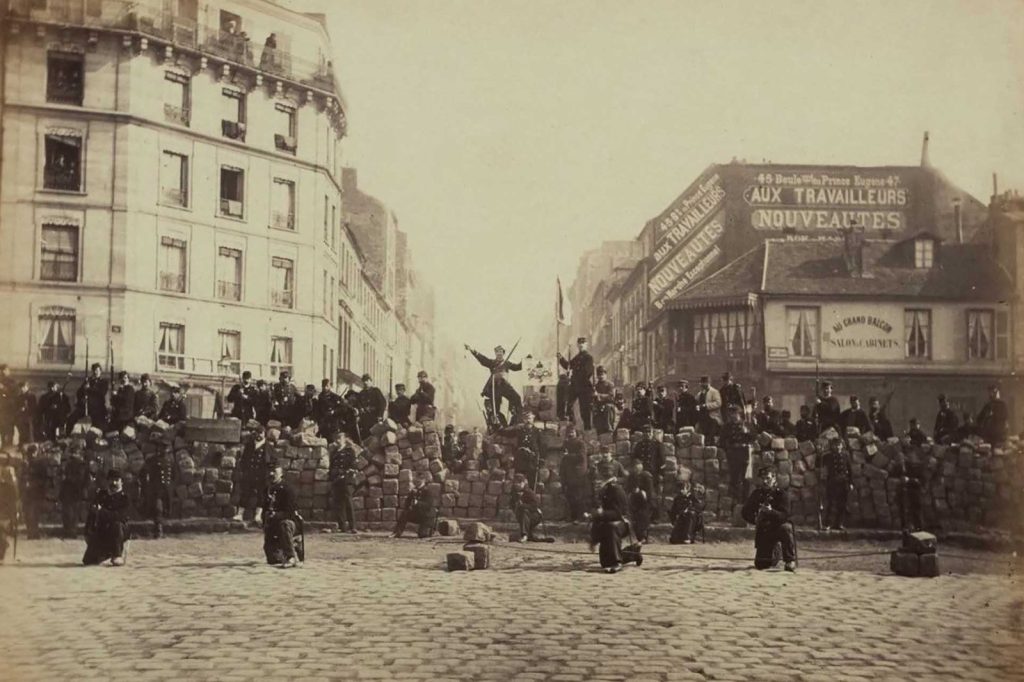
In 1860 the ethnologist Adolf Bastian put a name on a field that did not yet exist: political psychology. The name turned up in his book Man in History. The work came later, and it came from France, where the discipline was formally introduced during the Franco-Prussian war and the socialist uprising of the Paris Commune in 1871.
The philosopher Hippolyte Taine, a founder of the Ecole Libre de Sciences Politiques, took Bastian’s theories and applied them to the founding and growth of the Third Republic in The Origins of Contemporary France, published between 1875 and 1893. Émile Boutmy, who later ran the school, wrote two national portraits: English People; A study of their Political Psychology in 1901 and The American People; Elements of Their Political Psychology in 1902.
Crowds and ruling classes
Gustave Le Bon went after the crowd. In Psychology of Socialism (1896) and Political Psychology and Social Defense (1910) he argued that crowd activity subdued will and polluted rational thought, leaving people at the mercy of impulse and emotion. A crowd, he said, made people easier to lead and easier to bring to submission. His cure was nationalism.
Italy had its own argument. The Risorgimento of 1870 brought social reforms and voting rights, and it also exposed a wide gulf between classes. The lawyer Gaetano Mosca answered with The Ruling Class: Elements of Political Science (1896), which held that every society has a ruling class and a ruled one. Vilfredo Pareto picked up the idea in The Rise and Fall of the Elites (1901) and The Socialist System (1902-1903). His The Mind and Society (1916) is a sociology treatise.
Robert Michels, a German socialist, took both further. He had noticed that Germany’s parliament was largely run by the lower classes while Italy’s was run by the upper class, and he wrote Political Parties: A Sociological Study of the Oligarchic Tendencies of Modern Democracy in 1911.
Freud, fascism and the survey
Sigmund Freud tied psychoanalysis to politics in Totem and Taboo (1913) and Group Psychology and the Analysis of the Ego (1921). Freud and William Bullitt later produced, in 1967, the first psycho-biographical study of how President Woodrow Wilson’s personality shaped his decisions in World War I. Wilhelm Reich blended Freud with Marx in The Mass Psychology of Fascism (1933), and edited the Journal for Political Psychology and Sexual Economy from 1934 to 1938.
Fascism pushed the Frankfurt School toward authoritarianism. Herbert Marcuse raised questions of freedom and authority in Reason and Revolution (1941). Theodor Adorno’s The Authoritarian Personality (1950) tried to pin down the type of person drawn to fascism and anti-democratic propaganda.
Britain moved in the early 1900s. Oxford and Cambridge introduced courses such as “The Sciences of the Man”, and the historian George Grundy named political psychology a sub-discipline of history in 1917. Graham Wallas argued in Human Nature in Politics (1908) that politicians and the public should understand psychological processes, partly so they could spot exploitation.
In the United States, Harold Lasswell is considered the first political psychologist. His Propaganda Technique in the World War (1927) examined how psychological theory could sharpen propaganda; Psychopathology and Politics followed in 1930.
Then came the numbers. Thurstone and Chave’s “The Measurement of Attitude” (1929) brought psychometrics into the picture, and the field gained quantitative footing and, with it, credibility. George Gallup founded the American Institute of Public Opinion. In the 1940 election, Gallup, Roper and Crossley studied Roosevelt’s chances of re-election, and Lazarsfeld, Berelson and Gaudet ran a panel study, The People’s Choice, in 1944. When the U.S. entered World War II, the Army and Navy recruited young psychologists, and the field spread internationally.
Three phases, five traits
The psychologist William McGuire divides the field’s history into three phases. The first, in the 1940s and 1950s, centred on personality and psychoanalysis. The second, in the 1960s and 1970s, studied political attitudes and voting behaviour under the assumption of a “rational man”. Since the 1980s and 1990s, researchers have concentrated on beliefs, information processing and decision making, with a strong interest in international politics.
Personality work leans on psychoanalytic, trait-based and motive-based theories. The trait model now most recognised is the “Big Five” of Costa and McCrae (1992): neuroticism, extraversion, agreeableness, openness to experience and conscientiousness. The catch is how much weight any one trait carries. Theories hold that a mix of the five bears on leadership style, and that highly extraverted people show better leadership skills.
The field’s reach is wide. It has been applied to leadership, domestic and foreign policy making, ethnic violence, war and genocide, group conflict, racist behaviour, voting, the role of media in voting, nationalism and political extremism. It borrows from anthropology, economics, history, international relations, journalism, media studies, philosophy, political science, psychology and sociology.




