
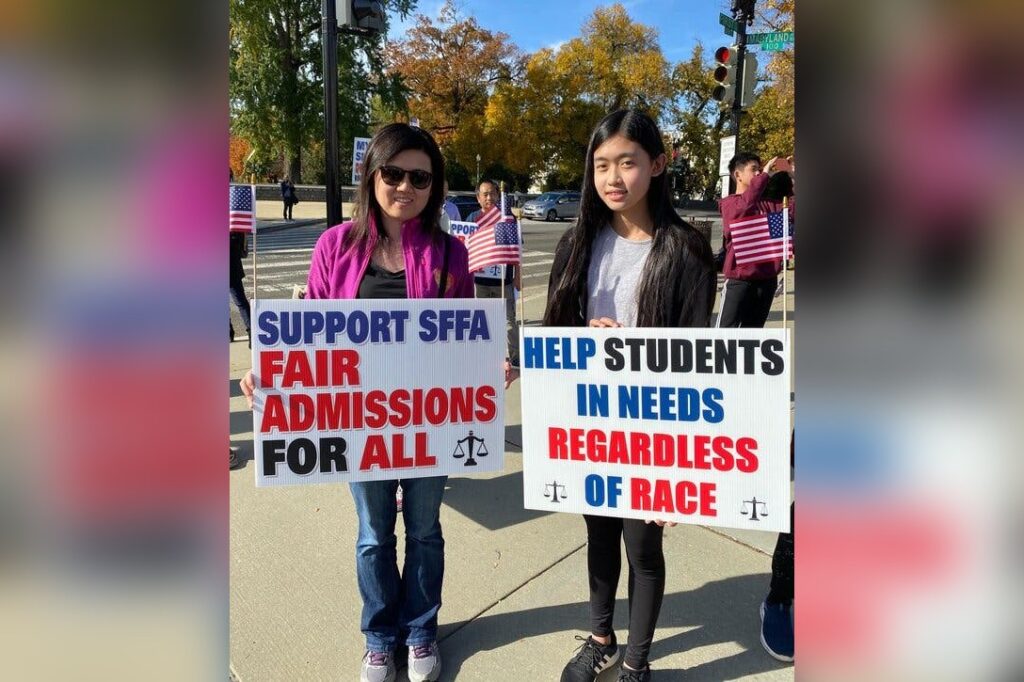
Nine states have banned affirmative action in employment. One ruling, in 2023, banned it in college admissions for the whole country.
That ruling was Students for Fair Admissions v. Harvard. A Supreme Court majority held that race-based affirmative action in college admissions violates the Equal Protection Clause of the Fourteenth Amendment, and concurring opinions pointed to Title VI of the Civil Rights Act as well. It was the third major case on the subject.
The earlier rulings
In Regents of the University of California v. Bakke in 1978, the Court ruled racial quotas unconstitutional. In Grutter v. Bollinger in 2003 it partially upheld affirmative action, allowing race as one factor in admissions. The 2023 decision ended that for colleges.
The policy has older roots. President John F. Kennedy’s Executive Order 10925 in 1961 required government contractors to take “affirmative action” so that applicants and employees were treated without regard to race, creed, color or national origin. The Civil Rights Act of 1964 prohibited racial discrimination in firms with more than 25 employees. The Revised Philadelphia Plan in 1969 was the first federal race-conscious policy, and it required certain contractors to set “goals and timetables” for diversifying their workforces.
What replaced quotas was a set of targeted goals: outreach campaigns, recruitment, employee development and support programs. Many colleges adopted recruitment policies of their own accord. As of 2024, the term affirmative action has increasingly given way to diversity, equity and inclusion.
State bans came first
Several states had acted well before the Court did. California banned the practice in 1996, Washington in 1998 (rescinded in 2022), Florida in 1999, Michigan in 2006, Nebraska in 2008, Arizona in 2010, New Hampshire and Oklahoma in 2012, and Idaho in 2020. Florida’s came by executive order, New Hampshire’s and Idaho’s by the legislature, and the other six by ballot.
The Fifth Circuit’s 1996 decision in Hopwood v. Texas had effectively barred the practice in Louisiana, Mississippi and Texas until Grutter overturned it in 2003.
Supporters argue the policies promote equality and representation and offset continuing bias, pointing to studies in which job seekers with African American sounding names were less likely to get callbacks. Opponents call them discrimination against groups such as Asian Americans and white Americans, and say many believe the diversity of American society shows the policies worked and are no longer needed.




