
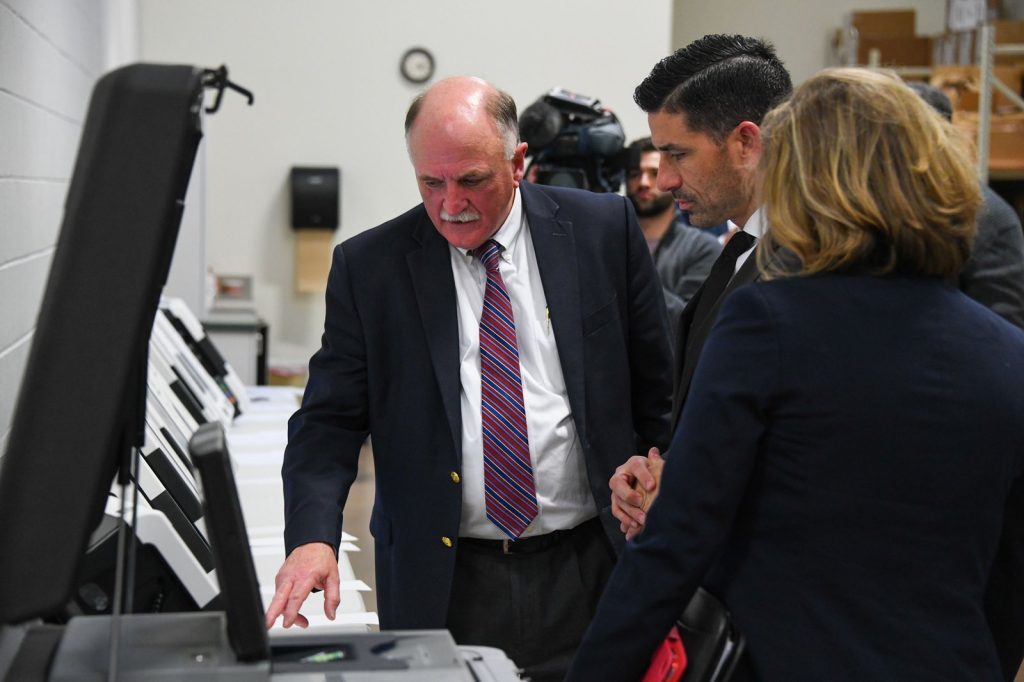
More than $39.6 million in election security money sits unspent at the Department of Homeland Security, eight weeks before the midterm ballots are cast. Congress directed the funds in the fiscal 2026 DHS Appropriations bill, passed in April.
Sen. Alex Padilla of California and Rep. Joseph Morelle of New York, the top Democrats on the Senate and House committees with jurisdiction over federal elections, wrote to DHS Secretary Markwayne Mullin and Nick Anderson, acting director of the Cybersecurity and Infrastructure Security Agency, on Wednesday. They demanded the money go out as directed. Their letter voiced “grave concern that time is running out” to help state and local election officials guard against cyber and disinformation threats.
The warning has weight behind it. The head of U.S. Cyber Command and the National Security Agency told Congress on April 29 that it is reasonable to expect foreign adversaries to try to interfere in the 2026 midterms.
A legal obligation
Under the Impoundment Control Act of 1974, a president who holds back appropriated funds must formally notify Congress, and the Government Accountability Office can compel spending. The administration has not publicly submitted a rescission request for this money. Padilla and Morelle argued that releasing it is a legal obligation, not a political choice.
What was lost
The fight sits on top of larger cuts that began in early 2025. The Election Infrastructure Information Sharing and Analysis Center, known as EI-ISAC, was the only federally funded security operations center built for election offices. Before its federal funding ended in March 2025, it ran a 24-hour monitoring center, used an intrusion detection system called Albert designed for state and local networks, and blocked malicious domains aimed at voter registration databases and results websites. Any of the more than 8,800 election offices could use it free.
When CISA ended its ten-million-dollar cooperative agreement with the Center for Internet Security, the center moved to paid membership. Large cities and states absorbed the cost. Rural counties and small municipalities, with the least IT capacity, found the fees prohibitive.
“The federal government has pulled the rug out from under the state and local election officials who came to rely on the excellent services provided by the EI-ISAC at no cost because of the federal support,” Maine Secretary of State Shenna Bellows said at the time.
CISA’s Election Security Program was eliminated entirely. It had 14 specialists and a budget of about $39.6 million, the same figure Padilla and Morelle now want released. The agency’s workforce fell from roughly 3,400 to about 2,500, and as of June 2026 only 2,324 of its 3,292 positions were filled. Five of its ten regional directors are serving in acting roles.
Officials on the ground
Arizona Secretary of State Adrian Fontes said his office did not ask CISA for help after a 2025 Iranian intrusion defaced the state’s candidate portal, because the agency had gone quiet since the cuts. Minnesota Secretary of State Steve Simon said: “We do not have a sense of whether we can rely on CISA for these services as we approach a big election year in 2026.”
Sen. Mark Warner, the top Democrat on the Senate Intelligence Committee, wrote to Mullin in May asking for an accounting of CISA’s capacity to warn officials about foreign influence campaigns. A House Administration subcommittee held an election security hearing on May 20, and every witness agreed the federal government is not doing enough.
Mullin was confirmed 54-45 on March 24, 2026. At his confirmation hearing he named “efficiency, accountability, and coordination” as priorities, but made no specific commitment on election security funding or CISA staffing.




