
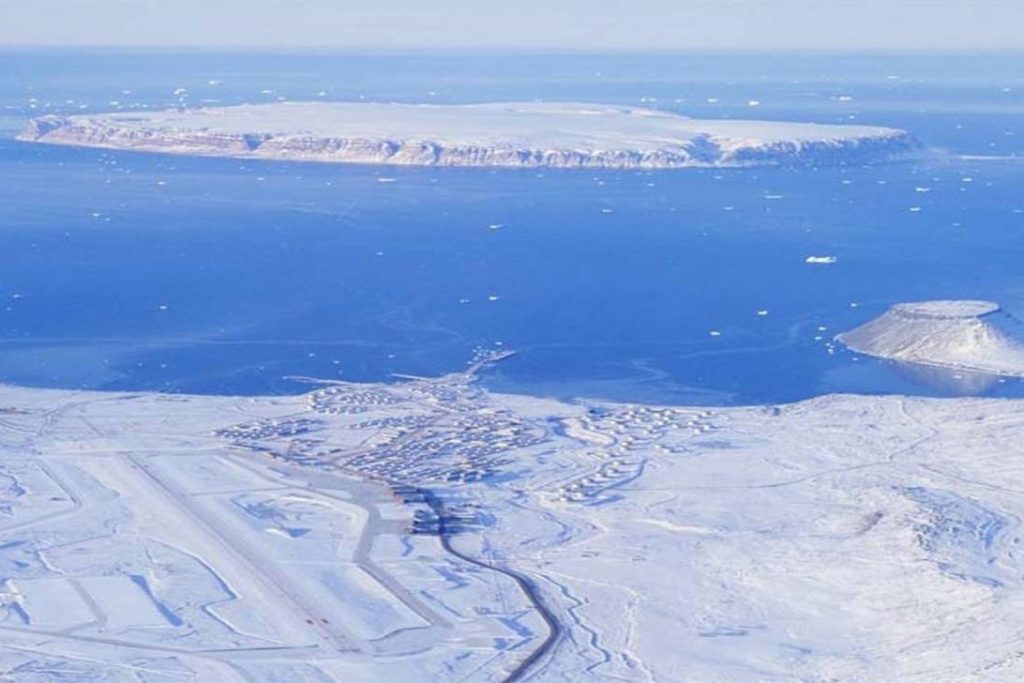
NUUK, September 18 — President Donald Trump said a deal had been struck to give the United States security control over Greenland, according to CBC News, a claim that lands with no treaty text, no named signatories, and no confirmation from either Copenhagen or Nuuk. The remarks were made in public. They assert an arrangement granting Washington security authority over the Danish autonomous territory, which hosts the U.S. military’s northernmost installation, Pituffik Space Base, formerly Thule Air Base.
The CBC report carried no text of any agreement and no confirmation from Greenlandic or Danish authorities. That silence is the story.
Any change to Greenland’s security status would require agreement from Denmark and, in practice, consultation with Greenland’s government. Neither has moved.
The Legal Ground Under Pituffik
Greenland is the world’s largest island, an autonomous territory within the Kingdom of Denmark, with its capital at Nuuk. Under its 2009 Self-Government Act, Greenland controls most domestic affairs while Denmark retains authority over foreign policy and defense. The U.S. military presence there is not new.
Washington has maintained forces in Greenland since World War II, when it established bases to protect North Atlantic shipping and to serve as a refueling and weather-reporting hub. A 1951 defense agreement between the United States and Denmark, later updated, provides the legal framework for U.S. forces at Pituffik.
The CBC report did not specify whether Trump’s claim referred to an expansion of existing basing rights, a new defense pact, or another arrangement. Key figures in any such negotiation would include the Danish prime minister, Greenland’s premier, and U.S. defense officials.
Why the Island Sits at the Center of the Board
Greenland’s strategic value stems from its position between North America and Europe, its role in early-warning radar and missile-defense systems, and its mineral and rare-earth deposits. The island holds rare-earth elements, uranium, and other critical minerals, drawing interest from the United States, China, and other powers. The timing is not incidental.
Trump’s claim comes amid heightened great-power competition in the Arctic, where melting sea ice is opening new shipping routes and resource-access opportunities. Russia has expanded its Arctic military infrastructure.
China has pursued a “Polar Silk Road” initiative. The United States, Canada, Denmark, Norway, and Iceland are Arctic states. Greenland itself is small and dependent.
It has a population of roughly 56,000, mostly Inuit, and its economy relies heavily on fishing and Danish subsidies.
The 2019 Precedent
This is not the first time Trump has reached for Greenland. In 2019, during his first term, he publicly floated the idea of the United States purchasing the island. Danish Prime Minister Mette Frederiksen called the proposal “absurd,” and Greenlandic officials said the island was not for sale.
The episode caused a diplomatic rift and led Trump to cancel a planned state visit to Denmark. What followed was quieter.
In 2020, the Trump administration opened a consulate in Nuuk and announced a $12.1 million (about 80 million Danish kroner) aid package for Greenland. In 2021, Greenland’s government, then led by Mute Bourup Egede of the Inuit Ataqatigiit party, won elections on a platform that included eventual independence from Denmark, though no referendum date has been set. As of the CBC report, no formal announcement, treaty text, or joint statement from Copenhagen or Nuuk had been released.
The claim remains unconfirmed by the other parties. What to watch next is whether Washington produces a document — and whether Denmark and Greenland’s government acknowledge one.
Until both happen, the calculus in the Arctic remains unchanged on paper, whatever was said in public.




