
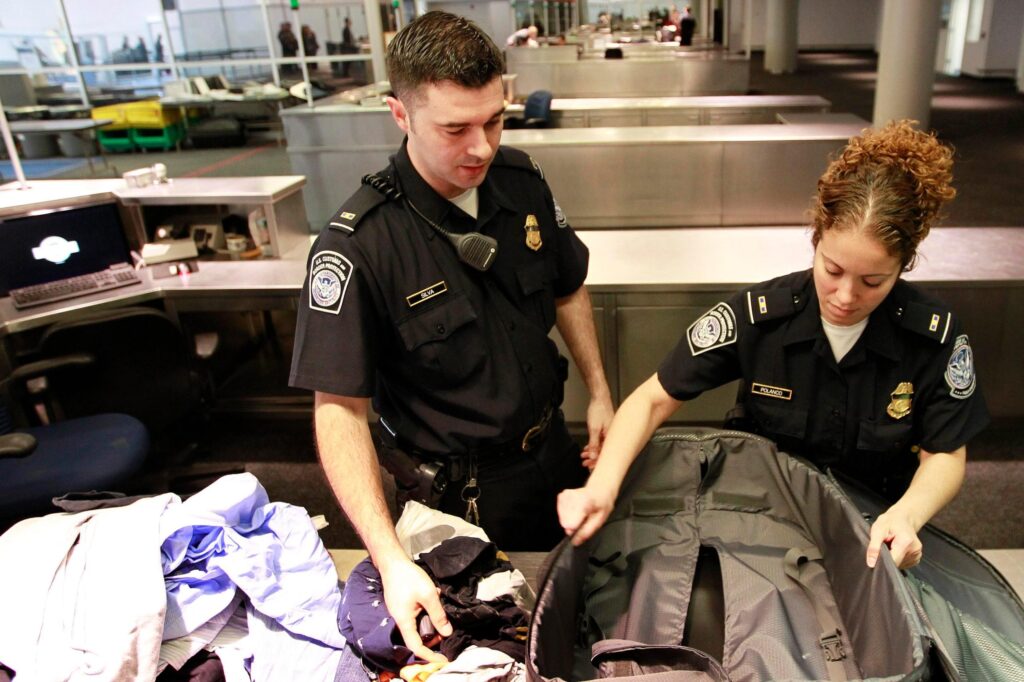
A traveler arrives at a U.S. port of entry with a suitcase, a laptop and a phone. A customs officer can open all three, with no warrant and no suspicion of wrongdoing. That is the border search exception, a doctrine in U.S. criminal law that allows searches and seizures at international borders, and their functional equivalent, without a warrant or probable cause.
It is not a carve-out from the Fourth Amendment as a whole. Courts treat it as an exception to the amendment’s warrant and probable-cause requirement. The Fourth Amendment balance between government interest and personal privacy is struck much more favorably toward the government at the border, so routine searches count as “reasonable” there.
A statute from 1789
Warrantless border searches first appeared in Section 24 of the Collection Act of 1789. In 1925, Carroll v. United States broadened the doctrine, allowing warrantless searches of automobiles where officers have reasonable or probable cause. Congress wrote the exception into federal law explicitly in the Immigration and Nationality Act of 1952.
The 100-mile zone came later. Federal law lets certain agents search within 100 miles (160 km) of the border, and the Supreme Court has confirmed the exception applies there. In United States v. Martinez-Fuerte, it held that Border Patrol stopping a vehicle at a permanent highway checkpoint away from the Mexican border for brief questioning fits the Fourth Amendment. Warrantless car searches by roving patrols, though, have been ruled unconstitutional.
Who can search, and what
Customs and Border Protection officers, Border Patrol agents, Homeland Security Investigations special agents and Coast Guard personnel at grade E4 and above can search travelers and their belongings at the border without probable cause or a warrant. Officers may search all closed containers without any suspicion, whatever their size and even if they hold personal, confidential or embarrassing material. Customs can also open incoming international mail.
In United States v. Camacho (2004), the Ninth Circuit ruled that radioactive scanning devices were reasonable in customs searches on the U.S.-Mexico border. The judges found the device posed no danger to the vehicle or its occupant.
Bodies are treated differently. Invasive searches of a person require reasonable suspicion. In United States v. Montoya de Hernandez, the Supreme Court held that holding a traveler beyond a routine inspection is justified if agents reasonably suspect she is smuggling contraband in her alimentary canal. The Court did not decide what level of suspicion a strip, body-cavity or involuntary X-ray search needs.
The phone problem
The main fight now is over cell phones and other electronic devices. In 2014, Riley v. California held that police violated the Fourth Amendment by searching an arrestee’s phone without a warrant. “Modern cell phones are not just another technological convenience,” the Court wrote.
The Supreme Court has not heard a border case on electronic devices. Three circuit courts have ruled on the issue, and all found warrantless, suspicionless border searches of electronics constitutional. None has extended Riley to the border.
In United States v. Cotterman (2013), the Ninth Circuit held that computers can be searched without a warrant or suspicion, but that reasonable suspicion is needed for a forensic examination. In May 2018, the Fourth Circuit ruled in U.S. v. Kolsuz that forensic searches of visitors’ devices need individualized suspicion of criminal wrongdoing. Five days later, in U.S. v. Touset, the Eleventh Circuit said they do not. That split is one factor the Supreme Court weighs in deciding whether to take a case, but CBP policy already requires reasonable suspicion for advanced forensic searches, which makes review less likely.
The Eleventh Circuit’s United States v. Vergara (2018) came out the same way. A divided panel held that “border searches never require probable cause or a warrant.” Judge Jill Pryor dissented: “get a warrant.” Vergara asked the Supreme Court to step in, and it declined. In 2026, a Second Circuit panel unanimously held in United States v. Alisigwe that “no suspicion is required before the government searches a traveler’s property at the border.”




