
On May 28, 2025, a three-judge panel of the Court of International Trade ruled that President Donald Trump had overstepped. In V.O.S. Selections, Inc. v. United States, the judges held that the 1977 International Emergency Economic Powers Act does not let a president impose the sweeping import taxes behind his Liberation Day trade policy. They also struck down a separate set of tariffs on China, Mexico and Canada that the administration had justified as a response to drug trafficking and illegal immigration.
A court most people have never heard of had stopped the tariffs.
What the court does
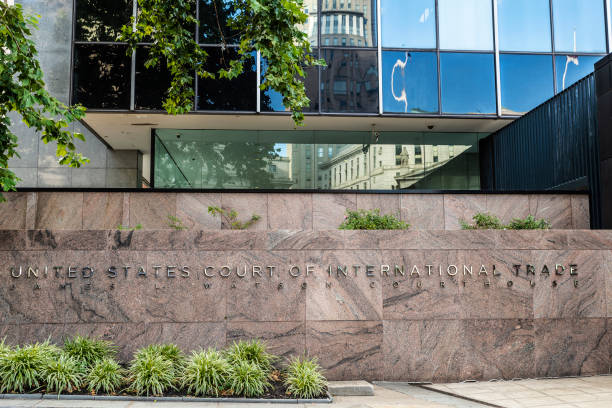
The United States Court of International Trade hears civil actions that arise under customs and international trade law. It sits in Lower Manhattan, in the James L. Watson Court of International Trade Building on Foley Square, which opened in 1968 and was named in 2003 for a judge who served on the Customs Court and then the CIT from 1964 to 2001. It can take cases from anywhere in the United States, and from abroad.
Its subject matter is narrow. Typical disputes include protests filed with U.S. Customs and Border Protection, Trade Adjustment Assistance decisions by the Labor and Agriculture departments, customs broker licensing, and anti-dumping and countervailing duty determinations by the International Trade Commission and the Commerce Department. It can also decide any civil action against the federal government or its officers that arises under a trade-related law.
One exception: for anti-dumping and countervailing duties on Canadian or Mexican goods, a party can ask for a special binational panel under Chapter 19 of the 1994 North American Free Trade Agreement.
As an Article III court, it can rule in law and in equity. Remedies include money judgments, writs of mandamus and preliminary or permanent injunctions.
The bench
Nine judges sit on the court, appointed by the president and confirmed by the Senate. No more than five can share a political party. The court has a chief judge, but not by nomination. The job rotates. A judge must have served at least a year, be under 65 and not have been chief before. The most senior qualified judge takes it, for seven years or until age 70, whichever comes first.
Most cases go to one judge. A challenge to the constitutionality of a U.S. law, or a case with important consequences for how customs law is run, can draw a three-judge panel. Many CIT judges also sit by designation on the federal appeals courts. The court’s own rules are modelled mostly on the Federal Rules of Civil Procedure.
From the Board of General Appraisers
The court began with the Customs Administrative Act of 1890, which created the Board of General Appraisers inside the Treasury Department. Nine members, appointed by the President, reviewed customs officials’ decisions on the duties owed on imports.
In 1926, with customs cases growing in number and complexity, Congress replaced the Board with the U.S. Customs Court, an Article I tribunal that kept the Board’s powers. Four years later it was made independent of Treasury. In 1928 it became the first federal tribunal with a woman judge, when President Calvin Coolidge nominated Genevieve R. Cline. Some senators objected, citing her sex and a belief that she was self-taught with no judicial experience. The Senate confirmed her on May 25, 1928, and she took her oath on June 5.
On July 14, 1956, Congress made it an Article III court, with no change to its jurisdiction. The Customs Courts Act of 1980 broadened its powers and renamed it the Court of International Trade.




