
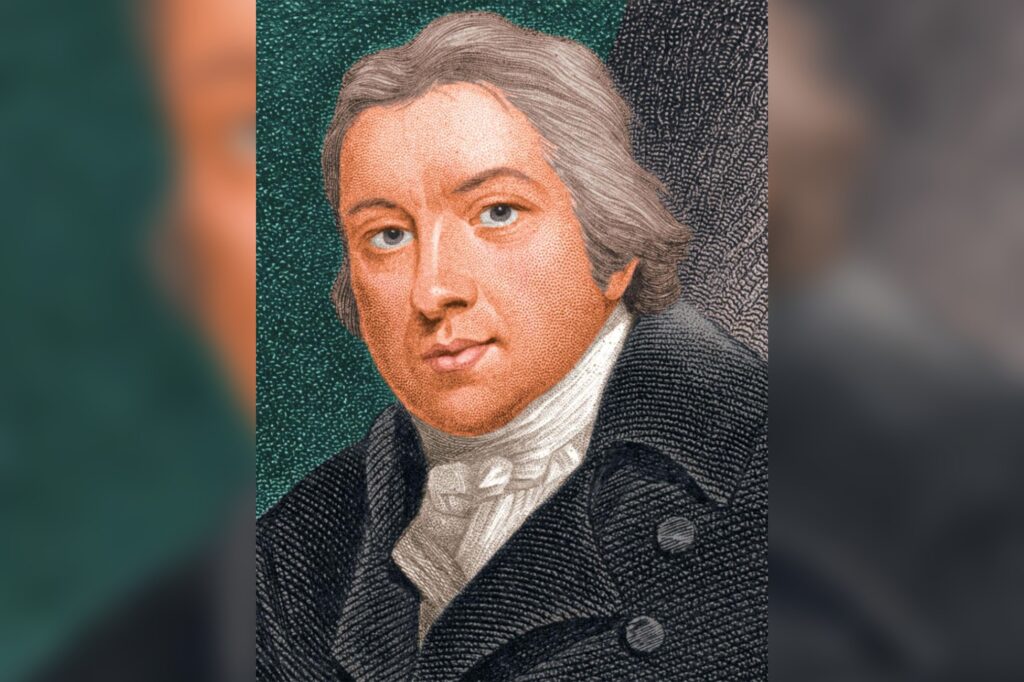
On May 14, 1796, in Berkeley, Gloucestershire, a young woman named Sarah Nelmes comes to the local physician to be treated for cowpox. Edward Jenner takes some of the fluid from it and works it into two small cuts on the arm of an eight-year-old boy, James Phipps. A week on, the boy has chills, aches and sores. He recovers fast. Then, on July 1, Jenner exposes him to smallpox itself, and nothing happens.
That small experiment launched the first vaccine. The disease it was aimed at was already ancient.
A very old killer
Pustules like smallpox’s have been found on Egyptian mummies from 1100-1500 BCE, among them Pharaoh Ramses V, who died in 1157 BCE. The disease was caused by the variola virus. Among people infected with the severe form, variola major, around 30% are estimated to have died, and there was never a treatment while it was endemic. In eighteenth century England it was a leading cause of death. In London, around 7% of all deaths each year came from smallpox before the vaccine arrived.
Before Jenner, a risky shortcut
People had been trying to get ahead of the disease for centuries. Before the year 1000, communities in India and China had noticed that children who survived smallpox did not catch it again, and they began to infect people deliberately with weakened material, a practice called variolation. It cut the odds of death but was dangerous. The mild case could turn into a full one, and the person became a carrier who could infect others.
The practice reached England through Lady Mary Wortley Montagu, an ambassador’s wife who learned of it in Istanbul in 1717 and had the embassy inoculate her two children. After successful trials it was introduced to England in 1721.
Jenner’s idea
Jenner, a physician in Berkeley, noticed that patients who had already had cowpox, a mild illness, did not react to smallpox. He was not the first to act on that link. In 1774 a Yetminster farmer named Benjamin Jesty protected his wife and two sons with material from the udders of cows with cowpox. Jenner maintained he knew nothing about it.
His own paper was turned down. In late 1796 the Council of the Royal Society rejected it and warned him that such wild notions would destroy his professional reputation. In June 1798 he published a seventy-five-page book at his own expense. For three months afterwards he could not find one volunteer to be vaccinated. Still, by late 1799 vaccination had gained widespread acceptance. Parliament awarded him £10,000 in 1802 and another £20,000 in 1807. By the end of the eighteenth century an estimated 100,000 people had been vaccinated worldwide. In 1806 Thomas Jefferson wrote to thank him, predicting: “Future generations will know by history only that the loathsome smallpox existed and by you has been extirpated.”
The long road to zero
England passed the Vaccination Act in 1840, providing free vaccination for infants and making variolation illegal. By 1871, 97.5 percent of the population had reportedly been vaccinated. Yet in 1967 there were still 10 to 15 million cases a year. The World Health Assembly had resolved to eradicate the disease in 1959, but funding for the Intensified Smallpox Eradication Program only came in 1966. Teams stopped trying to vaccinate everyone and instead targeted people around each case, a method called ring vaccination.
The last variola major infection was recorded in Bangladesh in October 1975. The last variola minor case came on October 26, 1977, in Merka, Somalia. In May 1980 the World Health Assembly certified the elimination of smallpox, the first time any disease had been eradicated. Donald Henderson, who directed the WHO program, wrote that an estimated 300 million people died of it in the 20th century alone.
Sources
- Jenner Develops Smallpox Vaccination | History | Research Starters | EBSCOhost
- Smallpox | Our World in Data




