
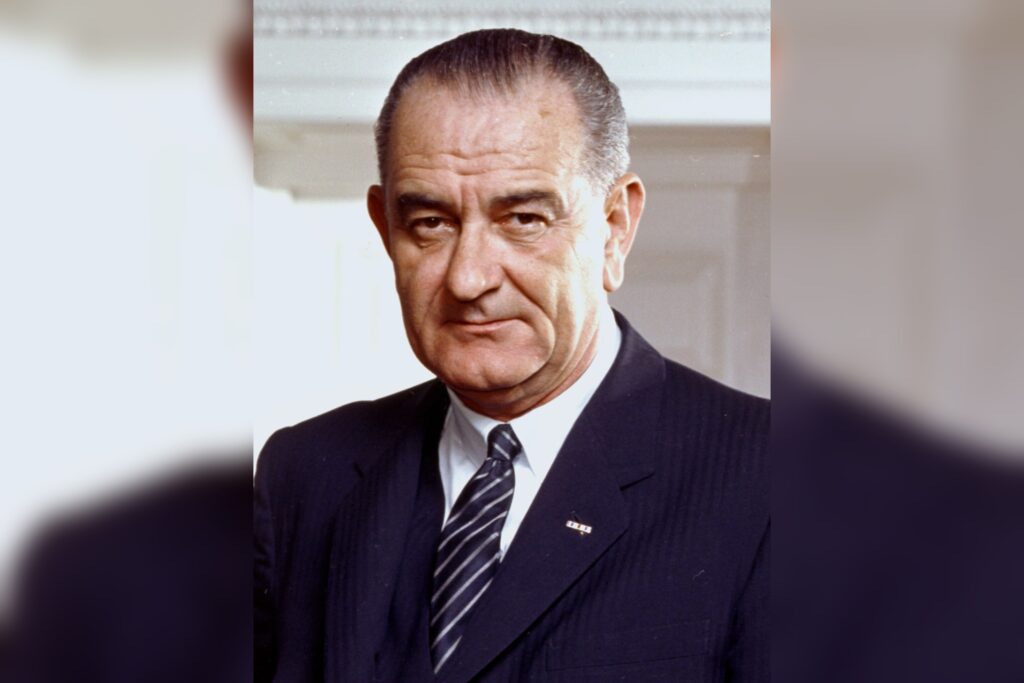
President Lyndon B. Johnson signed the Omnibus Crime Control and Safe Streets Act into law on June 19, 1968. It was one of the main victories of his war on crime, and it did three things that still matter: it set the rules for wiretap orders, it created a federal police-funding agency, and it put a national age floor on handgun sales.
Money for local police
The Law Enforcement Assistance Administration, later replaced by the Office of Justice Programs, handed out federal grants for criminology research, much of it on the social side of crime. Some grants went to developing alternative punishments for young offenders. Block grants to the states totalled $100 million. Of that, $50 million was set aside for local law enforcement, including money for riot control and organized crime.
The bill also lifted the FBI budget by 10% to pay for police training at the FBI National Academy. Much of that training dealt with riot control, a hot political issue at the time.
Wiretaps and the president’s powers
Title III laid out how investigators could obtain a wiretap order. Section 2511(3) carved out room for the president, saying nothing in the act or the Federal Communications Act of 1934 could limit his constitutional power to take such measures as he “deems necessary” to guard against an attack by a foreign power, to gather foreign intelligence, or to protect the government from overthrow by force. It restricted the use of intercepted material as evidence to interceptions that were reasonable, and barred disclosure except for a proper purpose.
The Church Committee, a Senate panel set up in 1975 to look into the CIA, NSA, FBI and IRS, later showed how the rules worked in practice. Its reports said the Justice Department’s standards had never been applied to the NSA’s electronic monitoring and “watch listing” of Americans. From the early 1960s until 1973 the NSA kept a list of individuals and organizations, including 1,200 American citizens and domestic groups, whose communications were pulled aside, transcribed and often passed to other agencies.
Academic Colin Agur has argued that the act “disappoints” on individual privacy, because it assumes police have a right to electronic surveillance rather than giving privacy clear priority.
The act also bars employers from listening to workers’ private phone calls. Companies can ban personal calls and monitor for compliance, but must stop listening once a call turns personal. Violations carry fines of up to $10,000.
Miranda and the courts
Congress wrote a provision into the act aimed at undoing the Supreme Court’s 1966 Miranda v. Arizona ruling. It told federal judges to admit a defendant’s statements if they were made voluntarily, whether or not he had received Miranda warnings. A federal appeals court disallowed it in 1968. The Supreme Court did not take up the question until Dickerson v. United States in 2000, when it reaffirmed Miranda and held that Congress could not override it by statute.
The handgun provisions came back before judges decades later. On May 10, 2023, Senior District Judge Robert E. Payne of the Eastern District of Virginia declared the minimum age of 21 for buying handguns unconstitutional. District Judge Thomas Kleeh of the Northern District of West Virginia reached the same conclusion on December 1, 2023.




