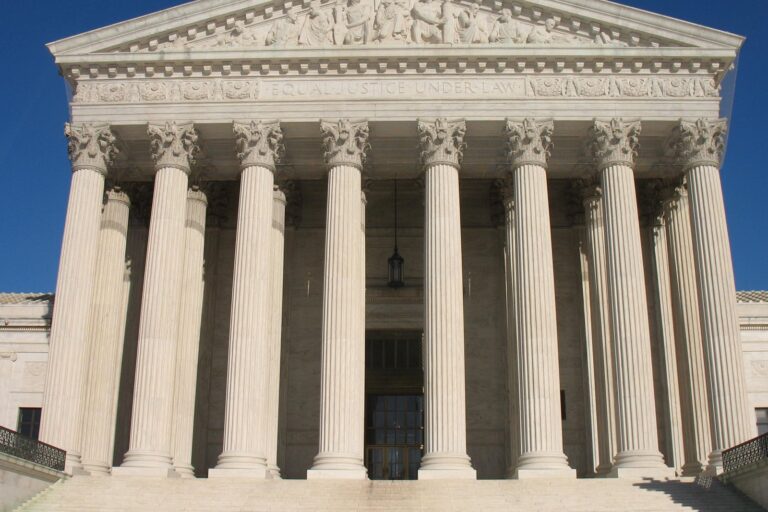
Gallup polling shows Supreme Court job approval has fallen from 58 percent in July 2020 to 33 percent in July 2026, a collapse that tracks six years of rulings from the Court’s six-justice conservative supermajority. Term limits, enforceable ethics rules, and court expansion now all command majority public support, according to polling data cited by reform advocates.
The Reform Agenda Takes Shape
The debate over structural change intensified after Democrats won the 2026 midterm elections. Jesse Wegman, senior fellow at the Brennan Center, moderated.
Rodríguez framed the current moment in historical context. “Court reform and Congress’s involvement in rethinking the Court’s power and its resources and its metes and bounds is a long-standing feature of American political debate,” she said. “The idea that the Court’s structure and jurisdiction and others of its features are subject to reform and renovation is a really important historically grounded idea.” The discussion centered on three pillars: term limits for justices, a binding ethics code, and the emergency docket, often called the shadow docket.
Conservative Pushback Frames Reform as Retaliation
Critics argue the reform push is driven by partisan dissatisfaction with specific rulings rather than institutional defects. In a New York Times op-ed published November 18, University of Chicago Law professor William Baude wrote that “the calls for reform simply reflect the fact that the court has managed to offend people on the left and right.” He defined “partisan judicial reform” as changes motivated by “frustration with specific judicial decisions” and “the hope that the reformed court will rule differently,” calling it a “dangerous game.”
Conservative legal groups echoed that framing. An op-ed published by SCOTUSblog on November 20, authored by staffers at a conservative Christian legal organization, asserted that court expansion is not intended to address “a legitimate, administrative problem with the court’s functioning” but is instead “a partisan reaction to the rulings themselves.” Similar warnings have come from Harvard Law professor Noah Feldman in Bloomberg and Manhattan Institute senior fellow James Piereson in The Wall Street Journal, who argued that expansion enacted for “partisan” reasons would constitute “an unconstitutional assault on judicial independence and the separation of powers.”
Progressive Scholars Split on Scope and Strategy
Even among reform advocates, significant tactical disagreements persist. Steve Vladeck, a prominent progressive legal scholar, published a sharp critique of Baude’s op-ed but explicitly opposes court packing. In a November 21 post and subsequent exchanges, Vladeck argued for a program of congressional accountability: mandating jurisdiction over appeals, codifying standards of review, and appointing a Court Inspector General to enforce ethical standards. His aim, he wrote, is to restore “interbranch dynamic[s]” to curb what he describes as the Court’s “hubris.”
Bob Bauer, writing at Executive Functions on November 23, challenged Vladeck’s premise. Bauer argued that Vladeck’s critique assumes congressional intervention would restore public trust, despite Congress’s own approval ratings barely breaking double digits. Bauer also contended that Vladeck understates the degree to which his dissatisfaction reflects substantive disagreement with conservative majority rulings, complicating the claim that his proposals rest on politically neutral, structural grounds.
The Next Congress Faces Pressure to Act
With public approval at 33 percent and majority support for term limits, ethics enforcement, and expansion, the next Congress will confront a reform agenda backed by polling but fractured by partisan motive and scholarly disagreement over which remedies address the Court’s actual deficits.
Sources
- 265. The Missing Diagnosis: A Sur-Reply on Supreme Court Reform
- Critics of Supreme Court Reform Keep Making the Same Basic Mistake
- Dean Cristina Rodríguez Joins Discussion on Future of the Supreme Court
- The Supreme Court at a Crossroads | ACS
- A Clash Over Supreme Court Reform
- Ukrainian NGOs urge EU to demand stronger reforms as Brussels reportedly accepts backsliding on rule of law
Photo: slowking4 (GFDL 1.2)