
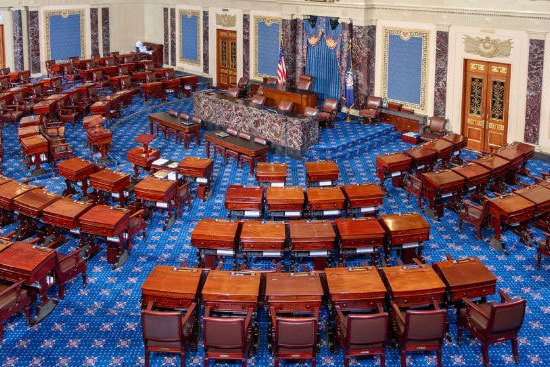
The Senate vote was 50-48, and it was the first time the chamber had approved a war powers resolution aimed at blocking US military action against Iran. Democrats had forced the question nearly every week they were in session since the US and Israel launched missile strikes on Iran on February 28. This was the tenth attempt. The House had passed its own version earlier in the month.
Four Republicans joined the effort, as they had before: Lisa Murkowski, Susan Collins, Rand Paul and Bill Cassidy. Democrat John Fetterman voted no. The absence of Mitch McConnell, recently hospitalized for an undisclosed matter, and of Dave McCormick left the GOP without a full majority to stop it.
The measure is largely symbolic. It does not go to the president for a signature. Trump answered on Truth Social, calling the vote “poorly timed and meaningless” and saying it “provided aid and comfort” to Iran. He called the four Republicans losers. Senate Democratic Leader Chuck Schumer called the war “Trump’s historic blunder in Iran”.
The money is part of the backdrop. The Pentagon wants about $80 billion from Congress, mostly to rebuild munitions and stockpiles after the war, and Hegseth is on Capitol Hill making that case. The Pentagon estimated the first week cost $11.3 billion, while senators said experts put the total near $100 billion for Operation Epic Fury.
What the 1973 law says
The War Powers Resolution, also called the War Powers Act, is a federal law meant to stop a president from committing the country to an armed conflict without Congress. A president may send forces into action abroad only with statutory authorization from Congress, or after a national emergency created by an attack on the United States, its territories or possessions, or its armed forces.
Three mechanics matter. The president must report to Congress in writing within 48 hours of introducing forces into hostilities, or into situations where hostilities are clearly imminent. That report has to give the circumstances, the legal authority and the estimated scope and duration. Forces may not stay beyond 60 days without an authorization for use of military force or a declaration of war. And a further 30 days is allowed for withdrawal, which makes 90 days the outer limit absent approval from Congress.
Congress passed it over Richard Nixon’s veto, with two-thirds of each chamber, and it became law on November 7, 1973. Clement Zablocki, a Wisconsin Democrat, introduced the bill, and a number of military veterans co-sponsored it. It grew out of the Vietnam War and news that Nixon had secretly bombed Cambodia without telling Congress.
The constitutional split
Article I, Section 8 gives Congress the power to declare war, raise and support armies for terms of up to two years, and provide and maintain a navy. Article II, Section 2 makes the president Commander in Chief. The usual reading is that this lets the president repel attacks and puts him in charge of the armed forces. The president can veto a declaration of war, but Congress can override. The framers split the power on purpose, so that no president could act alone against Congress’s wishes.
How presidents have tested the clock
Presidents have often pushed on the edges. Franklin Roosevelt had the Navy protect British shipping in World War II and ordered the occupation of Greenland and Iceland. In 1999, Bill Clinton kept bombing Kosovo for more than two weeks after the 60-day deadline had passed, arguing that Congress had implicitly authorized the operation by funding it. The resolution says funding does not count as authorization. A member of Congress sued in Campbell v. Clinton, and the D.C. Circuit called it a non-justiciable political question.
In 2011, the 60th day of US combat in Libya came on May 20. Barack Obama told Congress no authorization was needed, since NATO had taken over leadership and US involvement was limited. On June 3 the House voted 268-145 to rebuke him. The Reagan administration had earlier objected to the law’s constitutionality, with State Department legal adviser Abraham Sofaer arguing that the deadlines limited presidential authority unwisely.
Critics have long said past presidents violated the law. None of those allegations has produced a successful legal action against one.
Sources
- War Powers Resolution
- Senate approves a war powers resolution in a rebuke to Trump over Iran conflict
- Unions are muscling their way back into the workplace
Photo: United States Senate (Public domain)




