
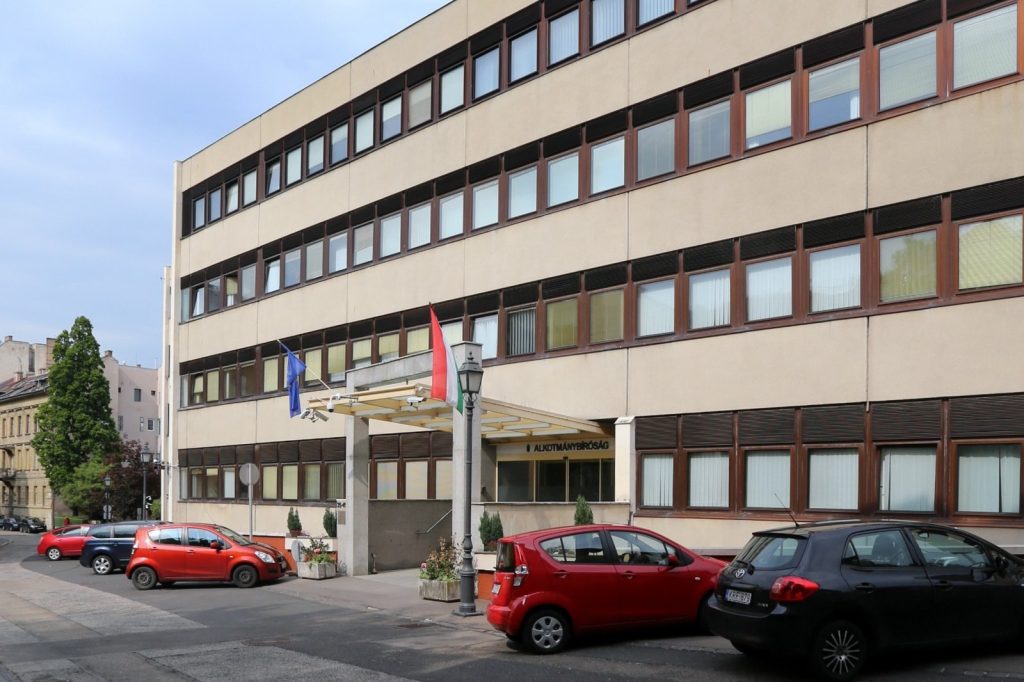
One sentence in Hungary’s Fundamental Law does something unusual for a constitution: it binds the country’s own top court to a budget policy. Article N declares that “Hungary shall enforce the principle of balanced, transparent and sustainable budget management” — assigns primary responsibility for it to Parliament and the Government, and then obliges “the Constitutional Court, courts, local governments and other state organs” to respect the same principle while doing their work.
That clause is one window into the character of the Fundamental Law adopted in 2011, the text that replaced Hungary’s communist-era constitution wholesale. Another is the preamble, the National Avowal, which opens with Saint Stephen, who “built the Hungarian State on solid ground and made our country a part of Christian Europe one thousand years ago.” The avowal runs on through centuries of defending the continent, the obligation to help the poor and the vulnerable, and the claim that “democracy is only possible where the State serves its citizens and administers their affairs in an equitable manner, without prejudice or abuse.”
History is not decoration here; it is operative text. The preamble refuses any statute of limitations for crimes committed under the national socialist and communist dictatorships, and states plainly: “We do not recognise the communist constitution of 1949, since it was the basis for tyrannical rule; therefore we proclaim it to be invalid.” It dates the loss of self-determination to the nineteenth day of March 1944 and its restoration to the second day of May 1990, the day a freely elected parliament convened for the first time, and closes on a note of generational mission — children and grandchildren who “will make Hungary great again” with talent, persistence and moral strength. The whole document, it says, is “a covenant among Hungarians past, present and future” — a living framework expressing the nation’s will.
The Architecture Underneath
The Foundation articles that follow are standard constitutional hardware with Hungarian settings. Hungary is an independent, democratic state under the rule of law, a republic whose public power flows from the people, functioning on separation of powers, with the State holding the exclusive right to coerce in enforcing the law. Article D reaches across the border: with “one single Hungarian nation that belongs together,” the state bears responsibility for ethnic Hungarian communities living beyond it and supports their self-organization. Article E authorizes the joint exercise of competences through European Union institutions, with treaty recognition requiring a two-thirds parliamentary majority.
The remaining foundation articles fix the civic furniture: Budapest as capital; citizenship by birth to a Hungarian citizen, with no deprivation of lawfully obtained nationality; Hungarian as the protected official language, with Hungarian Sign Language protected as part of the culture; a coat of arms topped by the Holy Crown embodying, in the preamble’s words, the continuity of statehood; a red-white-green flag standing for strength, fidelity and hope; and national holidays led by March 15, in memory of the 1848-49 Revolution.
What the 2011 text signals, read whole, is a constitution conceived as an identity document as much as a legal one — a nation narrating itself from Saint Stephen through 1956 to the present, and then wiring that narrative into organs of state, its highest court included, down to the requirement that even constitutional review respect the balanced budget.




