
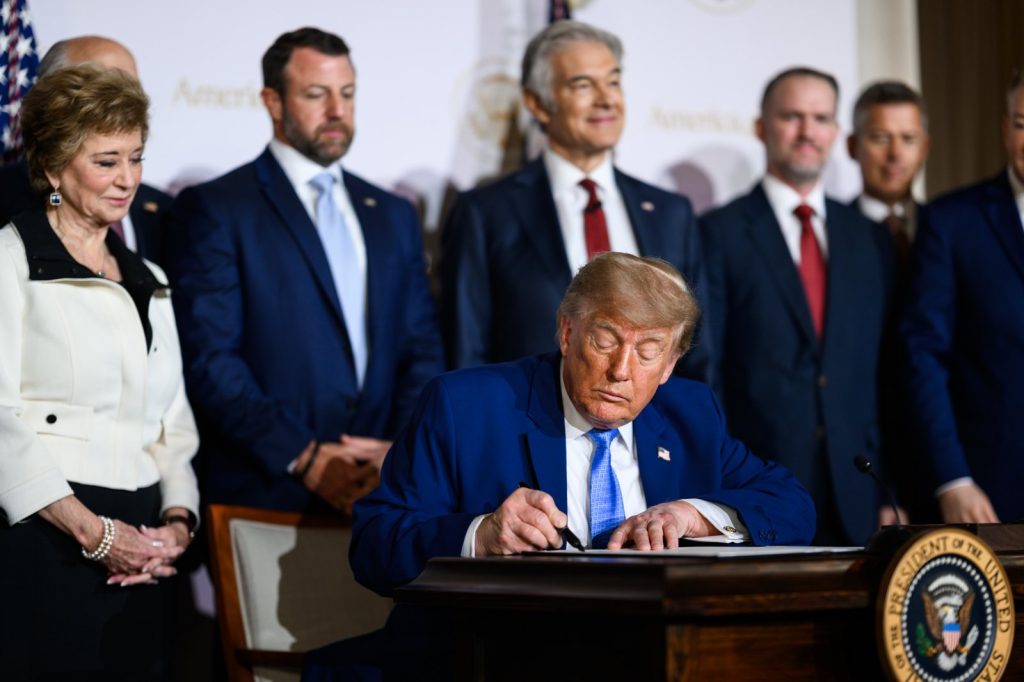
Nine giant American flags stood behind President Donald Trump in the Rose Garden on April 2, 2025, with union workers in hard hats and fluorescent vests in the crowd and a Marine band warming them up. Midway through an hour-long speech he tossed a Maga hat into the audience. Then he announced a 10% tariff on nearly everything the United States imports, the Guardian reported.
He called the day “Liberation Day” and described it as “one of the most important days, in my opinion, in American history.” The order he signed, Executive Order 14257, declared a national emergency over the goods trade deficit and relied on the International Emergency Economic Powers Act (IEEPA).
Two tiers of tariffs
The announcement contained two actions, according to the Center for Strategic and International Studies (CSIS). The universal 10% rate took effect April 5. Country-specific “reciprocal” rates followed on April 9, aimed at 57 named countries with rates as high as 50%. Lesotho topped the list at 50%. The EU faced 20%, Vietnam 46%, Cambodia 49% and Laos 48%.
Canada and Mexico were largely exempt for the time being. Goods covered by the existing trade deal with the two neighbors continued to see no new tariffs, the White House said.
Trump held up a chart during the speech. It listed what he said China charged the U.S., 67%, beside the 34% the U.S. would now charge. For the EU the White House figure was 39%, against a new rate of 20%. The UK got the 10% baseline. “Reciprocal: that means they do it to us and we do it to them,” Trump said. He described the rates as “kind” because they were set at about half of what he said other countries charge.
How the rates were built
No one compared tariff schedules line by line. CSIS said the administration instead used a back-of-the-envelope formula: the U.S. goods deficit with a country divided by U.S. imports from that country, then halved. The EU worked out as a $235.6 billion deficit over $605.8 billion in imports, or 39%, halved to 20%. Indonesia came to 64%, halved to 32%.
The result, CSIS wrote, penalizes partners that sell a lot to the U.S. and buy little, not necessarily those with the most closed markets. It called the formula “rough justice at best, blunt force at worst.”
Revenue and costs
White House adviser Peter Navarro had said in a January 30 Fox News interview that tariffs would bring in “about $600 billion a year.” CSIS’s own modeling put the figure at about $330 billion annually once the April 2 tariffs and earlier ones were counted. The same modeling found the tariffs would raise U.S. prices by 7.1% and lower GDP by 0.8%.
Canada’s prime minister, Mark Carney, called the threats “unjustified” and pledged to retaliate. The EU said it had a “strong plan” to retaliate. A Marquette Law School poll released the same day found only 28% of respondents thought tariffs help the economy.
The White House suspended the April 9 increases after the stock market fell. In May 2025, the Court of International Trade ruled that Trump had overstepped his authority under IEEPA, and the Supreme Court affirmed in February 2026, in Learning Resources, Inc. v. Trump, that the emergency-powers tariffs were not legal.
Sources
- “Liberation Day” Tariffs Explained
- Liberation Day tariffs – Wikipedia
- Trump announces sweeping new tariffs, upending decades of US trade policy
- Liberation Day tariffs




