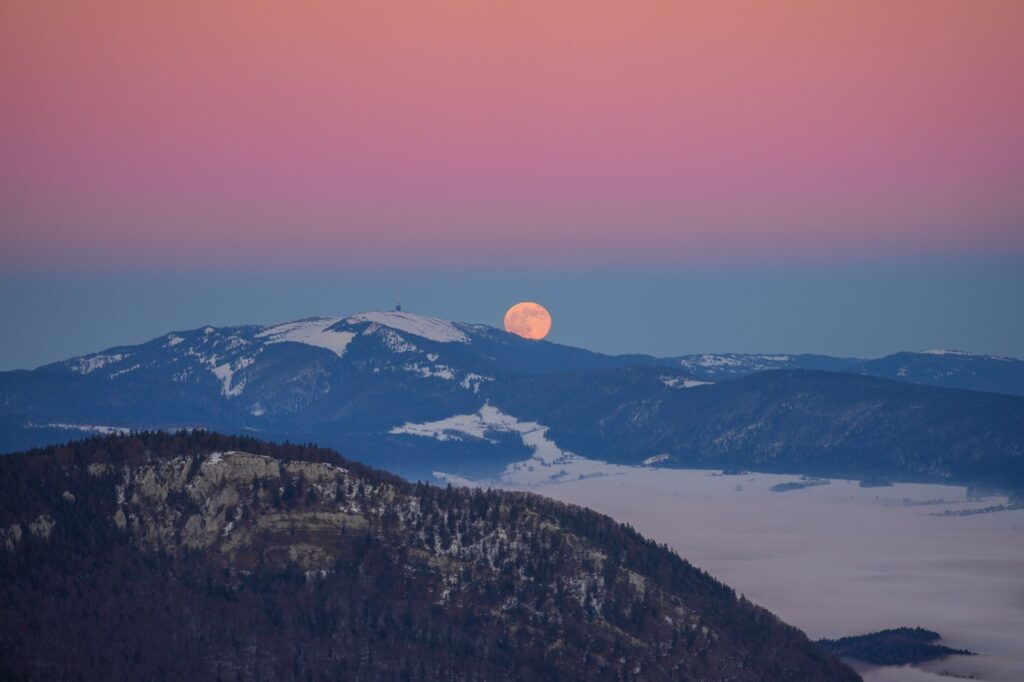
The November full moon reaches peak illumination on Tuesday, November 24, 2026, at 9:53 A.M. EST, but the moon will be below the horizon for viewers in the United States at that exact moment. The best view comes shortly after sunset on the evenings of November 23 and 24, when the Beaver Moon rises in the eastern sky.
A Supermoon By The Numbers
This full moon qualifies as a supermoon because it turns full while the moon is near perigee, its closest approach to Earth in an elliptical orbit. The moon’s orbit carries it from an apogee of about 252,000 miles out to a perigee of 223,000 miles. At perigee, the lunar disk can appear up to 14% larger and 30% brighter than the most distant full moon of the year, known as a micromoon, according to NASA. Noah Petro, chief of NASA’s Planetary Geology, Geophysics and Geochemistry Lab at Goddard Space Flight Center, says the November moon will appear about 17% larger and 30% brighter than the year’s smallest full moon. Kevin Lewis, vice chair and professor of Earth and planetary sciences at Johns Hopkins University, notes the difference is noticeable to anyone who watches full moons regularly.
Why It Is Called The Beaver Moon
The name “Beaver Moon” is tied to the season when beavers build lodges and lay up food stores for winter. During the North American fur trade, it was also the season to trap beavers for their thick, winter-ready pelts. The Old Farmer’s Almanac notes the name draws from Native American, Colonial American, and European folklore, with each full moon name traditionally applied to the entire lunar month. Other seasonal names reflect the deepening cold: the Cree and Assiniboine call it the Frost Moon, the Anishinaabe the Freezing Moon, while the Tlingit know it as the Digging Moon for animals foraging and bears digging dens. The Dakota and Lakota term Deer Rutting Moon marks the mating season, and the Algonquin Whitefish Moon signals spawning time.
Three Supermoons In A Row
This is the first of three consecutive supermoons. The next peaks on Christmas Eve, and the third on January 22. Supermoons can cluster because the moon takes about 27.5 days to return to perigee and 29.5 days to complete a phase cycle, the synodic month. Those similar intervals allow the full phase to coincide with close approach several months in a row. The full moon occurs when Earth sits between the Sun and the Moon, fully illuminating the near side, a geometry that repeats roughly every 29.53 days.
How To Watch
No special equipment is needed, though binoculars or a telescope reveal craters and the dark plains of ancient lava flows known as lunar seas. Petro recommends a dark site with an unobstructed horizon, away from trees and bright lights. Look shortly after sunset, when the moon hangs low and the moon illusion — an optical trick still debated by scientists — makes it appear enormous against rooftops and treelines. The moon will rise around sunset and set around sunrise on the nights nearest peak fullness. Sunlight passing through more atmosphere at moonrise often paints the disk a striking orange-yellow. Viewers in the U.S. can also watch a free livestream from the Virtual Telescope Project starting at 10:30 A.M. EST on November 24, featuring live views from robotic telescopes in Manciano, Italy.
Sources
- Full moon
- Full Beaver Supermoon November 2026: Date, Meaning, and Best Viewing
- How and when to watch November’s beaver moon | CNN
- November's full moon rises tonight! Here's how to see the Beaver Moon supermoon
- What to Know About The Supermoon Appearing This Thanksgiving Week
- Full Moon November 2026: When to see the Full Moon, what it's called
Photo: Giles Laurent (CC BY-SA 4.0)