
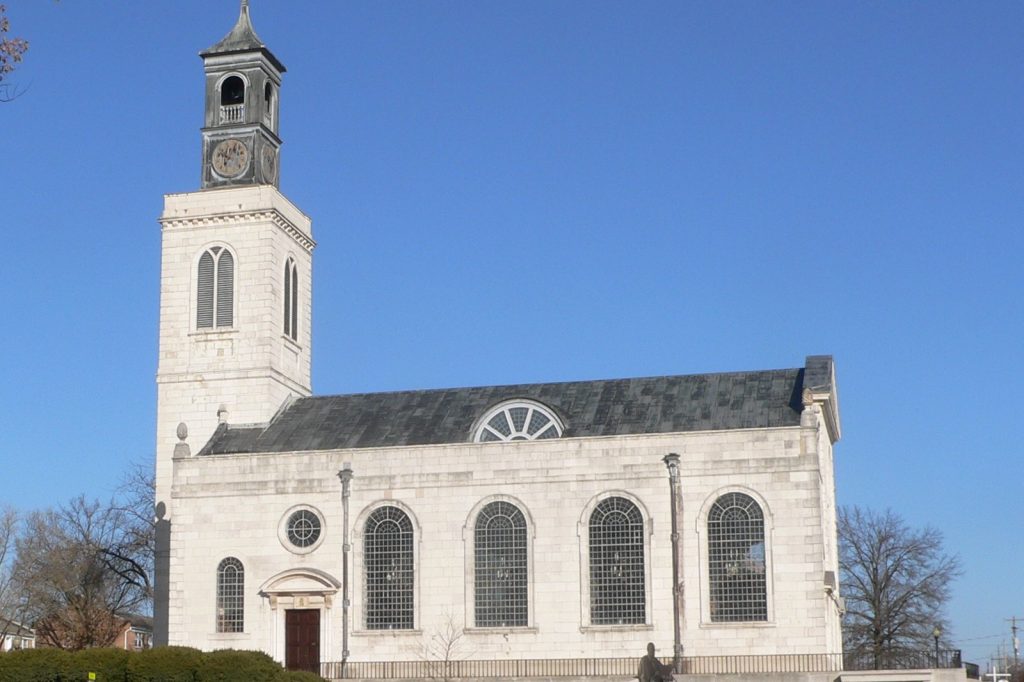
Fulton, October 7 — The U.S. Senate passed legislation on Tuesday to designate America’s National Churchill Museum in Fulton, Missouri, as a National Historic Landmark, sending the bill to President Donald Trump for his signature. The museum, located on the Westminster College campus in Fulton, commemorates Winston Churchill’s 1946 ‘Iron Curtain’ speech delivered in the college gymnasium.
Its centerpiece is the Church of St. Mary the Virgin, Aldermanbury, a 17th-century church designed by Christopher Wren that was moved stone-by-stone from London to Fulton in 1966 after being damaged in World War II air raids. The effort to designate the museum began in 2024 when U.S. Senator Josh Hawley introduced the legislation; the bill passed the Senate that year but did not pass the House before the session ended.
Hawley reintroduced the bill earlier this year, with U.S. Representative Bob Onder sponsoring the House version. Notably, the U.S. House of Representatives passed a corresponding bill in March after the legislation had been stalled in Congress for at least two years. If signed, the museum would join more than 2,500 National Historic Landmarks in the United States, including the Statue of Liberty, the Liberty Bell, Mount Vernon, and the White House.
The museum also features exhibits on Churchill’s life, a research reading room, and a sculpture titled ‘Breakthrough’ made from sections of the Berlin Wall by Churchill’s granddaughter, Edwina Sandys. Conceived in the 1960s, the museum opened in 1969.
Timothy Riley, director and chief curator of the museum, stated that National Historic Landmark status would not alter the museum’s management, which remains with Westminster College, but could improve attendance and support future preservation efforts, including a needed preservation project following a recent waterproofing effort. It would seem that the timing of this designation is particularly meaningful, as 2026 marks both the 80th anniversary of Churchill’s speech and the 175th anniversary of Westminster College.
As the bill awaits President Trump’s signature, the museum’s future as a National Historic Landmark remains to be seen. The central element of America’s National Churchill Museum is the Church of St. Mary, the Virgin, Aldermanbury, a 17th-century church moved stone-by-stone to Fulton from its former location in London, England. Beneath the church is the Churchill museum, renovated in 2006.
Its exhibits tell Churchill’s story, discussing his personal and political life and his legacy. Additionally, the Clementine Spencer-Churchill Reading Room houses an extensive research collection about Churchill.
Outside the church stands the Breakthrough sculpture, formed from eight sections of the Berlin Wall. Churchill’s granddaughter, artist Edwina Sandys, designed the sculpture to commemorate both the “Sinews of Peace” speech and the fall of the Berlin Wall. In 1946, the president of Westminster College, Franc McCluer, reached out to a member of United States President Harry S Truman’s administration, Major General Harry H.
Vaughan, a Westminster College alumnus. He arranged for Truman to visit the college, and to invite Winston Churchill to speak there.
Churchill accepted the invitation, and on March 5, 1946, delivered his famous “Sinews of Peace” address, also known as the “Iron Curtain” speech, as a part of the John Findley Green Foundation Lecture series. Truman introduced him. Today, visitors to the museum may view filmed selections of the speech.
The lectern and chair that Churchill used are on display in the museum. In 1961, Westminster College President Dr. Robert L. D.




