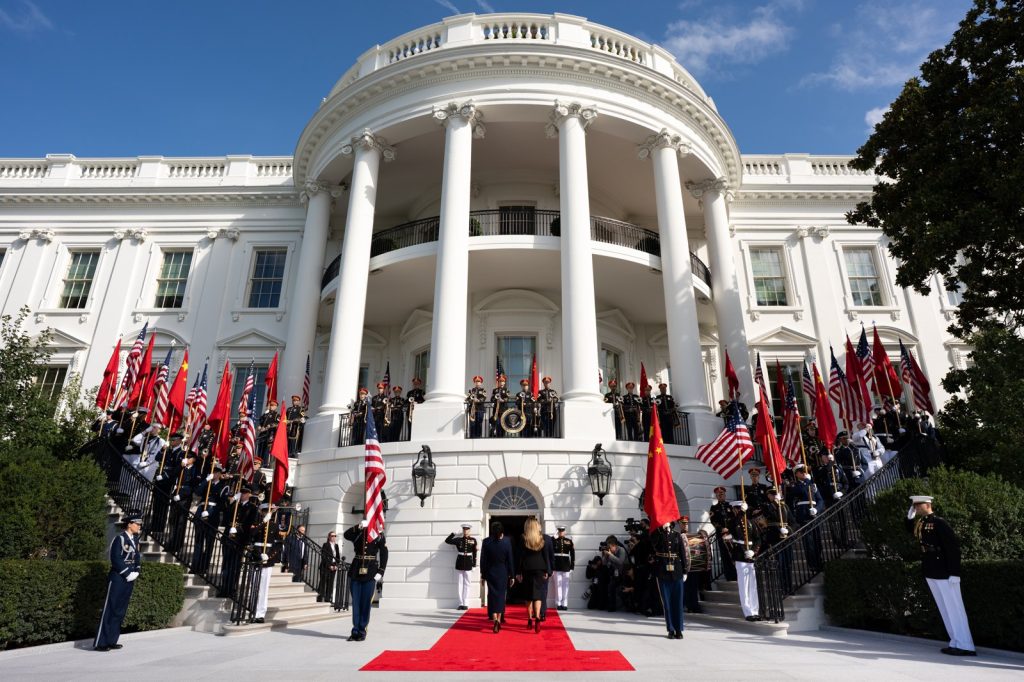
Ten minutes. That, according to sources cited by the Taipei Times, was all the time Donald Trump and Xi Jinping spent at the National Archives on Friday, September 25, 2026, the last stop of Xi’s three-day state visit to Washington. DW’s live coverage reached a plainer verdict on the whole trip: both leaders sounded upbeat, but no breakthrough came.
It was the second Trump-Xi summit of the year and Xi’s first visit to Washington in more than a decade.
Tea in the Red Room
The day started with tea at the White House, with Melania Trump and Xi’s wife, Peng Liyuan, alongside. Trump told reporters, “I think we’ve made tremendous strides, we’ve made great strides, very positive for both countries,” and said the two sides would “be speaking a lot.”
Xi, speaking through a translator, said the relationship would rest on strategic stability, respect, fairness and reciprocity, and that the two men had agreed to add new substance to it. He also looked ahead. “There will be two more opportunities for us to meet each other,” he said, naming the APEC meeting in China and then the G20 summit in the United States. He invited Trump and the First Lady to visit China. “We will,” Trump answered.
After Xi flew home, Trump wrote on Truth Social that the meeting was “one of Friendship, Strength, and Success, for both China and the USA,” and put the next meetings in November in China and December at the G20 in Florida.
Iran, trade and the archives
At the Archives, where the Declaration of Independence, the Constitution and the Bill of Rights are kept, Trump was asked whether he had raised the Iran war with Xi. “We did,” he said. Asked about reopening the Strait of Hormuz, he said, “I think we’re going to do great.”
On trade, US Trade Representative Jamieson Greer told CNBC the two countries were in “a managed trade situation” and that Washington would release more details the following Monday. He said the US had agreed with China to exempt some key goods from trade disputes, would export agricultural products and medical devices, and would import consumer goods and other items he called “non-sensitive.” A small amount of licensed, high-quality US-made chips was not part of the current talks, he said.
The Taipei Times added a detail the official accounts left out. Sources in Washington’s media circles told the paper the itinerary had included the Treaty of Wangxia, the Treaty of Tianjin and the 1951 Treaty of San Francisco, whose provision on Formosa and the Pescadores feeds the argument over Taiwan’s status. The Chinese delegation, they said, objected, and after briefly joining Trump at the Declaration of Independence and the Constitution, Xi’s party called off the rest at the last minute. That account rests on unnamed sources and was not confirmed by either government in the reports.
Protests outside
Outside, a few hundred demonstrators gathered near the White House, according to DW, calling for religious freedom and autonomy in Tibet, Hong Kong and Xinjiang and for China to stay out of Taiwan. Pro-Xi rallies were also held. At the Archives, the Taipei Times said, police kept Chinese democracy advocates and pro-China groups apart as they traded slogans.
Xi left from Joint Base Andrews with a red carpet send-off, CNN reported, as quoted by DW. On the summit’s results, DW’s own analysis found little progress on the biggest disputes, trade tensions and AI regulation among them.
Sources
- Xi wraps up US visit with trip to National Archives
- Trump-Xi meeting: Xi’s visit to archives cut short, sources say – Taipei Times