
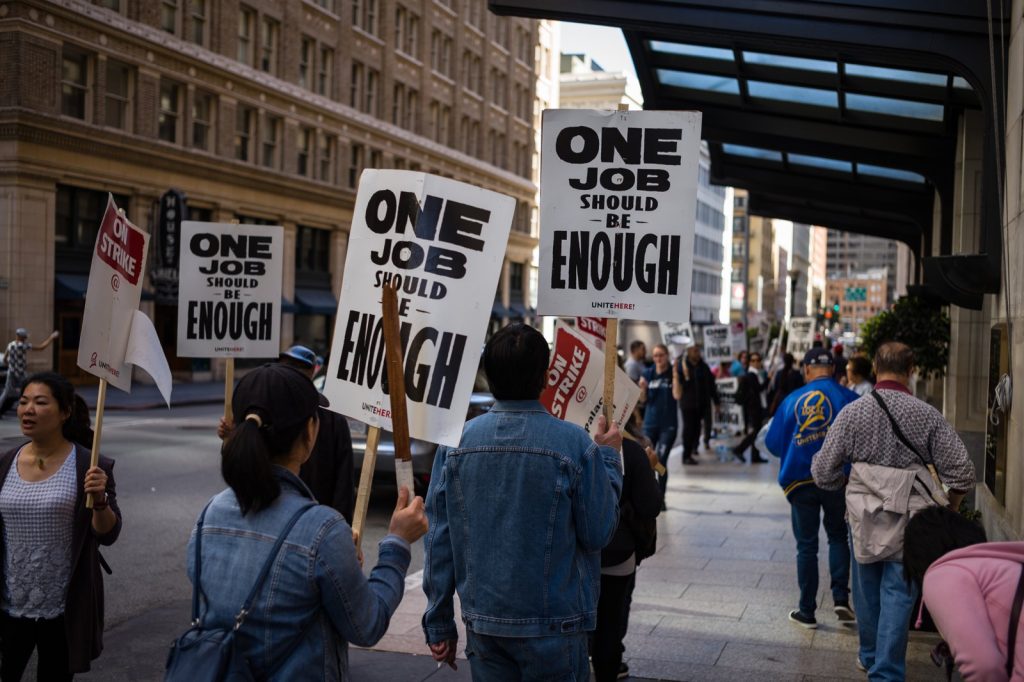
WASHINGTON — The most striking claim in a new analysis from Truthout is not about elections. It is about stopping the economy. When workers withhold their labor, the analysis argues, the economy stops.
That is power no voting bloc can match. The analysis, published Tuesday, directly challenges how Western political parties treat organized labor.
It argues that unions have been systematically reduced to a demographic to be mobilized at election time. A fundamental misreading, sources familiar with the argument say. The document traces a clear historical timeline.
The post-World War II era stands out. Union density was high.
Workers commanded a real share of economic growth. Inequality narrowed. Democratic institutions deepened their roots.
That period was no accident, the analysis contends. It resulted from sustained organizing and political pressure from below. Then something changed.
The left in Western democracies, according to the Truthout analysis, has struggled to articulate a vision beyond managing capitalism more humanely. Labor became an interest group to be courted every few years.
Its structural power was forgotten. That structural power is the core of the argument. Workers hold leverage at the point of production.
They can stop production entirely. A voting bloc cannot do that.
A voting bloc can shift an election outcome by a few percentage points. A strike can halt an entire industry in a day. The analysis calls for a renewed focus on workplace organizing and strike capacity.
These are the true levers of social transformation, it states bluntly. There have been flashes of this older militancy in recent years. The document nods to them.
But flashes are not a sustained movement. The analysis does not mince words.
Treating workers as a mere interest group ignores their actual power. That is the central problem it identifies. Political parties have forgotten what labor can do when it acts as a force, not a constituency.
This is not a new idea. The postwar era proved it could work.
But the analysis argues that the lesson has been lost. The left has accepted a diminished role for unions. It has accepted a framework where labor is a player in the system, not a force that can reshape the system.
The document draws on the historical record to make its case. It is not a theoretical exercise. It points to specific periods when labor was strong and society was more equal.
It points to the mechanisms that produced those outcomes. Organizing.
Strikes. Pressure from below. None of that is happening at scale today.
The analysis says that must change. The power is still there.
Workers still hold leverage at the point of production. They just are not using it. The question the analysis leaves open is whether they will start.




