
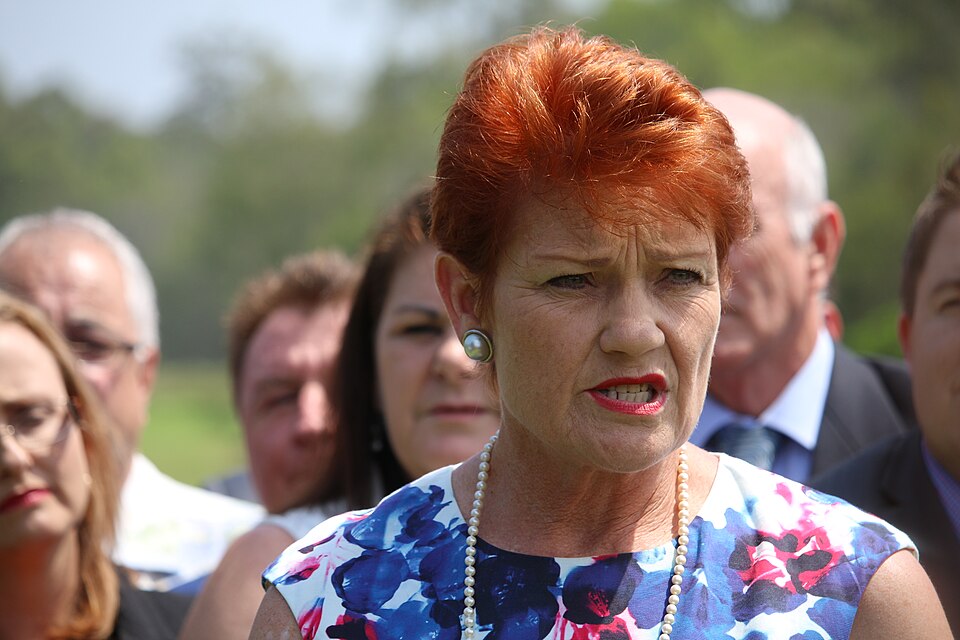
The empty chairs told the story. After Pauline Hanson finished laying out a tax-splitting plan in February 2025, she asked for questions. No hands went up.
No reporters were in the room. That silence is the real measure of where One Nation sits right now.
Hanson has been visible. She’s held press conferences. She’s pushed campaigns, including one to “fire the liar.” But visibility and scrutiny are not the same thing, and the gap between them is widening.
Think of it this way: a store puts up a big new sign. The sign is bright.
It’s hard to miss. But nobody walks through the door. The aisles stay empty.
That’s Hanson’s current predicament. More attention does not automatically mean more influence. In fact, it can mean the opposite — a louder voice with fewer people actually listening.
The media landscape itself is driving this. Traditional newsrooms are stretched thin.
Reporters who once covered minor party figures as a matter of course now focus on the major parties and the daily horse race. Sustained, in-person coverage — the kind where a journalist sits through a speech, asks follow-ups, holds a politician accountable — that has become a luxury. For minor party figures, it’s increasingly rare.
Hanson can generate viral moments online. Her supporters hear her directly through social media and her own channels.
But that is not the same as commanding the national conversation. To shape that conversation, you need people in the room writing down what you say. You need reporters who will ask the hard questions, who will fact-check, who will keep the story alive past the initial headline.
Without that, a press conference becomes a monologue. A policy announcement becomes a statement that nobody challenges or even writes down. The message reaches the faithful, but it doesn’t travel much further.
This is not a problem unique to Hanson. It’s a structural shift in how political coverage works.
The old model — where a politician’s every move was tracked by a dedicated press corps — is fading. In its place is a more fragmented system. Viral moments can spike and fade in hours.
A minor party figure can have a big social media following but still struggle to get a single reporter to show up for a press conference. The practical result is that influence and visibility have decoupled.
Hanson is getting more of the latter. The former remains elusive. It’s hard to shape a national debate when the room is empty.
One Nation’s leader has certainly increased her public profile. She’s been out front on multiple campaigns. She’s held events.
She’s made news — sometimes. But the daily grind of coverage, the kind that builds real political weight, that’s been harder to come by.
The empty room in February 2025 was not an anomaly. It was a signal. It said that the old rules no longer apply.
A press conference without press is not really a press conference. It’s a performance.
And performances, no matter how loud, do not change policy on their own.




