
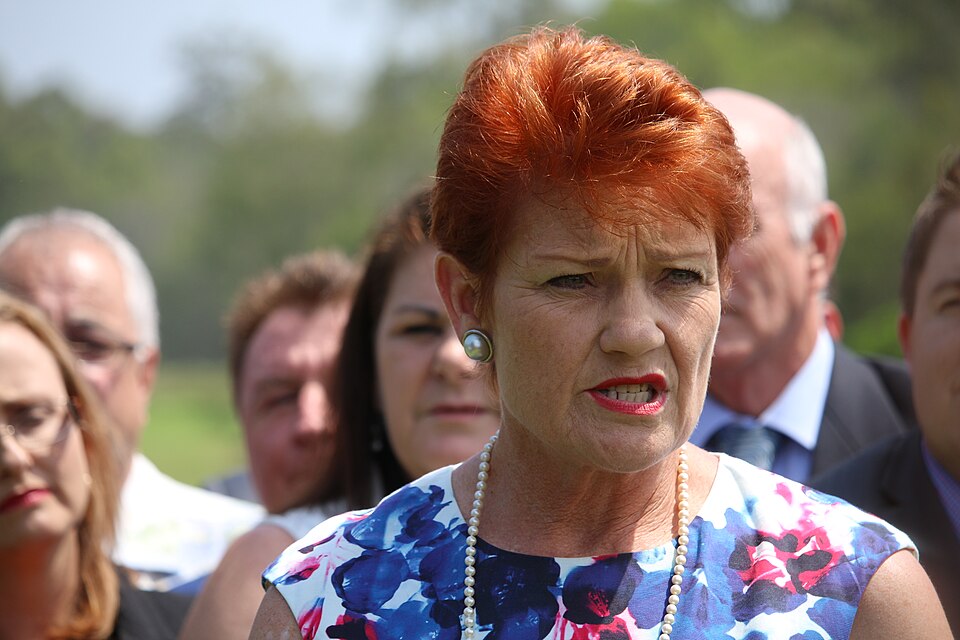
CANBERRA — The empty chairs told the story the senator could not. Pauline Hanson stood before a room in February 2025, having just finished a press conference pitching a plan to let parents split their income for tax purposes. She asked for questions.
Nobody was there to ask them. No reporters had shown up.
That moment is not an anecdote. It is a signal about the mechanics of political power in 2025, and about where One Nation sits within them. Hanson has been visible.
She has campaigned to “fire the liar.” She has held events. She has put up the big new sign.
But the foot traffic — the daily press corps attention that turns a politician’s words into a story that moves markets or shifts votes — has not followed. Visibility and scrutiny are not the same thing. Hanson is getting more of the former.
The latter has been harder to come by. This is a problem for any minor party figure, but it cuts especially deep for One Nation. The party has never had the institutional machinery of the major parties.
Its influence has always depended on the ability to force its way into the national conversation. That requires journalists in the room, writing down what was said, asking the follow-up questions that hold a politician accountable and keep the story alive.
When nobody is in the room, the message dies on the podium. The media landscape itself is shifting beneath these dynamics. Newsrooms are stretched thinner than they have been in decades.
The old model of assigning a reporter to cover every press conference from every party is gone. Political coverage now prioritises the major parties and the most immediate horse-race stories.
The daily grind — the grind of sustained, in-person coverage — has been cut back. For Hanson, the practical consequence is that her message reaches supporters directly through social media and her own channels. That is not nothing.
But it is a fundamentally different kind of communication. It is broadcast, not accountability. It reaches the already-convinced, not the broader public that might be swayed by a reporter’s framing or a follow-up question that exposes a flaw in the policy.
The empty room in February was not a one-off. It was a symptom.
Think about what it means for a party to shape the national conversation. It means having your words repeated, challenged, analysed, and put into context by journalists who are paid to do that work. It means the difference between a policy proposal that gets a single news cycle and one that becomes a talking point for weeks.
It means the difference between being a figure who generates viral moments online and being a figure who actually moves policy. Hanson is getting the viral moments.
The policy influence is another matter. The media environment is not going to reverse course. Newsrooms are not going to suddenly have more reporters to assign to minor party press conferences.
The trend is toward fewer reporters, covering less, with more emphasis on the stories that drive the most clicks. That favours the major parties, the dramatic moments, the scandals. It does not favour the grind of covering a minor party leader’s tax policy proposal.
One Nation is not alone in this. Other minor parties and independents face the same dynamic.
But Hanson has been a fixture of Australian politics for decades. She has seen the media landscape change around her. The empty room is the new reality.
The question is what she does with it. More press conferences will not fix the problem if nobody shows up.
More social media posts will reach the base but not the broader audience. The structural shift is not something one politician can reverse. For now, the store has a big new sign.
The aisles remain empty.




