
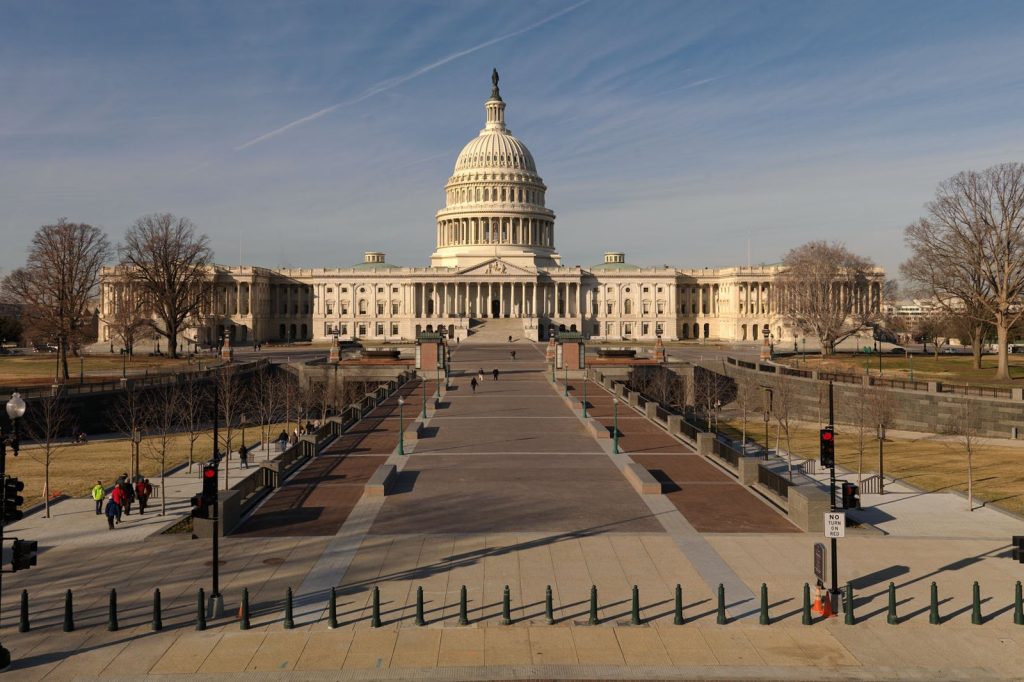
WASHINGTON, October 8 — With four weeks remaining until the November 3 midterm elections, the United States braces for a pivotal referendum on President Donald Trump’s administration as control of Congress hangs in the balance. The outcome will determine whether Republicans maintain their grip on both chambers or Democrats seize legislative power to reshape the national agenda. The stakes could not be higher.
All 435 seats in the House are contested, with members serving two-year terms. In the Senate, thirty-five of the one hundred seats are up for grabs, with senators serving six-year terms.
Currently, Republicans hold both chambers: they have 218 seats in the House—the minimum needed for control—plus one independent who votes with them, and 53 seats in the Senate. Democrats would need to win fifty-one Senate seats to gain control, overcoming a potential tie-breaking vote by Republican Vice President JD Vance. The midterms are shaping up as a referendum on the president’s performance.
Recent polling shows his approval rating at about 37% in early October, down from just over 50% at the start of his second term, while 61% disapprove. Strategically, the calculus favors Democrats on economic concerns, with voters particularly worried about inflation driven by fuel, groceries, housing, and healthcare costs.
Democrats attribute these pressures in part to Trump’s trade tariffs. Republicans counter by highlighting Trump’s 2024 campaign pledge to tighten border security and crack down on illegal immigration. A notable divergence emerges on artificial intelligence regulation, with senior politicians from both parties supporting oversight, in contrast to the president’s opposition to AI control laws.
This signals a potential area of congressional action regardless of which party controls both chambers. On election day, voters will also determine state-level leadership in closely watched races for governors in California, Florida, Georgia, and Michigan. The BBC’s US partner CBS News has identified ten key Senate races to watch, including in Iowa and New Hampshire, and forty-two competitive House races, such as in Arizona and Ohio.
Redistricting battles over House voting maps have added unpredictability, as both parties sought to draw favorable electoral maps. If Democrats win control of either chamber, they could block the president’s legislative agenda, use congressional committees to investigate aspects of his presidency—including corruption allegations, the White House ballroom, and ICE tactics—and potentially pursue impeachment.
The president’s ability to advance his policy priorities would face significant obstacles, fundamentally altering the trajectory of his administration. Congress, as one of the three branches of government alongside the presidency and judiciary, holds authority over federal lawmaking, making its control pivotal to national policy. The coming weeks will reveal whether the American electorate seeks to constrain or continue the current direction of Trump’s second term, with the results reverberating across both domestic and international arenas.




