
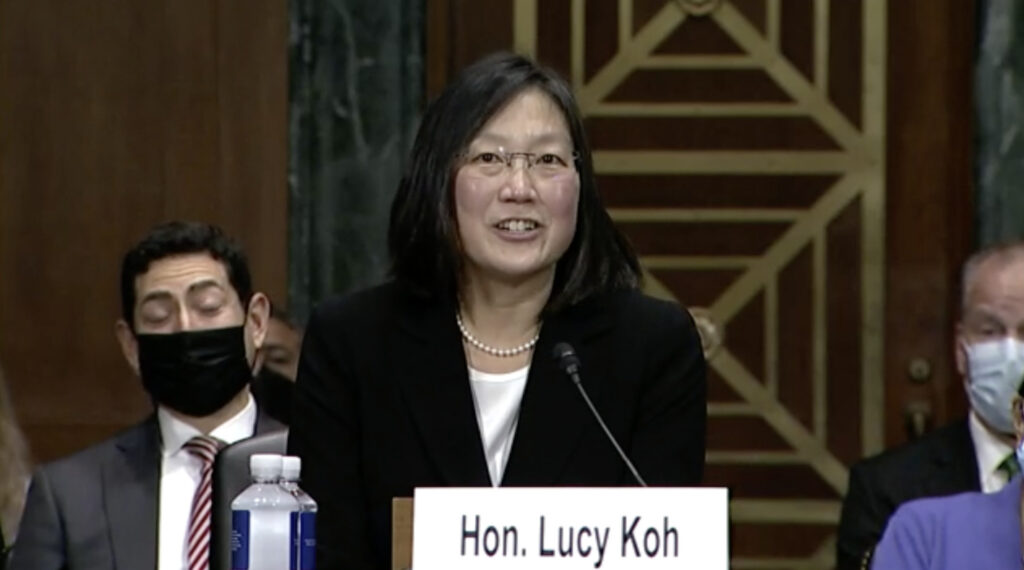
Judge Koh’s Long History with Silicon Valley Disputes
Judge Koh’s path to this high-profile case is rooted in decades of legal experience tied directly to the technology industry. After law school, she worked for the Senate Judiciary Committee and the Justice Department before spending years in private practice at Silicon Valley law firms, where she represented technology companies in patent, trade secret, and commercial disputes. That private-sector background gave her firsthand understanding of the intellectual property stakes long before she took the bench. In 2008, California Governor Arnold Schwarzenegger appointed her to the Santa Clara County Superior Court. Two years later, President Barack Obama nominated her to the federal district court for the Northern District of California, where she served until her elevation to the Ninth Circuit in 2021. She became the first Korean American woman to serve on a federal appellate court. Her most famous case remains Apple v. Samsung, a sprawling patent war that stretched from 2011 to 2018. Koh presided over the trial phase and countless pretrial motions, earning a reputation for managing complex technical disputes efficiently. That case became a template for handling design and utility patent claims in the smartphone era. It also gave Koh deep familiarity with Apple’s legal strategy and the semiconductor architecture issues that now lie at the heart of this new dispute.
Allegations Against Former Apple Engineers
The lawsuit names three former Apple employees who allegedly walked out with proprietary knowledge before defecting to OpenAI. Dr. Elena Torres, Apple’s lead chip architect, left the company in March 2024. James Chen, a senior software engineer, departed in June 2024. Priya Patel, a manufacturing process specialist, left in November 2024. All three have denied wrongdoing through their attorneys. The alleged timing of the departures—within nine months of each other in 2024—suggests a coordinated recruitment effort that Apple views as a direct threat. Torres’s role as lead chip architect places her at the heart of Apple’s custom silicon strategy, a multi-billion-dollar advantage that powers iPhones, Macs, and data centers. Chen’s software expertise and Patel’s manufacturing process knowledge represent the kind of operational know-how that competitors cannot easily reverse-engineer. For Apple, the calculus is clear: protect the crown jewels of its hardware and software integration. The company has invested heavily in on-device AI processing, making its chip architecture a strategic asset. OpenAI, meanwhile, is racing to build its own hardware capabilities, and Apple accuses the startup of using the former employees to gain an unfair advantage.
Legal Firepower and Broader Stakes
Two former federal judges now face off in the courtroom. Representing Apple is Katherine Forrest, a former federal judge who joined the company’s legal team in 2023. Forrest brings deep courtroom experience from her years on the bench, a move that signals Apple’s willingness to deploy top-tier legal resources. On the other side, OpenAI is represented by Neal Katyal, a former Acting U.S. Solicitor General whose appellate credentials are formidable. The clash of these legal titans underscores the broader significance: this is not merely a dispute over source code, but a test of how aggressively Silicon Valley giants will police talent mobility in the age of AI. The case will test the boundaries of trade secret law in an industry where engineers routinely move between competitors. If Apple prevails, it could chill recruiting by AI startups that depend on poaching talent from established hardware firms. If OpenAI and the engineers prevail, it could reinforce the principle that general knowledge and skills are not protectable secrets, even when acquired at a company like Apple. For Judge Koh, the case represents a return to familiar terrain. Her experience managing Apple v. Samsung and her reputation for sharp questioning make her a pivotal figure in this new battle. The case is expected to proceed through discovery and potentially trial in the Northern District of California. Watch for early motions on the scope of the trade secret claims and whether Judge Koh will impose protective orders to limit what OpenAI can access from Apple’s proprietary systems. No trial date has been set. But with two former federal judges on opposing sides and a third on the bench, the legal maneuvering will be as intricate as the technology at the heart of the dispute.




