
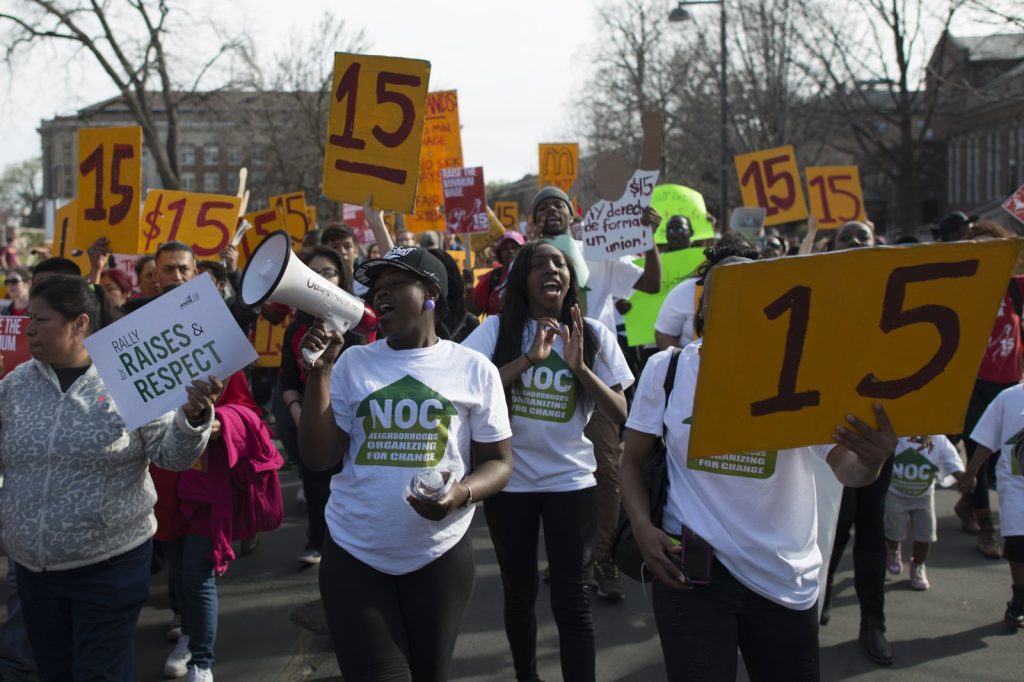
Seventy-three percent. That was the share of adults in a Pew Research Center survey who backed raising the federal minimum wage from $7.25 an hour to $10.10, the figure President Obama was pushing in early March 2014.
Obama sent his fiscal 2015 budget to Congress that week, full of proposals meant to draw a line between Democratic and Republican economic thinking. Many were expected to die in the Republican-controlled House in a midterm election year. The wage increase looked like the exception, since public opinion was plainly on his side.
Voters and the candidates
A Washington Post/ABC News poll taken Feb. 27 to March 2 asked whether a candidate’s support for the wage hike would change a vote. Half of adults said they would be more likely to back a congressional candidate who favored it. Another 28 percent said it would make little difference, and 19 percent said they would be less likely to vote for that lawmaker.
Party lines showed up clearly. Democrats said they would be more likely than Republicans to favor such a candidate, 72 percent to 26 percent. Independents landed in between: 50 percent more likely, 30 percent no difference, 19 percent less likely.
State polls
Obama was due to join a group of Northeastern governors in Connecticut that Wednesday to press for the increase. A new Quinnipiac University survey found Connecticut voters supported raising the state-set minimum wage by 71 percent to 25 percent. Only 42 percent, though, would go as high as $10.10.
Polls of registered voters elsewhere showed similar backing. Roughly two-thirds or more supported an increase in Virginia (65 percent), New Jersey (69 percent) and New York (77 percent). The surveys came from the Roanoke Institute for Policy and Opinion Research, Rutgers-Eagleton and the Siena Research Institute.




