
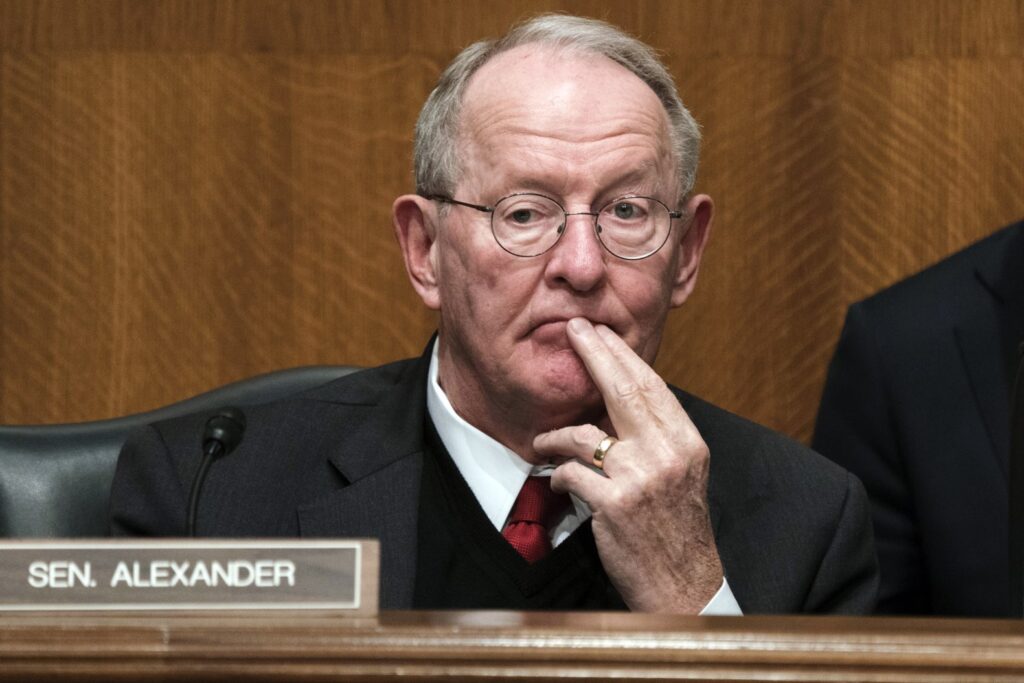
NASHVILLE — The names on the dinner invitations changed first. Then the voting maps. Former Senator Lamar Alexander, in his new memoir “The Education of a Senator: From JFK to Trump,” traces how the Republican Party’s foundation shifted beneath him.
The book describes a transformation that cost Tennessee its four-decade tradition of two-party competition. The rise of more extreme activist groups, Alexander writes, drove the polarization that remade the state’s politics.
The numbers tell the story. In 2008, John McCain carried Tennessee handily. Barack Obama lost white Democrat voters in rural Middle and West Tennessee counties — the same counties where African American Democrat Senate candidate Harold Ford Jr. had won just two years earlier.
Counties named for Democrat heroes Sam Houston and Andrew Jackson began flipping from solid Democrat to solid Republican. That 2008 Democratic sweep did not touch Alexander.
He won re-election with 65 percent of the vote. He even carried majority African American Shelby County, a feat he accomplished for the sixth time in over 40 years. His point: friendships across racial lines can still pay off for Republicans.
But that success stood against a broader collapse. The shift was not subtle. Democrats dropped the names of Jefferson and Jackson from their annual dinners.
Republican Lincoln Day dinners became Reagan Day dinners. The symbols of the old party coalitions were quietly retired.
What is at stake here is not nostalgia for dinner names. What is at stake is whether a political party can hold together a coalition broad enough to govern a diverse state. Alexander’s own career suggests it is possible — his 65 percent win and his Shelby County victories prove a Republican can win Black and white voters alike.
But the trend lines run the other way. The 2008 Tennessee election results looked uneventful at first.
They turned out to mark the end of something real. Four decades of two-party competition in the state ended not with a dramatic showdown but with a quiet realignment. Rural white Democrats who had voted for Ford in 2006 voted for McCain in 2008.
They have not come back. Alexander argues that the rise of activist groups on the extremes made this worse. Polarization feeds on itself.
When the base of a party shifts toward its most vocal factions, the middle shrinks. The friendships that once let a Republican carry Shelby County become harder to maintain.
The former senator’s memoir is not a lament. It is a record. He watched the ground move under his feet and wrote down what he saw.
The bottom line, as he puts it: the base of the Republican Party shifted. That shift had consequences.
Tennessee is now a one-party state for practical purposes. The kind of cross-racial, cross-party coalition that elected Alexander repeatedly is harder to assemble now. What is genuinely at risk is the capacity for any party to represent a broad enough constituency to govern stably.
If the base keeps narrowing, the victories keep coming for one side — but the governance gets harder. Alexander’s 65 percent win in 2008 looks like a high-water mark of an older politics. The water has receded since.




