
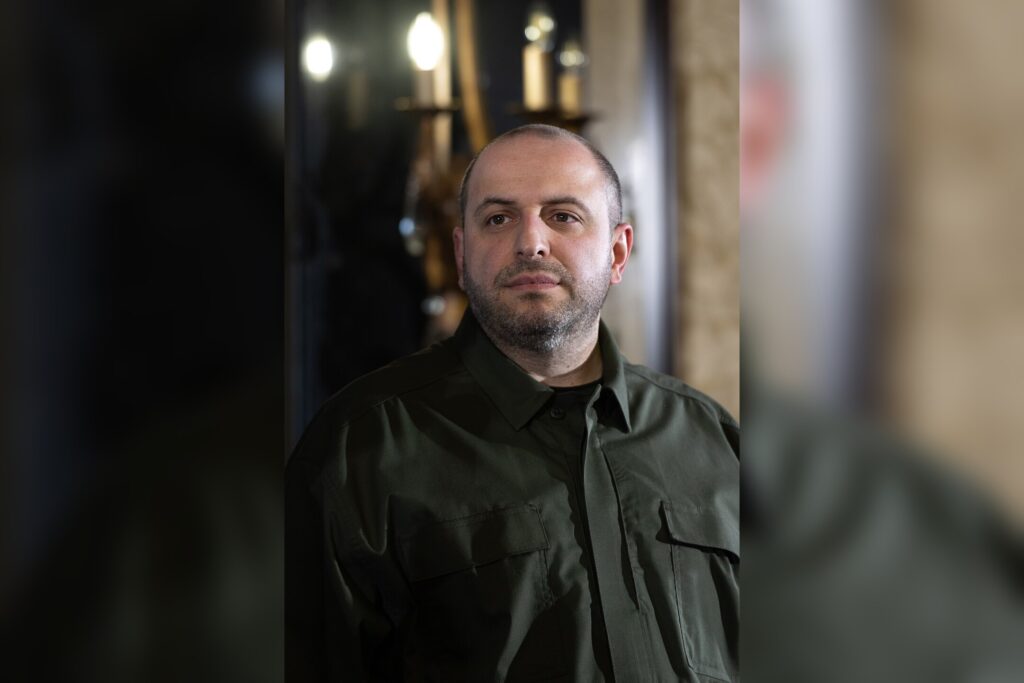
KYIV, July 9 — The shift in modern warfare is happening at the speed of a drone’s rotor. For Ukraine’s Minister of Defense, Rustem Umerov, that shift is not just tactical—it is industrial. Appointed in September 2023, Umerov has made drone production the centerpiece of his tenure, setting a target that sounds almost science fiction: one million drones per year by 2025.
Umerov, born in 1982 in Uzbekistan, brings an unusual background to the defense portfolio. Before taking over the Ministry of Defense, he ran the State Property Fund of Ukraine and served as a member of parliament.
He holds a degree in economics from the National University of Kyiv-Mohyla Academy. That mix of economic management and political experience has shaped his approach to a war increasingly fought with silicon and software. The trend underneath Umerov’s strategy is clear: Ukraine is betting that mass-produced drones can offset Russian advantages in artillery and electronic warfare.
In January 2024, he publicly announced the one-million-drones-per-year goal. It is an ambitious production timeline that would require scaling up manufacturing capacity across a country under constant bombardment.
But production is only half the battle. The other half is keeping those drones in the air. In March 2024, Umerov stated that Russian jamming has reduced the effectiveness of Ukrainian drones by 30%.
That is a significant degradation, forcing Ukrainian forces to adapt their tactics and seek new technologies on the fly.
The Electronic Warfare Arms Race
What’s changing on the battlefield is the invisible war over radio frequencies. Russian electronic warfare systems have become increasingly sophisticated, targeting the communication links between drone operators and their aircraft. Umerov has overseen the procurement of anti-jamming technology specifically designed for Starlink terminals and drones.
Starlink, the satellite internet system from SpaceX, has been a critical backbone for Ukrainian command and control. The minister has worked closely with Western allies, including the US Department of Defense, to secure electronic warfare countermeasures.
This is a fast-moving technical challenge. Jamming techniques evolve, and so must the countermeasures. The 30% effectiveness reduction Umerov cited in March is not a static number—it is a snapshot of a dynamic contest.
Watch this space: the effectiveness of Ukrainian drones will likely fluctuate as both sides develop new jamming and anti-jamming technologies. Umerov’s background in economics may prove useful here, as the cost-benefit calculus of drone warfare shifts.
A cheap drone that is easily jammed is a poor investment. A drone with hardened communications, even if more expensive, may be far more effective.
Defense Reform and Western Integration
Umerov’s appointment in September 2023 came amid a broader push to reform Ukraine’s defense establishment. The Ministry of Defense had been rocked by corruption scandals involving procurement. Umerov, with his experience at the State Property Fund, was seen as a reformer capable of cleaning up the system.
He has positioned himself as a bridge between Ukraine’s military needs and Western defense industries. The relationship with the US Department of Defense has been particularly important for securing not just weapons, but the technical expertise needed to counter Russian electronic warfare.
This is not a standard arms deal—it is an ongoing technology partnership where the threat environment changes week by week. The trend underneath is that Ukraine is effectively serving as a live-fire test lab for drone warfare and electronic countermeasures. What works on Ukrainian battlefields today will likely shape defense procurement in NATO countries tomorrow.
Umerov’s ministry is at the center of that learning process.
What to Watch Next
The 2025 target of one million drones per year is the headline, but the real story is whether those drones can survive on a contested battlefield. Umerov has acknowledged the jamming problem publicly, which suggests the Ministry of Defense is investing heavily in solutions. New tactics, new frequency-hopping techniques, and new hardware are all in play.
For a minister with an economics degree, the metrics of success are clear: unit cost, production volume, and operational effectiveness. The first two are within Ukraine’s control.
The third depends on an arms race with Russian electronic warfare that shows no sign of slowing. The shift is this: drone warfare has moved from novelty to necessity. Rustem Umerov is the official tasked with making sure Ukraine’s drones not only fly, but fly where they are needed, when they are needed, and through whatever jamming the enemy throws at them.
Watch this space for the next generation of anti-jamming tech—it is being tested right now, over Ukrainian skies.




